As fears of HBM oversupply mount, intensifying price competition puts pressure on chipmakers, reshaping AI memory landscape
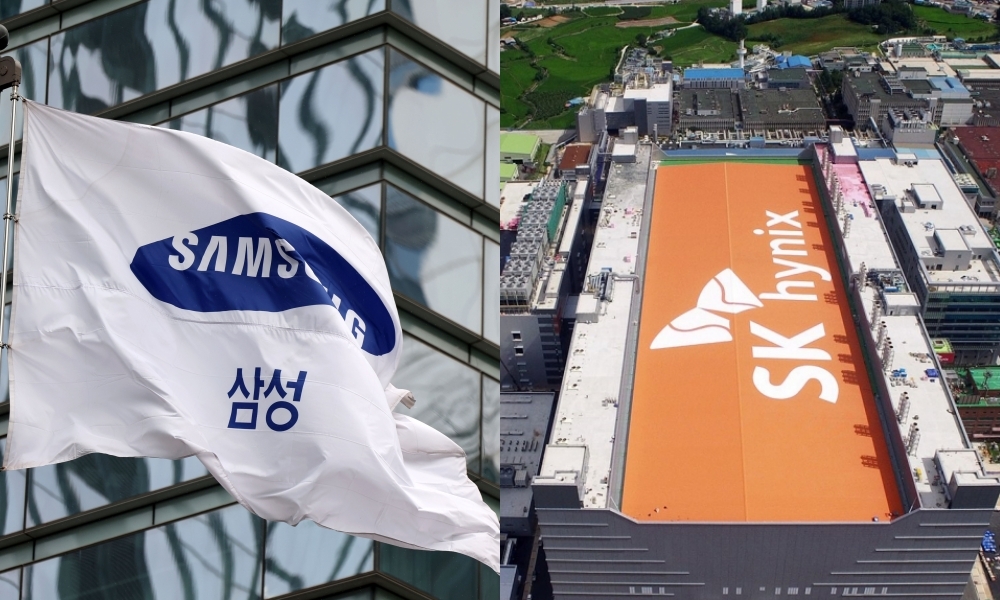
As concerns over a potential supply glut in the high-bandwidth memory market for artificial intelligence semiconductors intensify, South Korea’s two memory chip giants — Samsung Electronics and SK hynix — are seeing sharply divergent stock performances.
According to the Korea Exchange on Tuesday, so far in July, Samsung Electronics’ shares have surged 9.63 percent on the country’s main bourse, Kospi, outpacing the broader index's 2.6 percent rise. On the contrary, SK hynix’s shares have dropped 5.95 percent during the same period.
Analysts say growing fears of oversupply and falling prices in the HBM segment, a key component in AI chipsets, are driving foreign investors to offload shares. This is particularly the case for those of SK, since it holds the No. 1 position in the global HBM market.
Samsung's entry into the market of sixth-generation HBM chips, known as HBM4, is expected to erode the price premium previously enjoyed by SK hynix with its fifth-generation HBM3E products.
“There are rising concerns in the market about potential oversupply of HBM from this year and onward,” said Ryu Young-ho, a senior analyst at NH Investment & Securities. “It has triggered increased selling pressure on SK hynix shares.”
At the same time, Samsung Electronics’ stock — long overshadowed by SK hynix — has begun to recover as the company secured supply deals for both HBM3 and HBM3E with AMD and Broadcom, signaling renewed confidence in its technological competitiveness.
“If Samsung succeeds in entering Nvidia’s HBM supply chain, the oversupply issue could become even more pronounced,” Ryu said. Currently, SK dominates the global HBM market with a 53 percent share, followed by Samsung with 38 percent. With Micron joining the fray, competition is expected to intensify.
Samsung shares are also benefiting from expectations of increased HBM revenue, further buoyed by the recent lifting of export restrictions on Nvidia’s China-specific AI chip, the H20. With new market avenues opening, Samsung’s momentum in the HBM space appears to be strengthening.
As the market dynamic shifts, industry insiders are watching whether the HBM sector will transition from a technology-driven race to a price-driven war. Until recently, tight supply allowed suppliers to dictate prices. But as supply loosens, big tech clients like Nvidia and AMD are likely to gain leverage in price negotiations.
“The balance of power is shifting from suppliers to buyers,” said Ryu. “We may see weaker-than-expected price hikes for the upcoming HBM4 chips.”
Investment bank Goldman Sachs also forecast that HBM prices could fall by around 10 percent next year, citing the likely impact of increased competition and capacity.
“HBM has entered a maturing phase,” said an industry source who requested anonymity. “As supply constraints ease, chip makers will need not only technical excellence but also strong price competitiveness to survive. The real price war is likely to begin in earnest next year.”
Against this backdrop, both Samsung and SK are racing to mass-produce HBM4 by the second half of this year.
SK was the first chip maker to supply 12-layer HBM4 samples to Nvidia in March. Samsung is expected to follow suit within this month, shipping its samples to both Nvidia and AMD.
In an effort to regain lost ground after delays with HBM3E chips, Samsung is utilizing its advanced 1c DRAM technology, which employs a 10-nanometer process, in HBM4, aiming for high precision and yield stability. It is also actively investing in its Pyeongtaek Campus Line 4 (P4) to support volume production.
“Samsung appears to be rebuilding its strategy with a long-term perspective to win back customer trust, rather than focusing on short-term results,” said an anonymous source who is familiar with the matter. “Though Samsung may be behind SK in HBM development timing, if it can deliver on performance, it still has a strong chance to catch up to its rivals.”
SK, meanwhile, is prioritizing stable yields by using the same 1b, the fifth generation of the 10nm process and mass reflow-molded underfill packaging method from HBM3E. It is also deepening collaboration with Taiwan’s TSMC to enhance both HBM4 production and advanced packaging capabilities.
“We are accelerating open collaboration with global customers as well as TSMC, not only to develop the highest-performance HBM4 but to reinforce our position as a total AI memory provider,” said Kim Joo-sun, SK hynix president in charge of AI infrastructure.
yeeun@heraldcorp.com