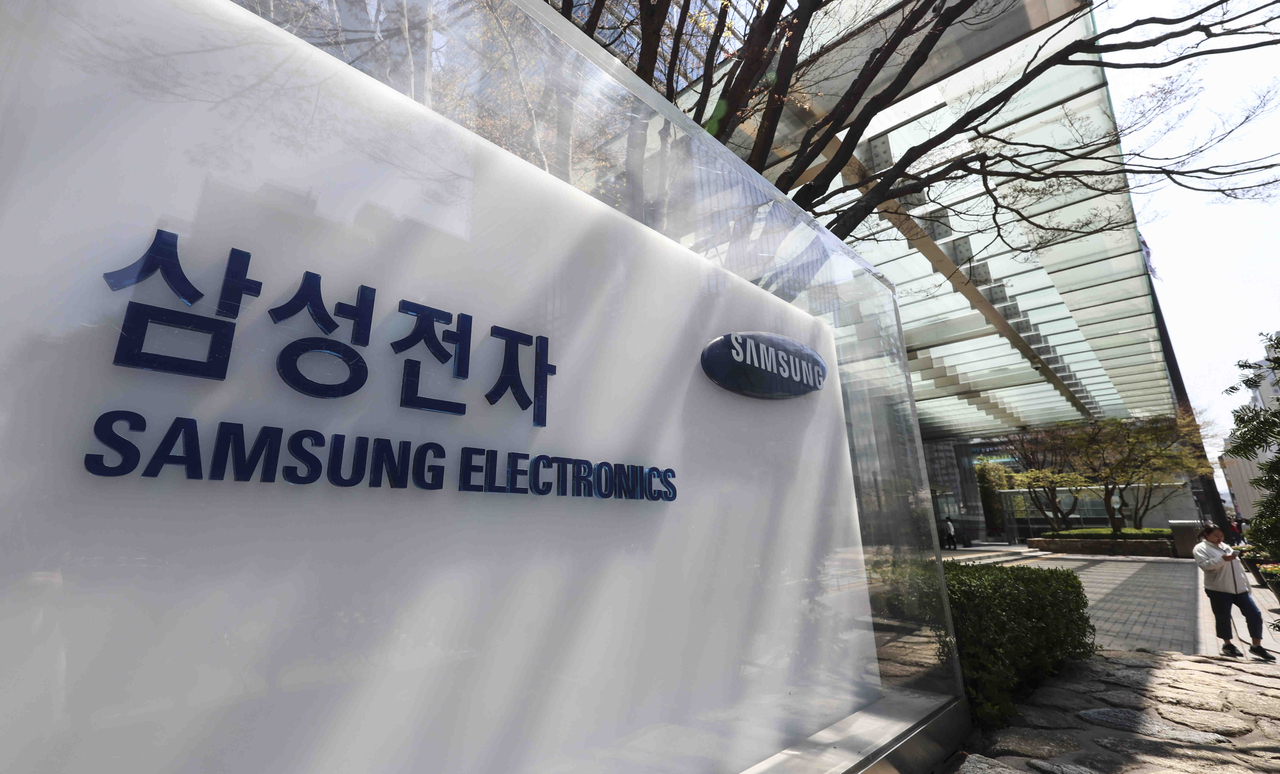
Despite Korea’s main bourse the Kospi having recently reclaimed the level of 3,000 points, the weighting of market bellwether Samsung Electronics’ market capitalization in the benchmark index fell to its lowest level in over nine years, data showed Sunday.
The tech giant’s common shares accounted for 14.53 percent of the main board's total market capitalization last month, according to the Korea Financial Investment Association. Including preferred shares, the figure stood at 16.17 percent.
The common stock ratio matched its lowest figure since March 2016, while the combined figure was the lowest since a month before that, when it had reached 15.83 percent, data showed.
The market cap ratio reflects the average proportion of Samsung’s closing market value against the total market capitalization of all listed stocks on the Kospi, measured daily over a month.
Market watchers attribute the decline in Samsung’s market dominance to continued underperformance in its chip division, the device solutions unit. Losses in its foundry and nonmemory operations have dragged down earnings, while the firm’s competitiveness in high-bandwidth memory technology has yet to be fully proven.
As a result, when the Kospi jumped 13.86 percent last month, buoyed by institutional and foreign buying, the tech giant’s shares rose only 6.41 percent. The tech giant's market cap stood at 353.99 trillion won ($259.8 billion) as of June 30.
While Samsung is scheduled to release its second-quarter earnings guidance on Tuesday, market watchers expect the company to have reached the bottom of its earnings in the second quarter, with performance expected to improve from the third quarter as revenue from HBM increases.
In the second half, Samsung plans to maintain its NAND production cutbacks while focusing on high-value products such as enterprise solid-state drives.
In the high-bandwidth memory segment, the company will accelerate supply discussions for its 12-layer fifth-generation HBM chips -- HBM3E -- with Nvidia, and is also targeting mass production of its sixth-generation HBM -- HBM4 -- later this year.
In the foundry business, Samsung will ramp up its efforts to commercialize its 2-nanometer node for chip production by year-end.
The division that focuses on system-on-a-chip products will also prepare the launch of the in-house Exynos 2500 for the upcoming Galaxy Z Flip 7, with plans to mass-produce the next-generation Exynos 2600 later this year in a bid to narrow operating losses.
“HBM sales to major clients like AMD are expected to rise and losses in the nonmemory segment are likely to narrow,” said Park Yu-ak, an analyst at Kiwoom Securities. “Stock momentum could strengthen in the third quarter as Samsung begins supplying HBM3E to Nvidia and demonstrates competitive strength in HBM4 technology with new foundry clients.”
yeeun@heraldcorp.com