Experts point to atmospheric instability as cause of sudden rain
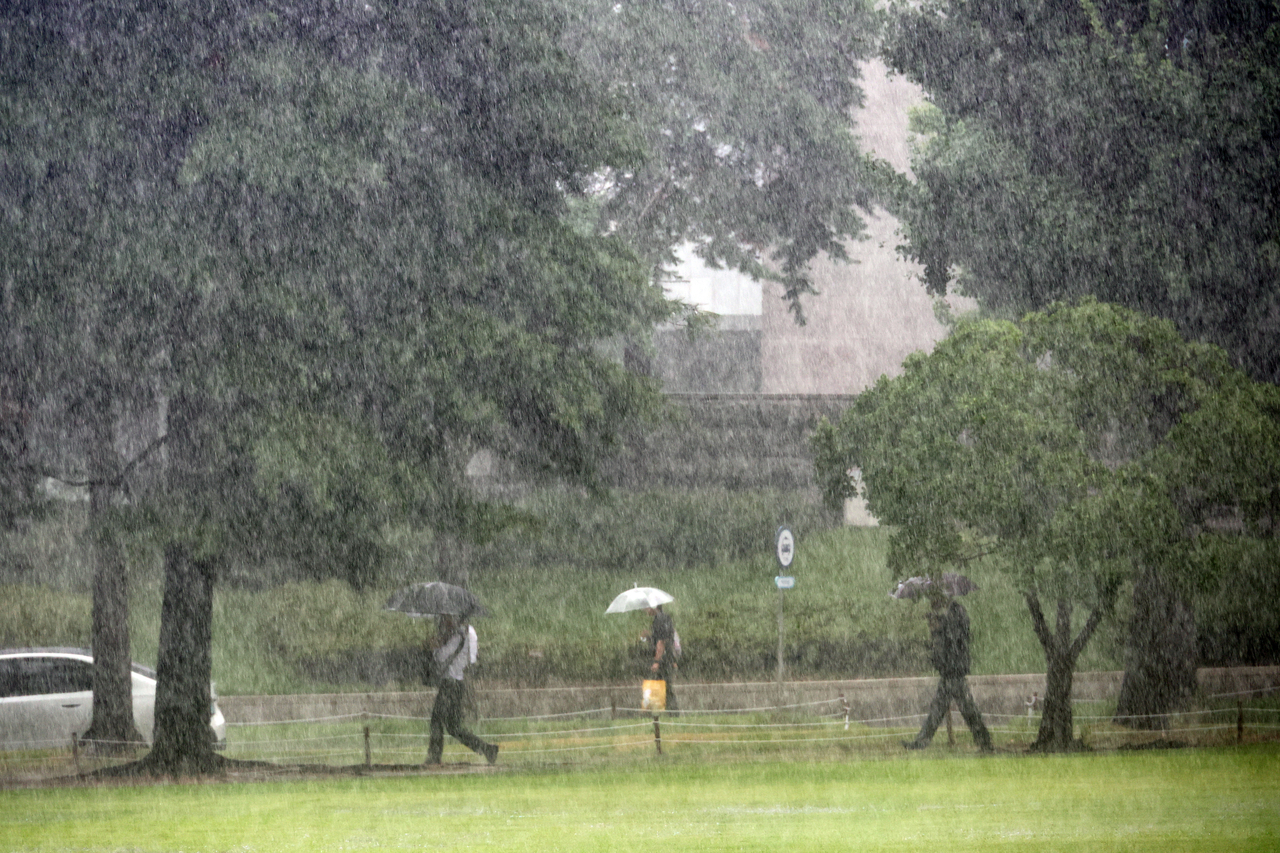
After weeks of extreme heat and a weak monsoon season, the Greater Seoul region was hit by a sudden evening downpour Tuesday, in what experts are calling a “new weather norm” fueled by atmospheric instability and climate change.
At 6:50 p.m., Tuesday evening, a heavy rain warning was issued in western parts of Seoul — the same day the capital city saw the highest July temperatures on record since national data collection began in 1908. South Korea issues heavy rain warnings when more than 90 millimeters of rain is expected to fall in three hours, or over 180 mm in 12 hours.
According to the Korea Meteorological Administration’s automatic weather observation, hourly rainfall in Seoul reached a maximum of 68.5 mm on Tuesday evening, as the sudden downpour persisted for about two to three hours.
Other areas in the Greater Seoul region, such as Icheon in Gyeonggi Province, saw 52 mm of hourly rainfall, while Bupyeong in Incheon and Pocheon in Gyeonggi Province each saw 30 mm of hourly rainfall during the same period.
“The reason behind the sudden heavy rain is due to atmospheric instability,” KMA official Woo Jin-kyu told The Korea Herald. “Strong updrafts were formed due to the extreme heat, triggering the development of localized rain clouds.”
An updraft forms when the ground heats under extreme temperatures, causing the warm air above it to rise. As it climbs into the sky, moisture in the air cools and condenses into clouds, which can quickly release heavy rain when conditions are right.
Woo added that though the stationary front is situated in the north and has weakened, it still lingers around Korea, making the country more prone to moist air masses colliding.
“However, even after the monsoon season ends and the stationary front moves away, Korea remains vulnerable to intense rainfall triggered by the frequent and intense heat waves,” Woo added.
“Heat waves these days are getting longer and more extreme and widespread, and this creates the ideal setup for sudden, heavy rain as the ground heats up under the sun all day and accumulates moisture. Even a small climactic trigger, such as shifting winds, can cause torrential downpours.”
Adding that such rainfall patterns will become more common in Korea, Woo stated that this pattern “reflects growing atmospheric instability driven by rising global temperatures.”
“As climate change accelerates, heat waves are becoming more frequent and intense, allowing the atmosphere to hold more moisture. When that moisture is suddenly released, it results in shorter but more intense rain events,” said Woo.
“With more intense heat expected in Korea this year due to the short-lived, dry monsoon season, such abrupt downpours are likely to occur more often this year, even after the monsoon season passes.”
lee.jungjoo@heraldcorp.com


![[Graphic News] Seoul rises to 7th in global financial hub ranking](https://wimg.heraldcorp.com/news/cms/2026/10/15/news-p.v1.20261015.d4dd881eab584b4e8ce6ec52a672b278_T1.gif?type=h&h=800)