JEJU ISLAND -- The crux of the new Korean government’s foreign and security strategy, former foreign ministers said, should be adapting to a shifting, more inward-looking US -- one demanding greater burden-sharing from its allies under President Trump’s “America First” doctrine -- while keeping the alliance at the heart of its approach at this critical crossroads.
Amid a wave of increasingly interconnected global crises, the former top diplomats also urged Seoul’s next leadership to move beyond the conventional US-centric approach and adopt a more holistic, big-picture foreign policy suited to the shifting global order.
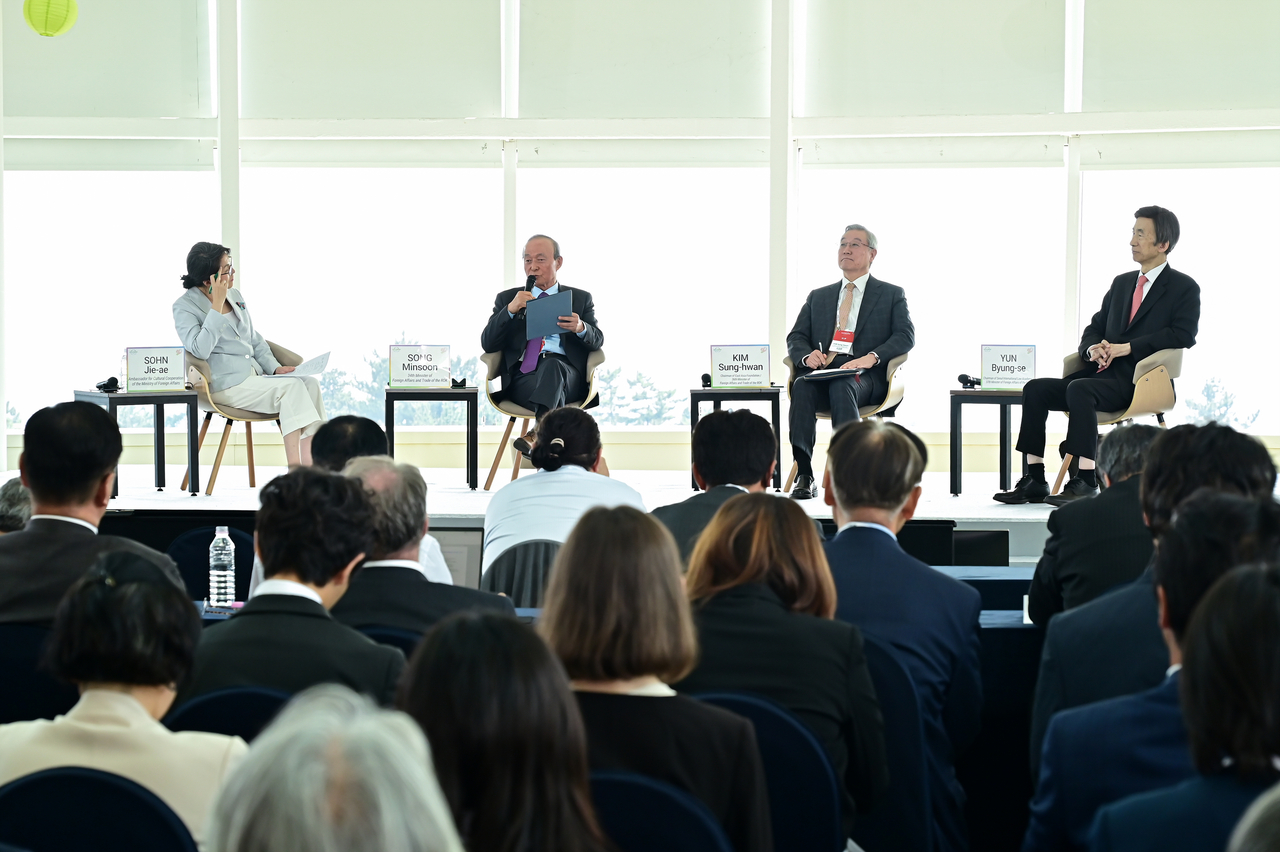
“What’s most important as Korea’s new government takes office is that we are facing not just one or two challenges, but a complex web of simultaneous crises. We all know that these issues are unfolding on multiple fronts at once,” former Foreign Minister Yun Byung-se, who served under the former conservative Park Geun-hye administration, said during Thursday’s session at the Jeju Forum held on the southern island of Jeju.
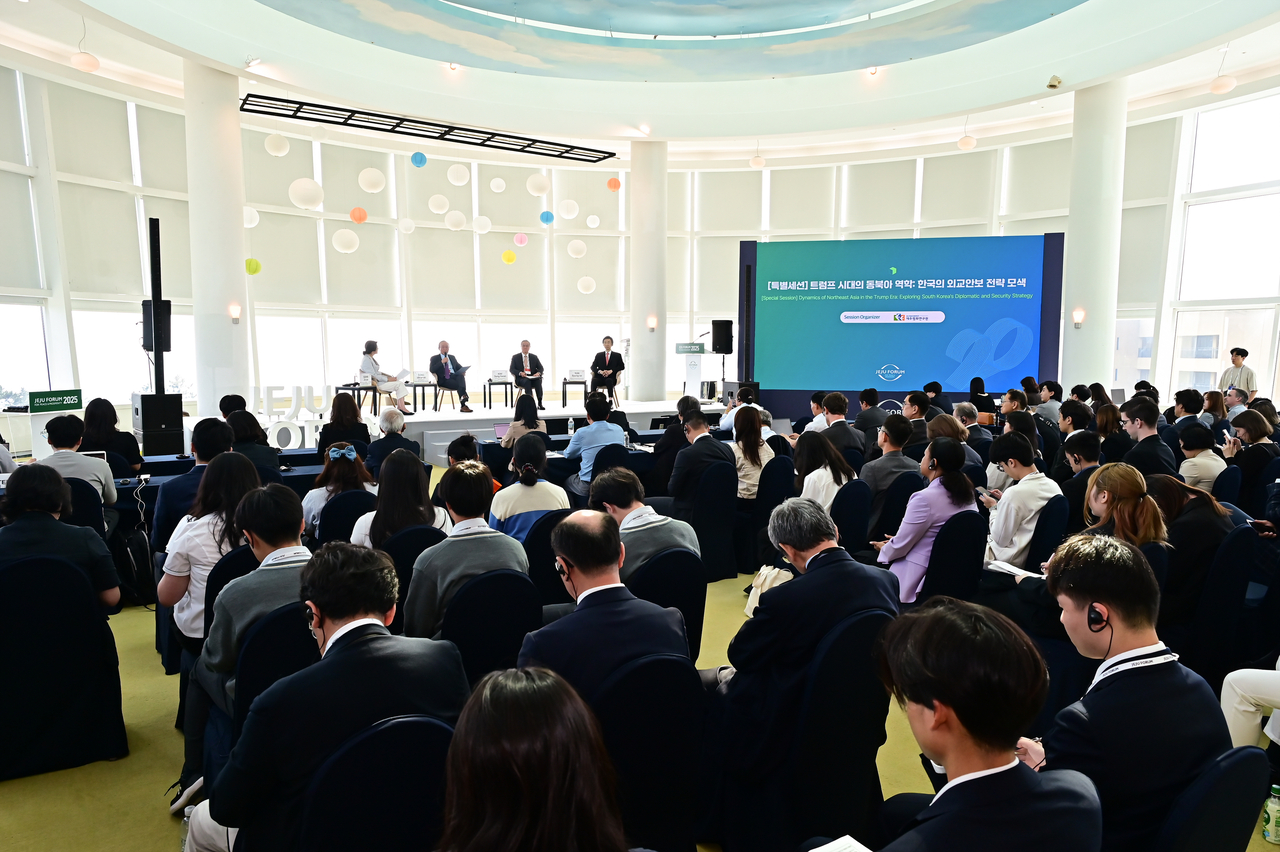
“Therefore, the new administration should not approach strategy solely through the lens of relations with the US, but should instead adopt a broader, more comprehensive perspective,” Yun said during a session on South Korea’s diplomatic and security strategy ahead of the early presidential election on June 3.
With no transition period before taking office, the new South Korean leadership will also need to quickly find its footing as it responds to growing US calls for greater responsibility in national and regional defense, as well as increased demands across the board within the bilateral alliance framework, Yun said.
Yun also noted that, unlike in the past when North Korea’s provocations were the main concern for an incoming administration, this time will be different: "the new government will need to prioritize how quickly it can formulate its own position in response to US priorities."
“Ultimately, it comes down to two main points: the role of US Forces Korea and South Korea’s own regional role,” Yun explained.
In Seoul, concerns are growing that the operational scope of US Forces Korea could extend beyond the Korean Peninsula and expand to regional defense, including being repurposed for a potential Taiwan contingency.
“In 2003, some units from US Forces Korea were redeployed to Iraq. Now, if they are redeployed -- not to Iraq, but to areas near Taiwan -- that could present a whole new set of challenges, and it’s something we need to think about very carefully,” Yun said. “From what I see, neither (presidential election) camp is fully prepared to address this issue yet.”
Both the classified “Interim National Defense Guidance,” as reported by The Washington Post, and Secretary of Defense Pete Hegseth’s statement on the development of the 2025 National Defense Strategy make clear that US forces will prioritize deterring China as the sole pacing threat. Another key point is that allies should shoulder more responsibility for defending against other regional threats -- for South Korea, this means threats posed by North Korea.
Calls for greater autonomy from alliance
Former Foreign Minister Song Min-soon underscored that “Korea needs to transform its current alliance system -- which is now overly dependent on the US -- into a more autonomous alliance, while still faithfully upholding the Korea-US alliance.”
"This is something the US also wants," Song said. "However, in Korea, there is a fear that moving toward a more self-reliant alliance could lead to isolation from the US, and how to overcome that fear is the challenge."
Song, who served in the former liberal Roh Moo-hyun administration, also called for the next South Korean government to “more actively explore ways to achieve a nuclear balance between the two Koreas,” instead of merely relying on US extended deterrence. Extended deterrence refers to Washington’s commitment to deter or respond to coercion and external attacks on its allies and partners with the full range of its military capabilities, including nuclear weapons.
“However, it doesn’t necessarily mean that we need immediate nuclear armament,” Song continued.
Former Foreign Minister Kim Sung-hwan, however, said the next government should pursue a policy toward the US to ensure that US extended deterrence is well maintained, opposing the idea of South Korea independently seeking a nuclear balance against North Korea.
On the diplomatic front, Kim emphasized that the key challenge is how to navigate between the Korea-US alliance and China amid the shifting global order.
"From the perspective of our diplomatic and security interests, regardless of who becomes the next president, the most important point is what stance South Korea should take between the US, our ally, and China, given our geopolitical realities," Kim said. "This remains our greatest diplomatic challenge."
But Kim also pointed out that the US is no longer willing to unilaterally provide public goods as it did in the past, as it needs to focus its limited capacity on addressing mounting domestic challenges.
Kim, who served under former conservative President Lee Myung-bak, expressed his concerns over a potential return to what’s known as the “Kindleberger Trap,” highlighting this as a key factor for South Korea to consider in devising its foreign policy. The trap refers to the failure of the international system due to the under-provision of global public goods and the dangers inherent in a shifting balance of power.
"Looking at the current global order, if the US stops providing public goods, who will take on that role? Is Europe economically strong enough to take on that responsibility?" Kim said. "These are the kinds of questions we need to seriously consider in the context of international affairs."
dagyumji@heraldcorp.com