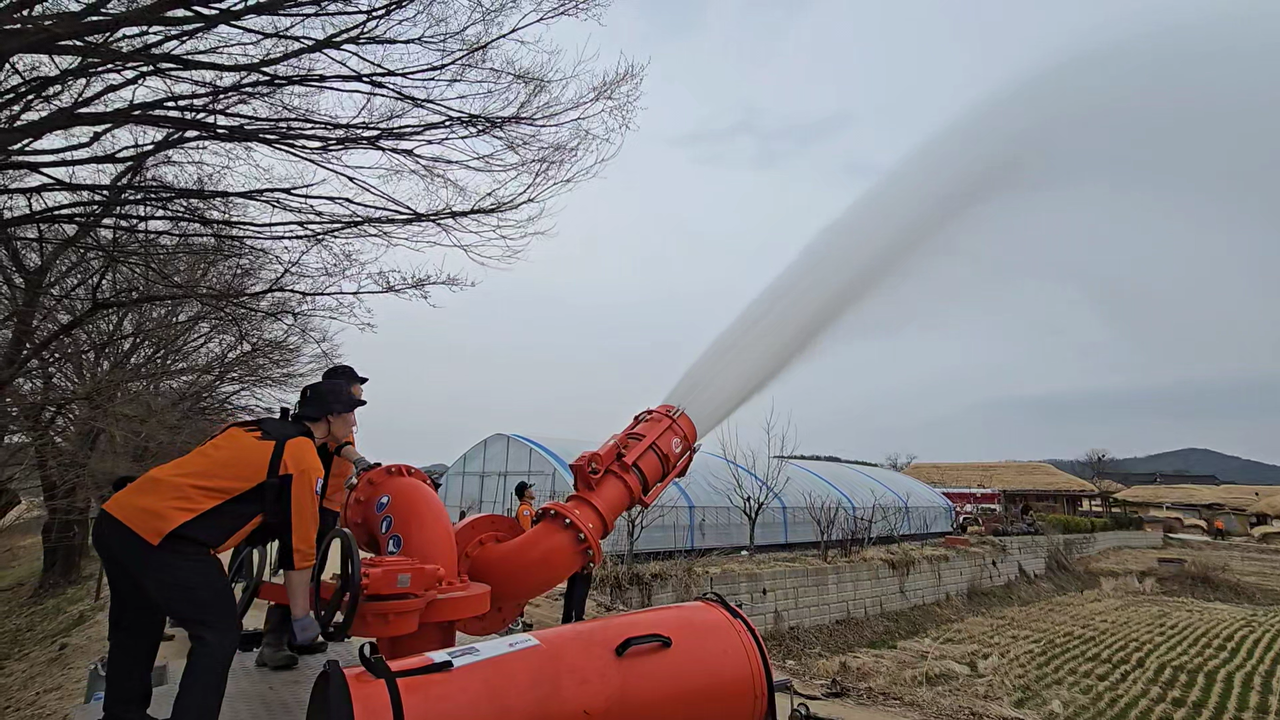
As flames from a deadly wildfire approached within kilometers of South Korea's historic and storied Hahoe Village, firefighters employed an unconventional strategy: continuously drenching the UNESCO World Heritage village with tens of thousands of liters of water, hour after hour and overnight.
Surrounding woodlands were also preemptively cleared to reduce the risk of the fire spreading.
The blaze started in Uiseong-gun, North Gyeongsang Province, on March 22, and rapidly spread to nearby towns. By Thursday, the flames were within 5 kilometers of Hahoe Village in Andong, a city which lies adjacent to the county of Uiseong-gun.
To preserve the site, firefighters worked through the night, dousing the hanok — centuries-old traditional wooden homes with straw roofs — in round upon round of water.
Supported by a giant firefighting pump system and the adjacent Nakdong River, teams fought to keep the hanok safe. According to the National Fire Agency, these efforts kept even a single spark from spreading to the village.
“The decision to soak the fire ground is made when the size of the flames is far greater than the available firefighting capacity. It is a defensive measure applied when wildfires are expected to grow intensely, fueled either by strong winds or other risks of combustion,” a fire agency official, who was not authorized to be named in accordance with agency policy, told The Korea Herald.
“When speed in implementing this measure mattered the most, the large-scale fire pump system played a crucial role,” the official added.
According to the fire authorities, this high-capacity system can discharge up to 75,000 liters of water per minute, a rate equivalent to that of nearly 27 fire trucks, which spray 2,800 liters of water per minute.
The fire pump system, which was first introduced at Ulsan Chemical Rescue Center in 2022, caught public attention after proving its effectiveness. On Feb. 10, it was able to bring major flames under control within 15 minutes when deployed to the oil storage tank fire at Ulsan Onsan Industrial Complex.
The official explained that the geographical location of Hahoe Village enabled the firefighters to apply this high-performance equipment successfully.
“There must be a river, sea or a reservoir to install this system, because it needs a huge amount of water. Luckily, we were able to draw water from the Nakdong River, which encircles the village,” said the official.
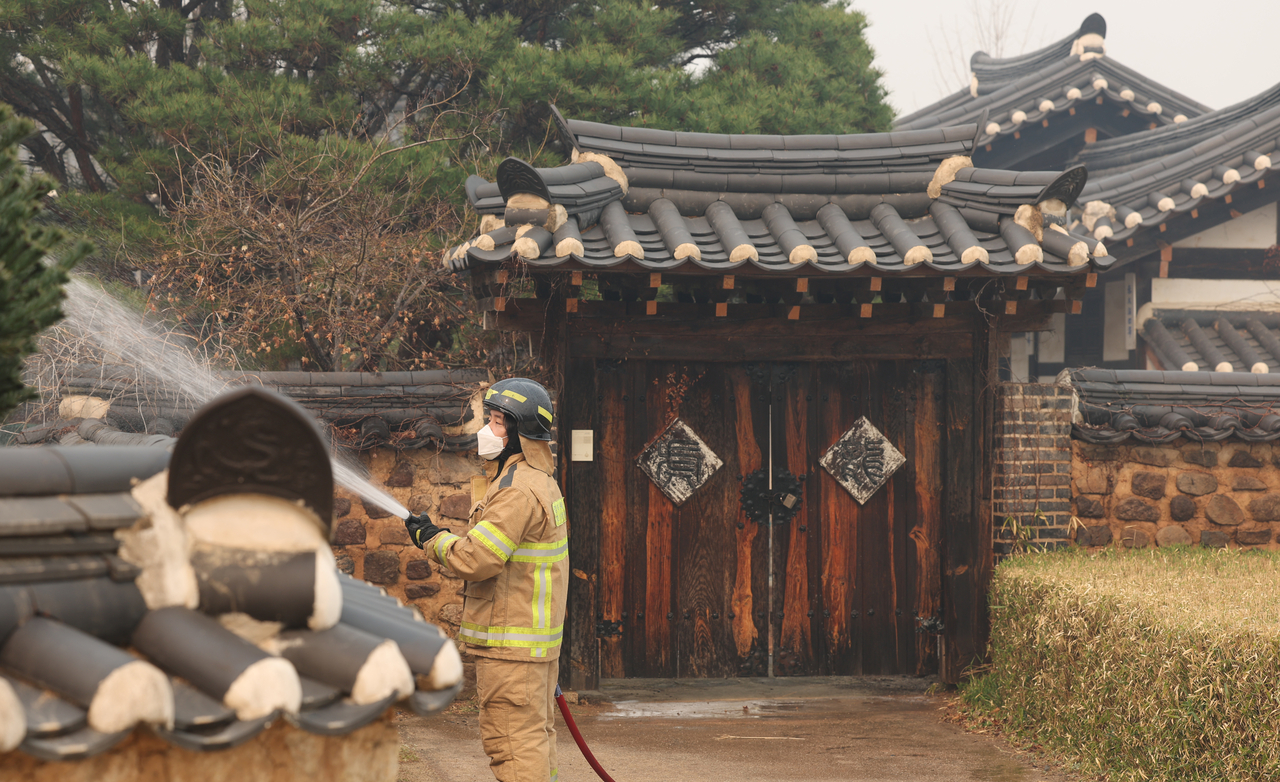
Advanced equipment aside, the fire authorities deployed some 100 firefighters, 21 fire trucks as well as three fire helicopters to the site for preemptive firefighting operations on Wednesday and Thursday, when the cultural heritage site was most threatened by the fast-moving wildfires.
The fire agency reportedly continued to spray water all over the village every one or two hours to keep the fire from spreading in dry conditions.
As part of broader efforts to protect nearby cultural sites, the fire agency also felled trees in areas near Byeongsanseowon, a 17th-century Confucian academy on the UNESCO World Heritage Site list, to eliminate any factors that could ignite small fires.
Pine and oak trees in 1,322 square meters of woodland near Byeongsanseowon were cut down, and authorities built a defense line by soaking the felled trees to contain the wildfire.
The fire authorities took similar firefighting measures at Byeongsanseowon Confucian Academy with the fire pump system and more than 10 fire trucks, soaking the cultural heritage site to prevent wooden buildings from catching fire.
Wildfires in southeastern South Korea burned through 48,238 hectares — an area equivalent to about 80 percent of the size of Seoul — despite a week of containment efforts, claiming 30 lives and injuring 45 as of Sunday morning, according to the authorities.
The Ministry of Interior and Safety announced that all the wildfires that had raged across the Gyeongsang provinces were fully contained as of Sunday afternoon.
The wildfires forced more than 37,000 people to evacuate and damaged some 6,100 private and public facilities.
sj_lee@heraldcorp.com