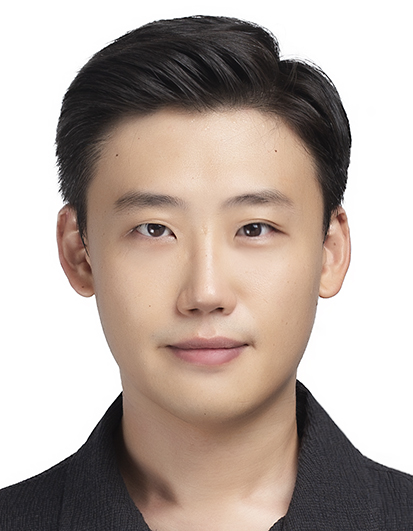
South Korea's Constitutional Court is poised to hand down a ruling Monday that could see Ma Eun-hyuk added to its bench to complete its nine-member lineup.
The court, which is also tasked with hearing Yoon's impeachment trial, will decide on whether acting President and Deputy Prime Minister Choi Sang-mok's refusal to approve the National Assembly's nomination of Ma, a senior judge of the Seoul Western District Court, was constitutional.
Rep. Kim Yun-duck, secretary general of the main opposition Democratic Party of Korea, demanded Sunday that the court "put the brakes on Choi's attempt to disrupt the constitutional order" through selective nomination approvals.
Choi approved two out of three Constitutional Court justice nominees on Dec. 31 -- Chung Kye-sun, considered left-leaning, and Cho Han-chang, seen as right-leaning -- while holding off on approving Ma, considered liberal, saying it needed further deliberation between the two main parties.
Both major parties denounced Choi's move. The ruling party insisted that Choi approve none of the justices and that the impeachment verdict be made through a six-justice bench. This is thought to improve the chances of Yoon's impeachment being rejected, as it requires the support of six justices to be upheld.
The emocratic Party demanded Choi name all three.
Rep. Kweon Seong-dong, floor leader of the ruling People Power Party, argued Sunday that Choi should reject Ma even after the court rules that he should approve him, saying the Constitutional Court has no power to limit the acting president's use of presidential power to reject Ma's approval.
Kweon, one of the three lawmakers set to visit Yoon behind bars Monday morning, also claimed procedural flaws. The National Assembly Speaker Rep. Woo Won-shik filed for an arbitration individually without gaining the parliament's consent, Kweon said.
The ruling party's Rep. Yoon Sang-hyun echoed Kweon's remarks, saying such flaws will make the ruling "a mere show meant to waste a court's time."
Later on Sunday, the Democratic Party Rep. Noh Jong-myeon refuted such claims, saying the Assembly's consent is not necessary if the arbitration was filed by the speaker.
Filling the empty spots on the bench has been a source of controversy even before Yoon's martial law declaration, with the Assembly's failure to make nominations leaving the court with just six justices — one short of the number needed to hold trials on impeachment motions the Assembly had passed.
An injunction was approved in October allowing trials to resume with six justices, but controversy has followed over whether this can be applied to the ruling on a presidential impeachment.
Since the martial law crisis, the tide has turned, with the Democratic Party pushing to fill the bench to maximise the chance of Yoon's impeachment being upheld, and the People Power Party pushing against appointments and arguing that quorum requirements are not being met.
Most recently, conservatives calling on three out of the eight sitting justices to remove themselves from the trial.
Yoon's legal team and the conservative ruling party have claimed the justices' past remarks and their families' activities indicate that it is difficult to expect an impartial ruling.
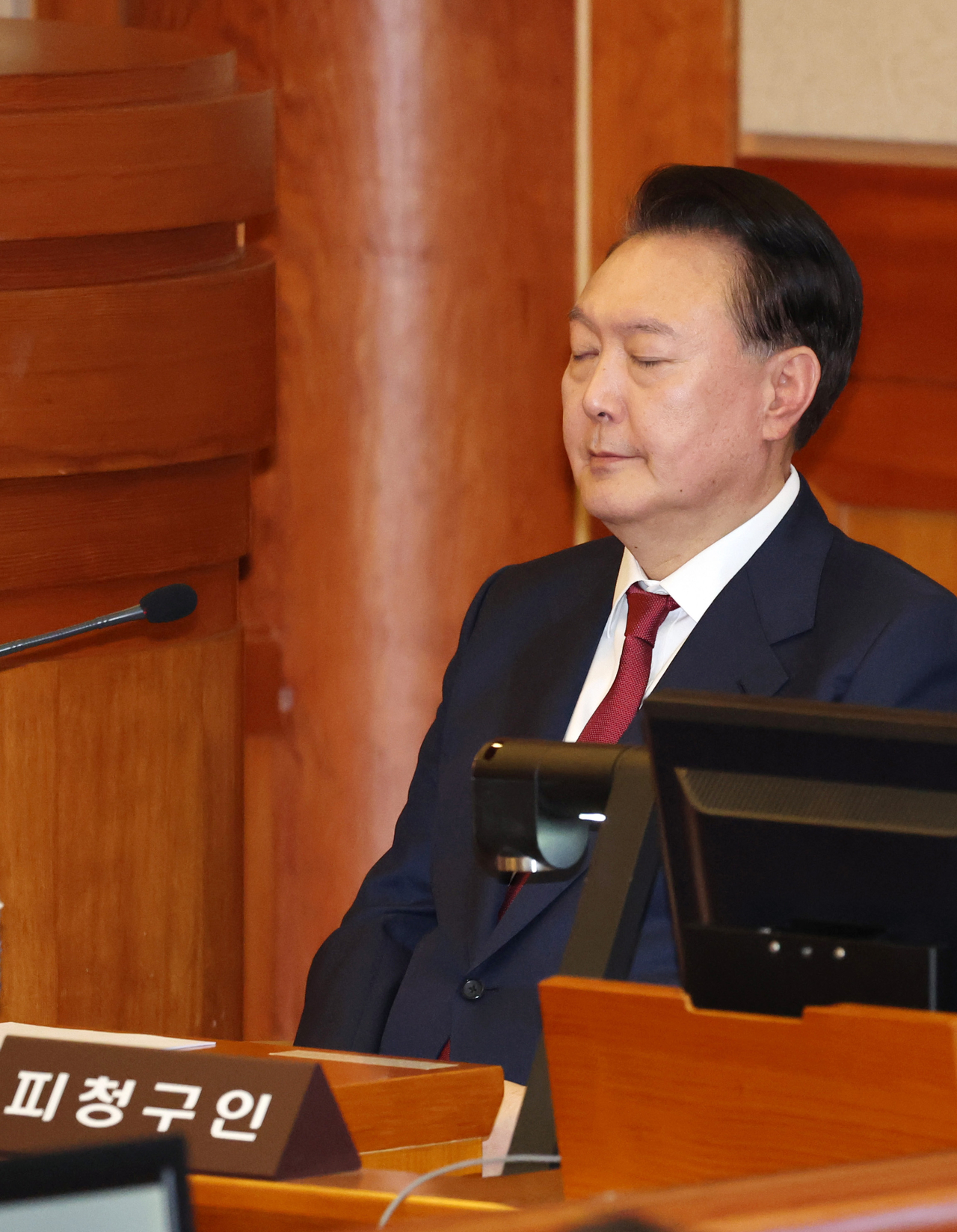
Yoon's lawyers said Saturday that they had formally requested Chief Justice Moon Hyung-bae, Justice Lee Mi-son and Justice Chung Kye-sun to voluntarily pronounce themselves ineligible to take part in the trial of the current eight-member bench due to political bias.
The team said Chief Justice Moon belongs to an association of progressive judges, and that past social media posts indicated political bias. Moon's social media posts were "highly concerning given his view toward North Korea." He also exchanged messages on social media with Rep. Lee Jae-myung who is currently Democratic Party leader, according to Yoon's team.
It also said Justice Chung's husband had taken part in a movement to call for Yoon's resignation, and that he belongs to GongGam Human Rights Law Foundation, whose leader had teamed up with the National Assembly's legal team that worked on Yoon's impeachment.
It added that Justice Lee's younger brother serves as a vice chair of progressive lawyer group Minbyun's special committee that called for Yoon's resignation.
The removal of all three justices would create a significant deadlock in the process of the impeachment trial, as the verdict to impeach a public official requires at least six justices' ruling in favor.
But unlike in recusal process, in which a party asks the court to remove a judge or a justice from his or her trial, Saturday's request do not necessarily require the court to make a decision
Yoon's lawyers earlier demanded that Chung, who took office in January, be recused from the impeachment trial. The seven sitting Constitutional Court justices other than Chung unanimously rejected the recusal bid on Jan. 14. Under the Constitutional Court Act, a party may not move to recuse two or more justices for the same case.
The Constitutional Court also played down the possibilities that any judgment would be made through the personal leanings of individual justices.
"There are instances where the political circles and media's depiction of a personal tendency of an individual justice distorts the essence of the impeachment trial," the Constitutional Court's spokesperson Cheon Jae-hyun said Friday. "We express grave concerns over the possibilities that the judiciary power could be breached."
Democratic Party of Korea, which controls the majority of the National Assembly and led the process of impeaching the sitting conservative president, blasted Yoon's lawyers and the ruling party for attempting a political attack on the judiciary and catering to the far-right group.
Kim, the three-term lawmaker of the Democratic Party, said Sunday that the ruling party should "immediately stop attempting to neutralize the judiciary power and stop building up excuses for their disobedience to an impeachment verdict," in case Yoon's impeachment is upheld.
consnow@heraldcorp.com