SALT LAKE CITY (AP) _ Sarah Burke was an X Games star with a grass-roots mentality _ a daredevil superpipe skier who understood the risks inherent to her sport and the debt she owed to it.
The pioneering Canadian freestyler, who helped get superpipe accepted into the Olympics, died Thursday after a Jan. 10 crash during a training run in Park City, Utah.
Burke, who lived near Whistler, in British Columbia, was 29.
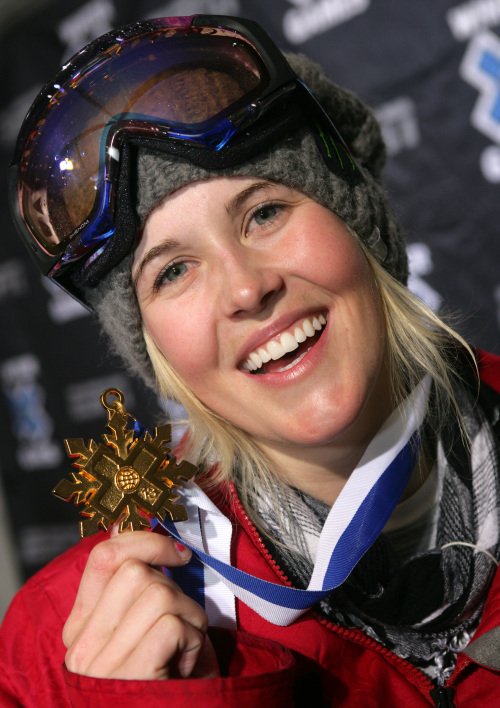
Sarah Burke, of Canada, holds her gold metal after winning the Women's Superpipe event at Winter X Games 13 at Buttermilk Ski Area, near Aspen, Colo. Burke died Thursday, Jan. 19, 2012, nine days after crashing at the bottom of the superpipe during a training run in Utah. She was 29. Burke was injured Jan. 10 while training at a personal sponsor event at the Park City Mountain resort. (AP)
Tests revealed she sustained ``irreversible damage to her brain due to lack of oxygen and blood after cardiac arrest,'' according to a statement released by her publicist, Nicole Wool, on behalf of the family.
A four-time Winter X Games champion, Burke crashed on the same halfpipe where snowboarder Kevin Pearce sustained a traumatic brain injury during a training accident on Dec. 31, 2009.
Wool said Burke's organs and tissues were donated, as she had requested before the accident.
``The family expresses their heartfelt gratitude for the international outpouring of support they have received from all the people Sarah touched,'' the statement said.
A four-time Winter X Games champion, Burke will be remembered as much for the hardware she collected as the legacy she left for women in superpipe skiing, a sister sport to the more popular snowboarding brand that has turned Shaun White, Hannah Teter and others into stars.
Aware of the big role the Olympics played in pushing the Whites of the world from the fringes into the mainstream, Burke lobbied to add superpipe skiing to the Winter Games program, noting that no new infrastructure would be needed.
Her arguments won over Olympic officials and the discipline will debut at the Sochi Games in 2014, where Burke likely would have been a favorite for the gold medal.
``Sarah, in many ways, defines the sport,'' Peter Judge, the CEO of Canada's freestyle team, said before her death. ``She's been involved since the very, very early days as one of the first people to bring skis into the pipe. She's also been very dedicated in trying to define her sport but not define herself by winning. For her, it's been about making herself the best she can be rather than comparing herself to other people.''
She was, Judge said, as committed to the grass roots of the sport _ giving clinics to youngsters and working with up-and-coming competitors _ as performing at the top levels.
``She was a great, positive person for the whole team, the whole sport,'' said David Mirota, the Canadian team's high performance director. ``She enlightens the room, and she's great.''
News of Burke's death spread quickly through the action-sports world, where the Winter X Games are set to start next week in Aspen, Colorado, without one of their biggest and most-beloved stars.
``She's probably one of the nicest people I've known in my life, and that's about the only thing I have to say about it,'' said American superpipe skier Simon Dumont, a multiple X Games medalist.
Jeremy Forster, the program director for U.S. Freeskiing and U.S. Snowboarding, said freeskiers would remember Burke ``first, as a friend, and then as a competitor who constantly inspired them to do greater things.''
``She was a leader in her sport, and it's a huge loss for the freeskiing community,'' Forster said.
``Shocked and saddened,'' former freestyle Olympian Jeremy Bloom said on Twitter. ``Sarah was a true champion in everything that she did.''
Burke's death is also sure to re-ignite the debate over safety on the halfpipe.
Pearce's injury _ he has since recovered and is back to riding on snow _ was a jarring reminder of the dangers posed to these athletes who often market themselves as devil-may-care thrillseekers but know they make their living in a far more serious, and dangerous, profession.
The sport's leaders defend the record, saying mandatory helmets and air bags used on the sides of pipes during practice and better pipe-building technology has made this a safer sport, even though the walls of the pipes have risen significantly over the past decade. They now stand at 22 feet high.
Some of the movement to the halfpipe decades ago came because racing down the mountain, the way they do in snowboardcross and skicross, was considered even more dangerous _ the conditions more unpredictable and the athletes less concerned with each other's safety.
But there are few consistent, hard-and-fast guidelines when it comes to limiting the difficulty of the tricks in the halfpipe, and as the money and fame available in the sport grew, so did the tricks. In 2010, snowboarding pioneer Jake Burton told The Associated Press that much of this was self-policed by athletes who knew where to draw the line.
``If the sport got to the point where halfpipe riding became really dangerous, I think riders would do something about it,'' Burton said. ``It wouldn't be cool anymore.''
His opinion is shared by many.
``There are inherent risks in everything,'' Judge said. ``Certainly, freestyle skiing has one of the greatest safety records of almost any sport. Freestyle is a very safe sport in large part because we had to build a safe sport in order to get into the Olympics.''
In 2009, Burke broke a vertebra in her back after landing awkwardly while competing in slopestyle at the X Games. It was her lobbying that helped get the X Games to include women's slopestyle _ where riders shoot down the mountain and over ``features'' including bumps and rails.
It wasn't her best event, but she felt compelled to compete because she pushed for it.. She came to terms with her injury quickly.
``I've been doing this for long time, 11 years,'' she said in a 2010 interview. ``I've been very lucky with the injuries I've had. It's part of the game. Everybody gets hurt. Looking back on it, I'd probably do the exact same thing again.''
She returned a year after that injury and kept going at the highest level, trying the toughest tricks and winning the biggest prizes.
A native of Midland, Ontario, Burke won the ESPY in 2007 as female action sports athlete of the year.
In 2010, she married another freestyle skier, Rory Bushfield, and they were headliners in a documentary film project on the Ski Channel called ``Winter.''
In her interview with AP two years ago, Burke reflected on the niche she'd carved out in the action-sports world.
``I think we're all doing this, first off, because we love it and want to be the best,'' she said. ``But I also think it would've been a great opportunity, huge for myself and for skiing and for everyone, if we could've gotten into the (Vancouver) Olympics. It's sad. I mean, I'm super lucky to be where I am, but that would've been pretty awesome.''
A little more than a year later, with Burke's prodding, her sport was voted in for the next Winter Games.
미녀 스키선수 사라버크, 결국 사망
훈련중 사고를 당해 혼수상태에 빠졌던 스키선수 사라버크가 결국 사망했다.
19일(한국시각) 외신들은 “연습 중 사고를 당해 혼수상태에 빠졌던 사라버크가 29세 젊은 나이로 사망했다”고 보도했다. 사라 버크는 생전 장기기증 서약에 따라 자신의 장기를 필요한 이들에게 나눠주고 세상을 떠났다.
사라버크는 지난 10일 미국 유타주 파크시티에서 하프파이프 훈련 중 잘못 착지하면서 머리와 척추를 다쳤다. 혼수상태에 빠진 사라버크는 즉시 수술을 받았다. 남편 로리는 “사라는 젊고 강하다, 잘 이겨낼 것”이라고 희망을 드러냈으나, 결국 그녀가 사망하면서 주위를 안타깝게 하고 있다.
사라버크의 주종목은 프리스타일 스키 중 하프파이프. 사라버크는 X게임에서 4번이나 금메달을 따내는 등 실력을 인정받았을 뿐아니라, 2014 러시아 소치 동계올림픽에서 프리스타일 스키가 시범 종목으로 채택되는 데도 공로를 세웠다. 그러나 그녀는 올림픽에서 프리스타일 스키 경기가 열리는 것을 보지 못한 채 눈을 감았다.










