WASHINGTON (AP) ― In a spectacle that might have beguiled poets, lovers and songwriters if only they had been around to see it, Earth once had two moons, astronomers now think. But the smaller one smashed into the other in what is being called the “big splat.”
The result: Our planet was left with a single bulked-up and ever-so-slightly lopsided moon.
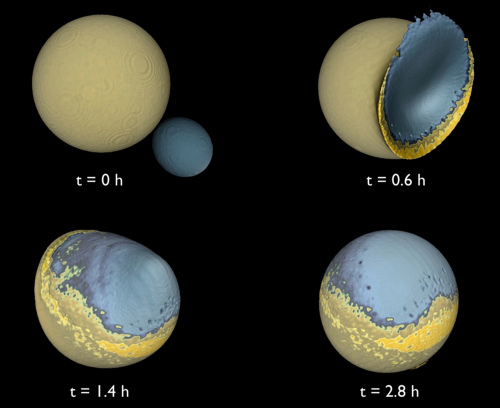
A diagram showing a simulation of four stages of a collision between the Moon and a hypothetical companion moon about 4 billion years ago. (AP-Yonhap News)
The astronomers came up with the scenario to explain why the moon’s far side is so much more hilly than the one that is always facing Earth.
The theory, outlined Wednesday in the journal Nature, comes complete with computer model runs showing how it might have happened and an illustration that looks like the bigger moon getting a pie in the face.
Outside experts said the idea makes sense, but they aren’t completely sold yet.
This all supposedly happened about 4.4 billion years ago, long before there was any life on Earth to gaze up and see the strange sight of dual moons. The moons themselves were young, formed about 100 million years earlier when a giant planet smashed into Earth. They both orbited Earth and sort of rose in the sky together, the smaller one trailing a few steps behind like a little sister in tow.
The smaller one was a planetary lightweight. The other was three times wider and 25 times heavier, its gravity so strong that the smaller one just couldn’t resist, even though it was parked a good bit away.
“They’re destined to collide. There’s no way out. ... This big splat is a low-velocity collision,” said study co-author Erik Asphaug, a planetary scientist at the University of California, Santa Cruz.
What Asphaug calls a slow crash is relative: It happened at more than 8,050 kph, but that’s about as slow as possible when you are talking planetary smashups. It’s slow enough that the rocks didn’t melt.
And because the smaller moon was more than 965 kilometers wide, the crash took a while to finish even at 8,050 kph. Asphaug likened the smaller moon to a rifle bullet and said, “People would be bored looking at it because it’s taking 10 minutes just for the bullet to bury itself in the moon. This is an event if you were looking at, you’d need a big bag of popcorn.”
The rocks and crust from the smaller moon would have spread over and around the bigger moon without creating a crater, as a faster crash would have done.
“The physics is really surprisingly similar to a pie in the face,” Asphaug said.










