ROME (AP) ― Excavations in the bowels of an ancient Roman hill have turned up a well-preserved, late 1st century wall mosaic with a figure of Apollo, nude except for a colorful mantle over a shoulder.
Archaeologists and city officials unveiled the recent find to reporters Friday on the Oppian Hill.
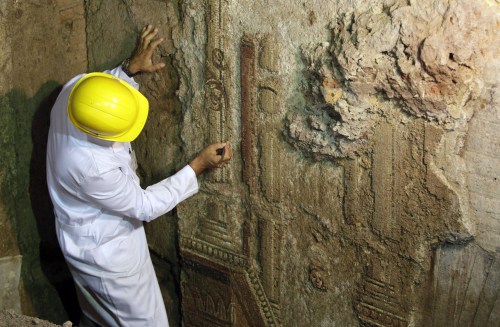
An archaeologist works on a mosaic discovered in downtown Rome, Friday, July 29, 2011. Excavations in the bowels of an ancient Roman hill have turned up a well-preserved, late 1st Century wall mosaic with a figure of Apollo, naked except for a colorful mantle over a shoulder. The mosaic-covered wall is 16 meters (53 feet) wide and at least 2 meters (6.6 feet) high. Officials think the wall continues down some 8 meters (26.5 feet) more. Archaeologists say the wall appears to be in a tunnel built to help support Trajan's Baths, named for the emperor who ruled from 98 till 117. The mosaic, which also depicts a Muse, apparently embellished a room where wealthy Romans gathered to hear music and discuss art. (AP Photo/Pier Paolo Cito)/2011-07-30 06:04:30/ <저작권자 ⓒ 1980-2011 ㈜연합뉴스. 무단 전재 재배포 금지.>
An archaeologist works on a mosaic discovered in downtown Rome on Friday. AP-Yonhap News
An archaeologist works on a mosaic discovered in downtown Rome on Friday. (AP-Yonhap News)
The mosaic-covered wall is 16 meters (53 feet) wide and at least 2 meters high. Officials think the wall continues down some 8 meters more.
Archaeologists say the wall appears to be in a tunnel built to help support Trajan’s Baths, named for the emperor who ruled from 98 till 117. The mosaic, which also depicts a Muse, apparently embellished a room where wealthy Romans gathered to hear music and discuss art.