The first locally developed civilian aircraft completed its maiden flight at Korea Aerospace Industries in Sacheon, South Gyeongsang Province on Wednesday.
Once the project is completed, and necessary certifications are granted for the vehicle, Korea will become the world’s 28th country to have developed civilian aircraft using indigenous technologies.
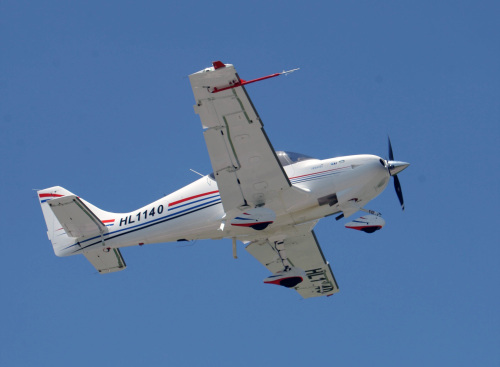
The first locally developed civilian aircraft is seen during its maiden flight in Sacheon, South Gyeongsang Province. (Yonhap News)
Although Korea Aerospace Industries had developed aircraft for military use ― the T-50 training jet ― this is the first airplane developed for civilian use using indigenous technologies. According to the Ministry of Land, Transport and Maritime Affairs, which oversaw the project, 90 percent of the parts used in the airplane were produced locally.
The four-seater light plane was developed as a collaborative project between a number of local companies and research organizations including Korea Aerospace Industries and the Korea Aerospace Research Institute as a Transport Ministry’s research and development program launched in 2008.
The 1,633 kilogram vehicle is capable of reaching speed of 389 kilometers per hour, with a maximum flight range of 1,850 kilometers, the ministry said.
According to the ministry, the combination of extensive use of carbon-based materials for the body of the vehicle and electronic control system for the engine allowed the developers to improve the plane’s fuel economy by 10 percent.
“(The Ministry of Land, Transport and Maritime Affairs) Will continue to conduct R&D projects for developing aviation and satellite navigation technologies to make Korea one of the top 10 countries in aviation technologies,” Minister of Transport Kwon Do-youp said at the event.
The ministry said that while the exact price hasn’t been set, concerned organizations are looking at a price tag of around 600 million won ($568,000) for the plane.
The ministry added that it aims to gain certification under the Bilateral Aviation Safety Agreement with the U.S. Federal Aviation Administration by 2013 to open export opportunities.
By Choi He-suk (cheesuk@heraldm.com)
cheesuk@heraldcorp.com











