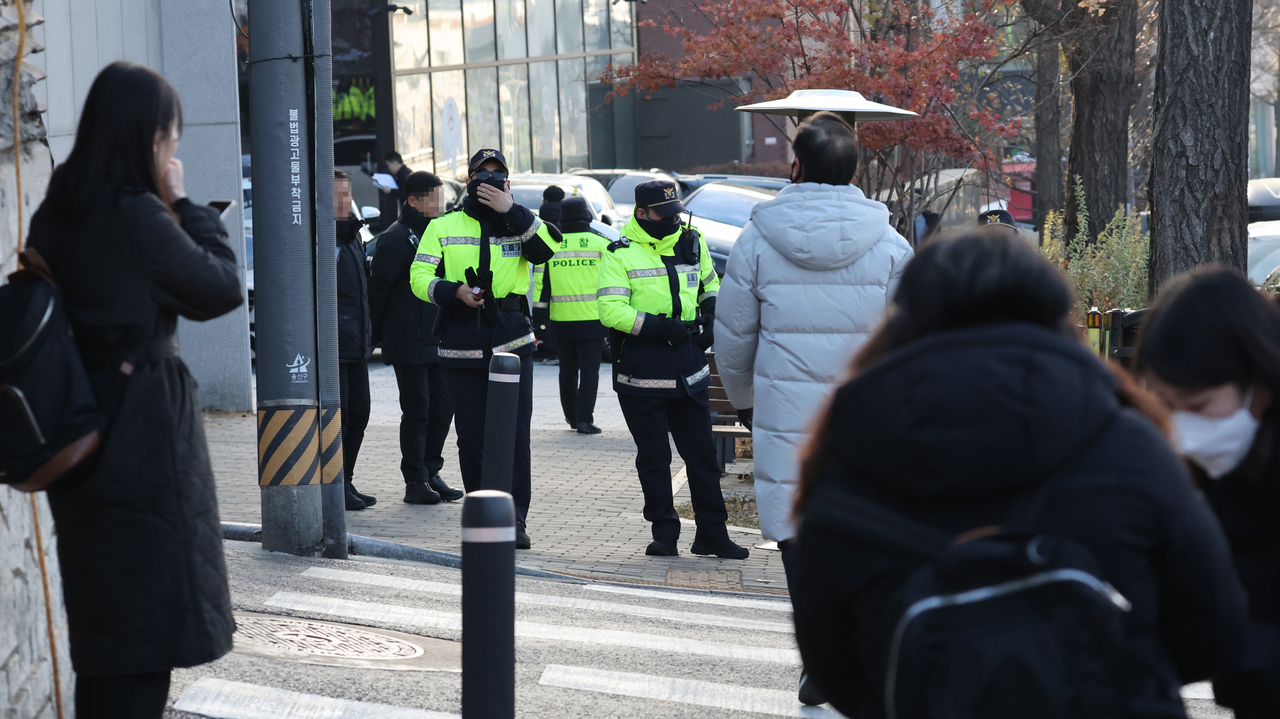
South Korean police have been blocking the majority of protests and press conferences in front of the presidential residence in Hannam-dong, Seoul, with reports showing the grounds for prohibiting the demonstrations as a resident's complaint filed seven months ago.
The local Kyunghyang Shinmun newspaper reported that Hannam-dong residents living near President Yoon Suk Yeol's home had filed a complaint with police to restrict excessive noise from protests in May this year. The complaint requested that police stop the protests from going on until late at night and prohibit protestors from shouting profanity and insults during school hours.
Police used the months-old complaint as grounds to deny permission for a protest that the nongovernmental Center for Military Human Rights Korea had requested on Saturday.
While there is a legal clause banning protests adjacent to major government facilities, the portion concerning the presidential residence was ruled unconstitutional by the Constitutional Court in December 2022. The court said that the area near the presidential residence is the "most effective place for citizens to convey their opinion to the president," and prohibiting protests there would be a restriction of key parts of the freedom of assembly.
But police have been cracking down hard on demonstrations near Yoon's home, even one-person protests that are not mandated by law to report to authorities, since they are subject to the Assembly and Demonstration Act.
It was reported recently that a lawyer named Kim Nam-ju, who was part of a relay of one-person protests in front of the presidential residence staged by legal experts, was dragged away by police for unspecified reasons.
With police effectively banning demonstrations near the presidential home, protesters have been holding demonstrations near Hangangjin Station, some 600 meters from Yoon's residence. The area has been used by anti-Yoon demonstrators since the president's controversial declaration of martial law on Dec. 3, including a recent deomonstration by farmers who moved in a convoy from southern parts of the country over several days on their tractors and trucks.
minsikyoon@heraldcorp.com