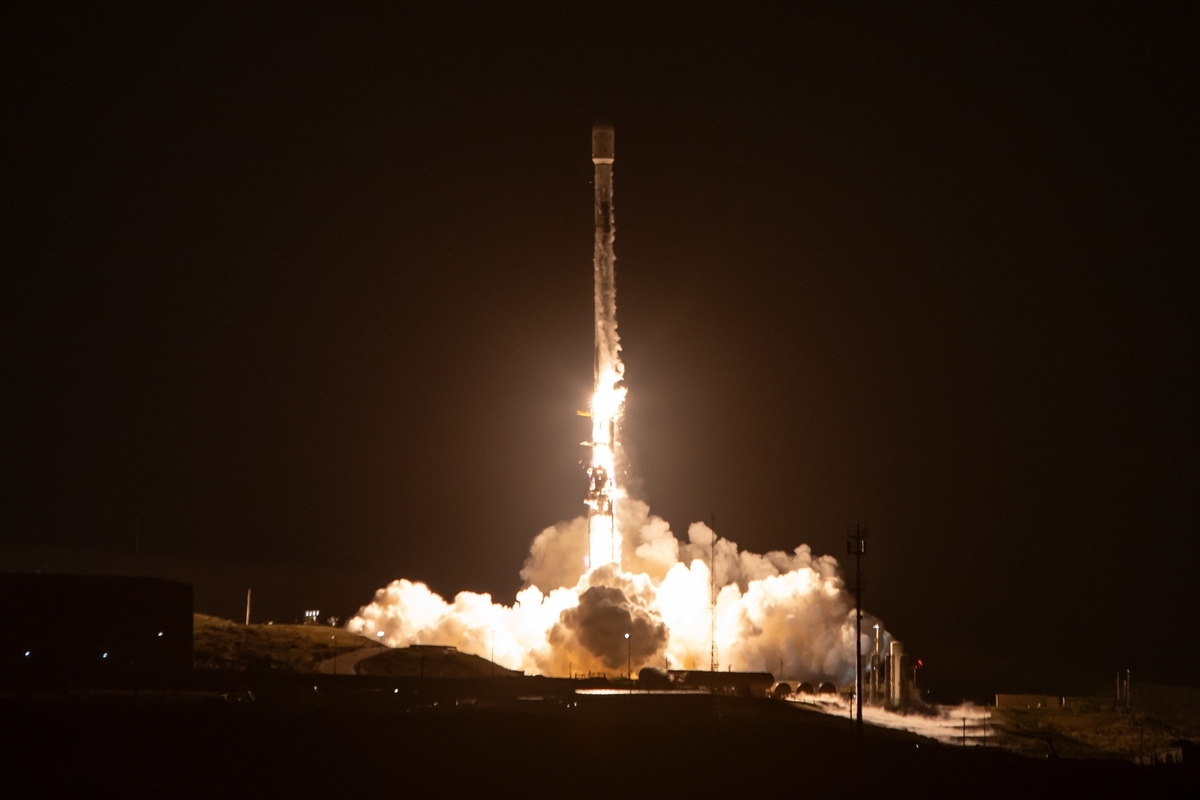
South Korea successfully placed into orbit its third homegrown spy satellite launched from a US space center Saturday, the defense ministry said, as the country seeks to bolster its independent surveillance capabilities on North Korea.
A SpaceX Falcon 9 rocket carrying the satellite normally lifted off at 8:34 p.m. (Korean time) from the Vandenberg Space Force Base in California as planned and sent the reconnaissance satellite into orbit at 9:24 p.m., according to the ministry.
The launched satellite succeeded in communicating with an overseas ground station at 11:30 p.m., it added, in a step indicating the satellite's normal operation.
It is the third military satellite launched under South Korea's plan to acquire five spy satellites by 2025 to better monitor North Korea with an independent military satellite network. South Korea has previously relied largely on satellite imagery provided by the United States.
"We will strive to bolster our military's independent surveillance capabilities by succeeding with additional launches going forward," the ministry said, noting the success of the latest launch has enabled more accurate and swift identification of North Korean provocations.
It is the third military satellite launched under South Korea's plan to acquire five spy satellites by 2025 to better monitor North Korea with an independent military satellite network. South Korea has previously relied largely on satellite imagery provided by the United States.
South Korea launched its first spy satellite -- equipped with electro-optical and infrared sensors to capture detailed images of the Earth's surface -- in December last year from the California space base.
In April, the country placed its second spy satellite -- fitted with synthetic aperture radar (SAR) sensors that capture data using microwaves and are capable of collecting data regardless of weather conditions -- from John F. Kennedy Space Center on Merritt Island, Florida.
Like the third satellite equipped with SAR sensors, the remaining two satellites will also be equipped with such sensors.
South Korea's defense authorities expected the launch to further enhance the military's three-pronged deterrence program against the North's nuclear and missile threats.
Once all five satellites are fully deployed, the military is expected to be able to monitor a certain target in North Korea every two hours, according to analysts.
The satellite network is also expected to enable more flexible and comprehensive coverage compared with just one or two satellites.
Defense Acquisition Program Administration Minister Seok Jong-gun, who is overseeing the third launch, said the grouped operation of satellites will enable the military to better identify signs of North Korea's provocations.
The latest launch comes as North Korea has also been ramping up efforts to acquire space-based reconnaissance capabilities.
Pyongyang successfully launched its first military spy satellite, the Malligyong-1, in November 2023 and has vowed to launch three more spy satellites this year.
But North Korea has yet to launch a satellite since a rocket carrying a satellite exploded shortly following takeoff in May.










