Hyundai Glovis has scaled up its ocean fleet with the world’s largest vehicle carrier, capable of transporting 10,800 vehicles, in a bid to capitalize on China’s rapidly expanding auto exports.
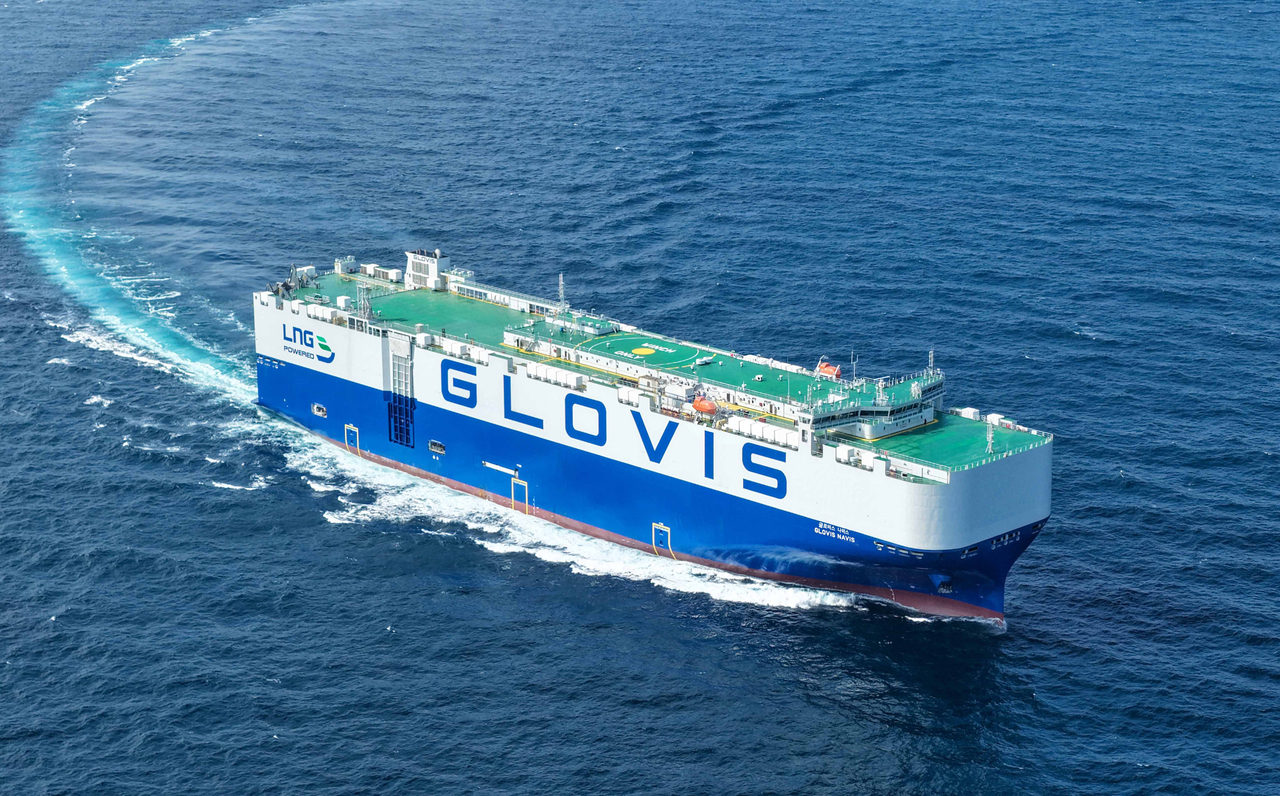
The company said Sunday it recently deployed the Glovis Navis pure car and truck carrier (PCTC) for maritime vehicle transport. Key officials, including Hyundai Glovis CEO Lee Kyoo-bok and Kim Hyung-joon, head of the maritime strategy division at the Korea Ocean Business Corporation, attended the ship naming ceremony held at Guangzhou Shipyard International in Guangzhou, China, on Thursday.
The Glovis Navis — measuring 230 meters long and 40 meters wide with a 102,590-ton displacement — features 14 vehicle decks with a maximum capacity of 10,800 compact cars, making it the world’s largest PCTC currently in service.
The ship is one of four car carriers Hyundai Glovis is acquiring with financing from Korea Ocean Business Corp. Each can carry up to 10,800 car-equivalent units. The first, Glovis Nova, was delivered in July, followed by Glovis Noble and Glovis Navis in November. The final vessel, Glovis Nautilus, is due in February. All four will serve global auto shipping routes.
These deliveries are part of Hyundai Glovis’ broader fleet expansion. The company is adding eight 10,800-CEU car carriers this year, 10 in 2027 and two in 2028. Measured in 6,500-CEU vessel equivalents, its fleet is projected to grow from 106 this year to 110 in 2027, 118 in 2028, 123 in 2029 and 128 in 2030. The company aims to capture 20 percent of the global car carrier market, according to Kim Jung-seok, head of the marine business division at Hyundai Glovis.
A key target market for Hyundai Glovis is China, where a boom in vehicle exports is surpassing local carrier capacity. The company said China’s auto export volume is projected to surge from 2 million units in 2021 to 12 million this year and reach 15 million by 2027.
In contrast, China’s own vehicle shipping capacity remains constrained — projected at just 6.08 million units this year and 7.4 million by 2027. Chinese shipping companies and automakers currently operate roughly 2 million vehicles, with a significant number of vehicles being transported by container ships.
Notably, Chinese electric vehicle giant BYD operates just eight PCTCs capable of transporting 200,000 units annually. Chinese-operated PCTCs are expected to reach a mere 150 vessels by 2030.
To bridge this supply gap, Hyundai Glovis aims to boost its share of China’s vehicle export market from 12.2 percent this year to 13.6 percent next year, positioning itself as the top carrier operator in the country.
Hyundai Glovis’ quarterly auto shipping volume out of China has already jumped from 120,000-130,000 units last year to 150,000-180,000 units this year. As of the third quarter of this year, Chinese shipments accounted for 25 percent of the company’s total vehicle shipment volume.
Driven by surging exports from Chinese automakers such as BYD and Tesla’s Shanghai plant, Hyundai Glovis’ PCTC revenue surged 38.5 percent year-on-year to 1.37 trillion won ($1.03 billion) in the third quarter. Propelled by this momentum, the company delivered record earnings in the July to September period, posting 9.54 trillion won in revenue and 566.5 billion won in operating profit.
hyejin2@heraldcorp.com