Korea Press Foundation turns to theater to explore media literacy, challenging audiences to confront conflicting accounts and assumptions
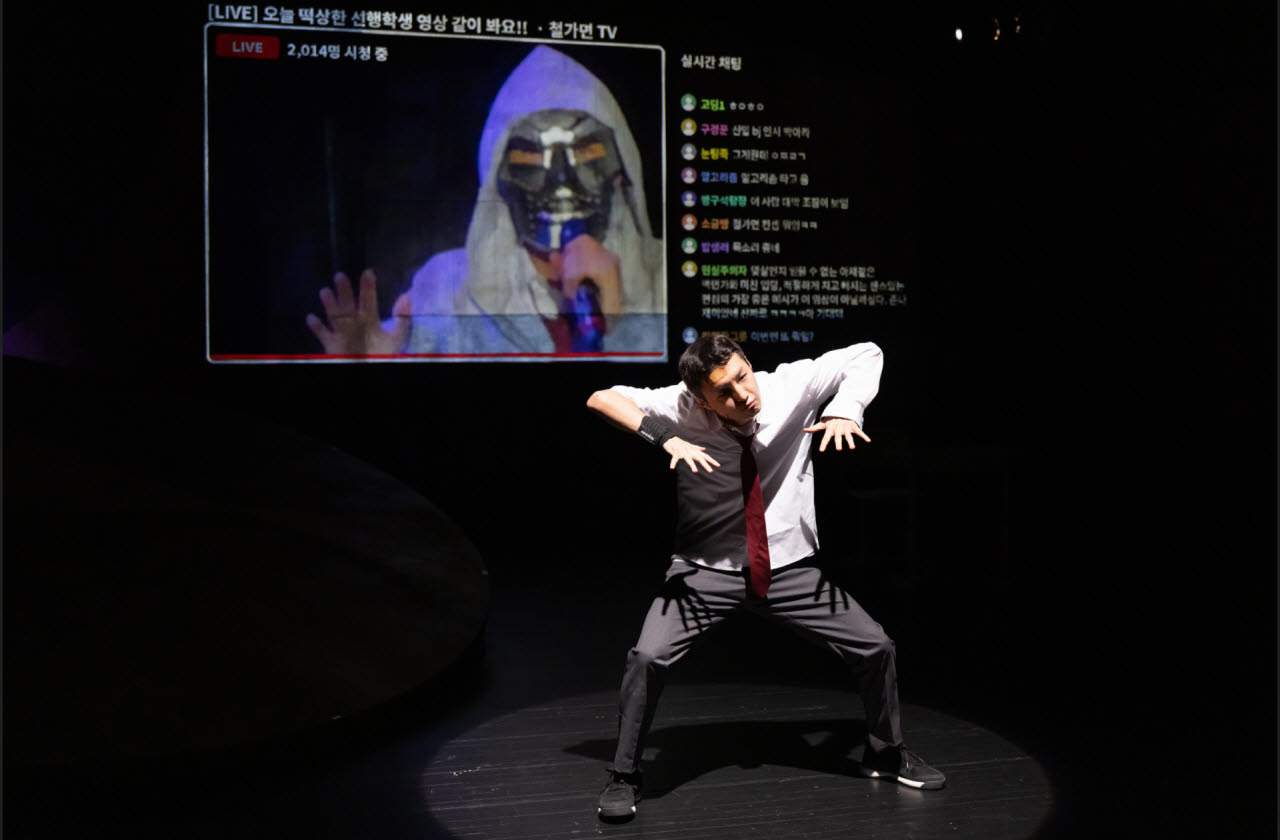
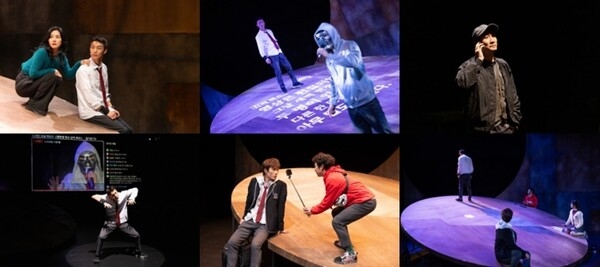
A video shot in an alley before dawn sets off a chain of accusations in “JumpXCut,” and the play never tells its audience who got it right. That is the point, according to the director.
“As a director, I always try to hold on to the attitude that I don’t know the truth,” Kang Hoon-gu said at a press call Wednesday in Seoul. “Only then can I be a lawyer for every character.”
The 80-minute play, written by Oh Se-hyeok, runs through Sunday at Wooran Foundation’s Wooran 2gyeong in Seongdong-gu, eastern Seoul. The Korea Press Foundation presents it as part of its work on media literacy, the ability to critically judge the information people encounter through news, video and social media.
Oh said he wanted to show how the truth each person holds can differ depending on where they stand — “not wrong, just a little different.” The play is “not about settling on an answer,” he added, but about how people share the different ways they see the same event.
The other starting point was a well-known case from China that Kang told him about, in which a man who helped an elderly woman up after she fell getting off a bus was accused by her family of causing her injury and was condemned online. Oh said the man later vowed never to help anyone again, and that story became the seed for a play about teenagers.
At the center of the play is a young man who does parkour. “Parkour is done with the body alone, without words. You can’t know why the person is doing it,” Oh said. He wanted to ask how differently the people around someone silently absorbed in his own pursuit would see him.
“We live in a time when someone becomes the talk of the town and someone else becomes a target of blame, and that cycle is very short,” Kang said. “We have to judge quickly and easily, and are pressured to judge.”
Theater, he asserted, is already a genre about media literacy, because it puts many characters on stage to give their own accounts of what they saw. “If the truth were something we could know so easily, it couldn’t be the truth,” he noted.
The staging carries that idea into physical space. Kang employs a sloped, nearly circular stage of varying heights that mark the relationships and power gaps between characters, so the same scene appears differently depending on where each audience member sits.
The foundation, which has long supported media literacy education in schools, turned to theater because such literacy “can’t be solved with knowledge alone,” said Shim Ha-young, head of the foundation’s media education support team. The same story has also been staged by students at five schools and toured to 59 schools and institutions, with expansion planned for next year.
Oh said the work began with himself. “I sometimes only look at the news I want to see, and take in things online without much thought,” he said. “I wrote it looking back at myself more than anyone.”
gypark@heraldcorp.com