Seoul stocks closed lower Monday as investors digest uncertainties facing the artificial intelligence sector, including an internal probe at Nvidia Corp., following allegations its chief was targeted by a Chinese spy. The local currency strengthened against the US dollar.
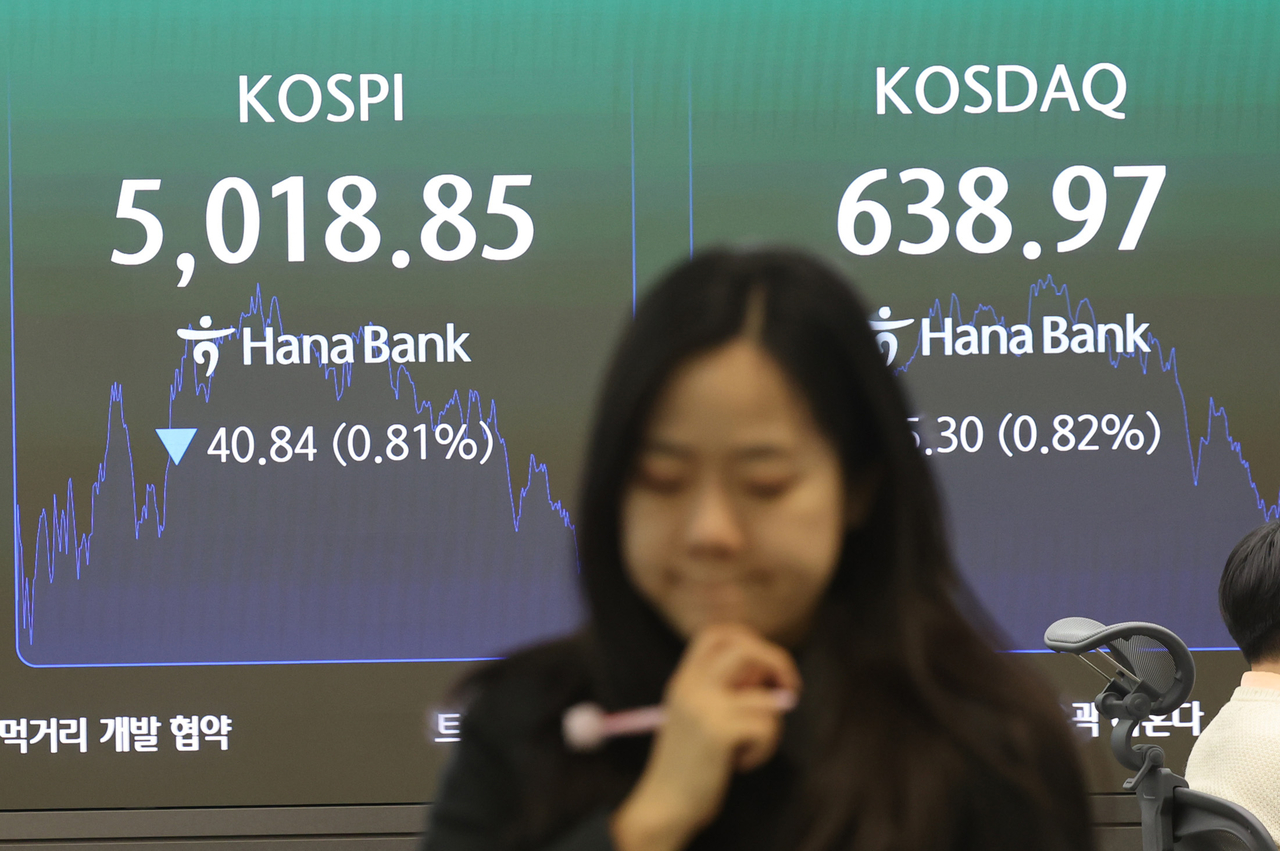
After rocky trading, the benchmark Korea Composite Stock Price Index closed down 40.84 points, or 0.81 percent, to 5,018.85.
Trade volume was light at 231.8 million shares worth 17.26 trillion won ($12.8 billion). Losers outnumbered winners 527 to 340.
Foreigners and retail investors were net sellers, offloading a combined net 1.18 trillion won. Institutional investors snapped up a net 717.1 billion won.
"Investors were searching for direction while bargain hunting continued in semiconductors," said Lee Kyoung-min, an analyst from Daishin Securities.
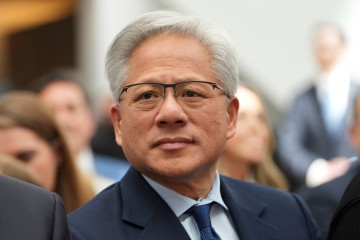
Semiconductors recovered some ground as concerns over the future of artificial intelligence data centers following the Democrats' sweeping victory in the United States midterms eased. However, the scandal involving Nvidia Corp.'s Chief Executive Officer Jensen Huang caused fresh jitters, he added.
The US chip giant announced in a statement Sunday it will open an internal probe into Huang's alleged affair with a suspected Chinese spy.
In a message to Nvidia employees, Huang admitted to being unfaithful to his wife and took "full responsibility" for his actions.
In Seoul, most large-cap shares closed lower while semiconductors strengthened.
Samsung Electronics rose 0.64 percent to 189,900 won, while SK hynix inched up 0.35 percent to 1,136,000 won.
Battery maker LG Energy Solution surrendered 5.78 percent to close at 318,000 won, carmaker Hyundai Motor shed 2.86 percent to 271,500 won, and defense giant Hanwha Aerospace fell 3.18 percent to 639,000 won.
The Korean won was quoted at 1,347.1 won against the US dollar as of 3:30 p.m., up 9.5 won from the previous stock trading session's close.
Bond prices, which move inversely to yields, closed lower. The yield on three-year Treasurys added 2.6 basis points to 3.639, and the return on the benchmark five-year government bonds rose 1.4 basis points to 3.731. (Yonhap)