Turing Award winner rejects fears of uncontrollable AI, saying better safeguards can contain cyber risks
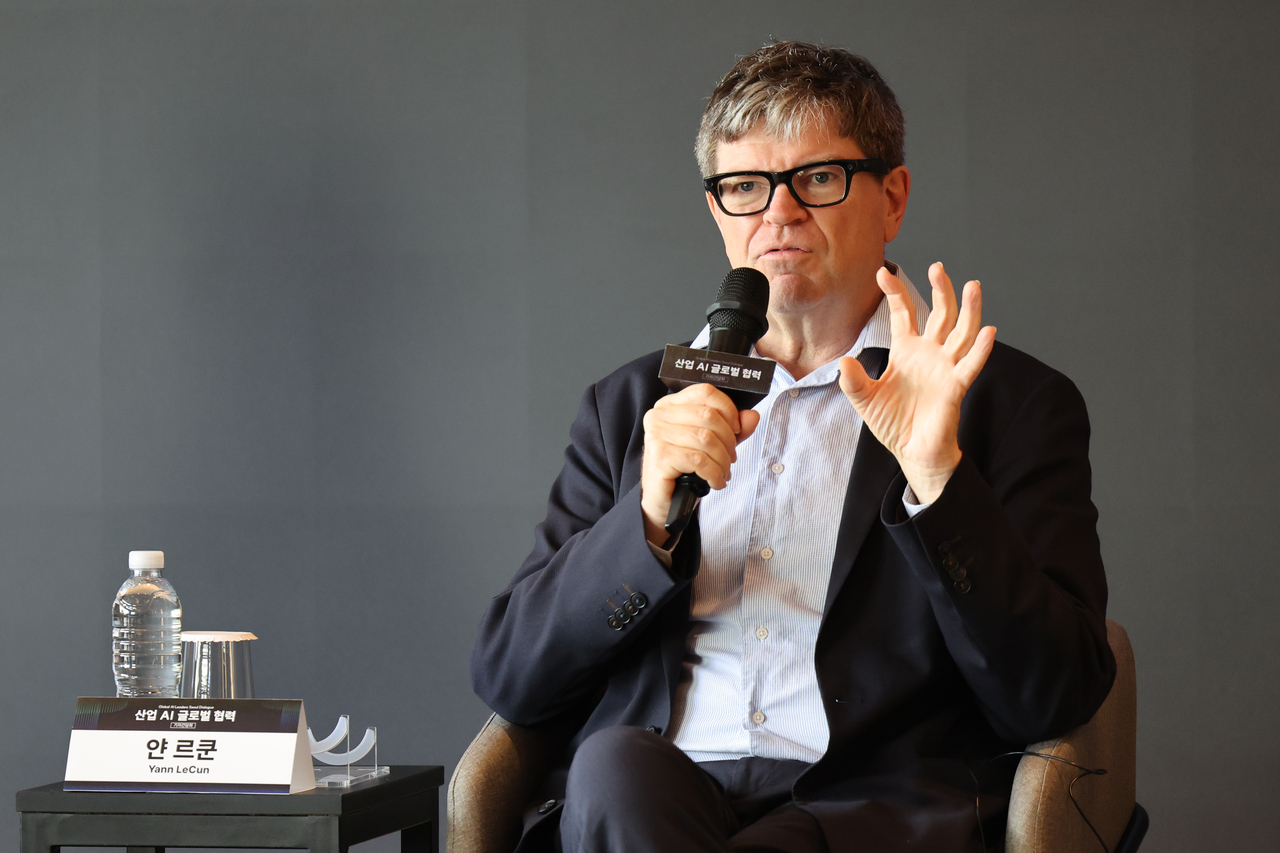
Artificial intelligence’s next breakthrough will come not from ever-larger language models, but from systems that can understand, predict and act in the physical world, AI pioneer Yann LeCun said Monday, arguing that “world models” will drive the next phase of AI.
The shift could give South Korea an opening in the global AI race by playing to its strengths in manufacturing, robotics and engineering, LeCun and other global AI leaders said at an industrial AI panel discussion in Seoul.
Rather than trying to match US tech companies' massive AI infrastructure spending, Korea should move quickly to deploy AI in factories, ships and machinery, where it has a competitive edge, they said.
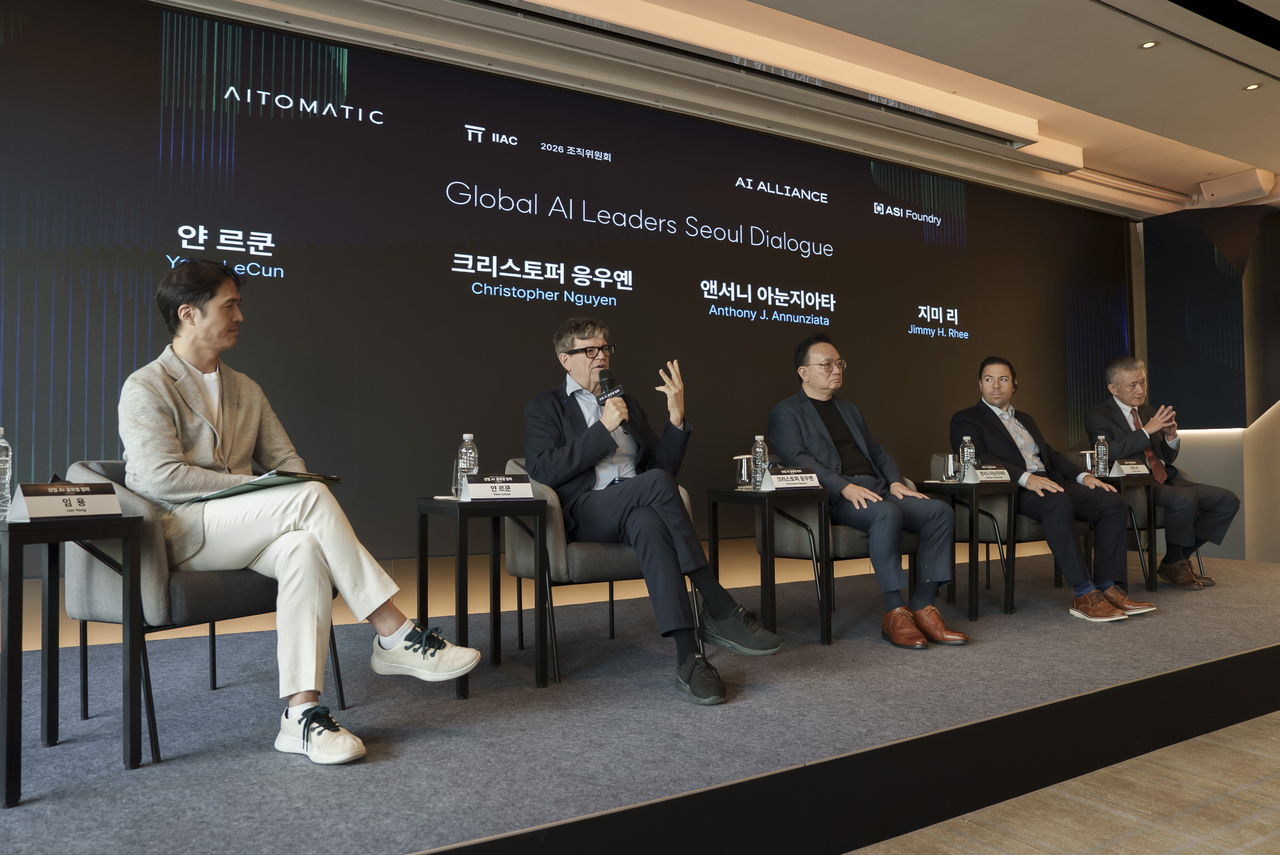
The event, organized by Aitomatic and the IIAC 2026 committee, came ahead of the fifth International Industrial AI Conference in Tokyo on Tuesday. Joining LeCun were Aitomatic CEO Christopher Nguyen, AI Alliance co-founder and co-Chair Anthony Annunziata and ASI Foundry Chairman Jimmy Rhee.
LeCun said today's large language models are effective at capturing knowledge contained in text, images and video, but lack a reliable understanding of cause and effect in the physical world.
AI can prove mathematical theorems and pass professional exams, he noted, while robots still struggle with household tasks a 10-year-old can perform without training.
LeCun, a 2018 Turing Award winner and founder and chairperson of AMI Labs, is pursuing an alternative centered on world models — systems designed to predict how the physical world will change in response to an action.
Such systems could plan a sequence of actions needed to achieve a goal rather than simply predict the next word or imitate patterns in human-generated data. AMI Labs is developing the approach through a joint-embedding predictive architecture.
Nguyen said the transition could favor manufacturing economies such as Korea. Previous digital technologies largely remained confined to cyberspace because they could not effectively interact with the physical world, while AI is beginning to extend digital intelligence into factories, ships and machinery, he said.
He urged Korea to deploy industrial AI “early and often” while strengthening security and governance. Rather than simply following US AI companies into heavy infrastructure spending, Korea should capitalize on its advantage in industrial deployment, he said.
LeCun also called on Korea to attract global research talent and strengthen the path from fundamental research to commercialization. As foundation models increasingly become open infrastructure, Korea could build on them to establish leadership in physical AI and robotics, he said.
Annunziata pointed to Project Tapestry, the AI Alliance's collaborative development initiative, as a way to combine global cooperation with technological sovereignty. Participants can jointly develop an open foundation model while retaining control over their data and building proprietary systems on top of it.
Rhee described Korea's industrial data as a strategic “data well,” saying its manufacturing base and research talent provide an advantage, but that waiting for perfect information could allow competitors to pull ahead.
Ha Jung-woo, vice chairman of South Korea's National AI Strategy Committee, said AI competition is shifting from model performance toward industrial productivity. International cooperation will be crucial to turning Korea's strengths in semiconductors, automobiles, shipbuilding and batteries into economic value, he said.
LeCun also rejected the idea that recent AI-related attacks on Korea's financial sector showed AI was becoming uncontrollable, saying they instead exposed inadequate cybersecurity safeguards.
“The companies deploying the agents lacked sufficient security expertise, while the software sandboxes surrounding them were leaky,” he said.
While current LLMs can be jailbroken and are difficult to constrain through fine-tuning alone, future objective-driven systems could evaluate guardrails before acting, LeCun said.
“I'm not saying this is an easy engineering problem, but it's an engineering problem,” he said, adding that AI could ultimately favor cyber defenders because they have greater resources and collaborate more openly.
herim@heraldcorp.com