Unification Minister Chung Dong-young on Friday proposed to North Korea talks to address issues along the border, amid heightened inter-Korean tensions over last week's mine blast inside the Demilitarized Zone.
Chung made the remark after the South's military blamed North Korea for the Sept. 21 land mine explosion on the South's side of the Military Demarcation Line separating the two Koreas. The incident left three South Korean soldiers injured, two of them critically.
Earlier this week, the South Korean military demanded an apology and responsible measures from the North over the blast. Pyongyang has categorically denied its involvement, accusing Seoul of fabricating its investigation result to pin the blame on the regime.
"The root cause of this incident ultimately lies in the issue of the ceasefire line, the MDL line," Chung told reporters upon arriving for work. He cut short his trip to Europe and returned Thursday to handle the fallout from the land mine blast.
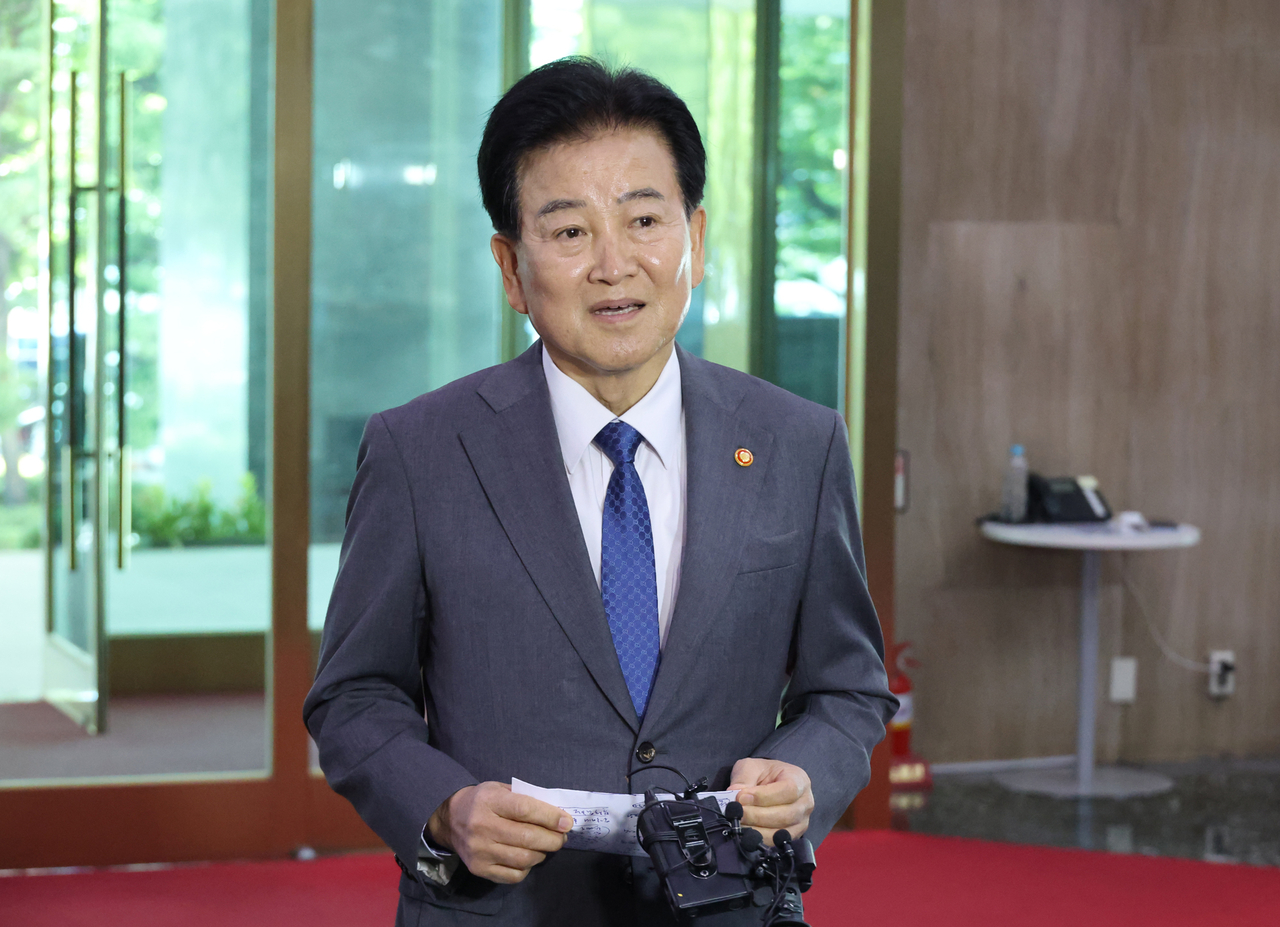
"I, as unification minister, propose to the North: We should meet now and communicate. We should at least start communicating, verifying the MDL and surveying it again," he said, citing the fading visibility of the border line as a primary factor behind the DMZ blast.
The minister also cautioned against resuming anti-Pyongyang loudspeaker broadcasts along the border in response to the blast, calling such a move an "irresponsible and dangerous" act.
Chung reiterated that Seoul has no intention of treating Pyongyang with hostility and that the two Koreas must sit down together to pave the way for a peaceful coexistence.
"No one should try to use this incident to disparage and distort the government's consistent efforts toward peace," he said.
Upon the signing of the armistice agreement in 1953, the UN Command and the North Korean military installed 1,292 signs along the MDL to mark the ceasefire line.
However, only around 200 remain intact today, as many have deteriorated over time due to weather exposure and lack of maintenance.
The defense ministry has acknowledged that discrepancies exist between the UNC's MDL baseline and that of the South Korean military across roughly 60 percent of the border coordinates. (Yonhap)


![[Graphic News] Seoul ranks 4th among Asia’s most revisited destinations](https://wimg.heraldcorp.com/news/cms/2026/10/01/news-p.v1.20261001.4ac504a054534238aa1997420394b832_T1.gif?type=h&h=800)