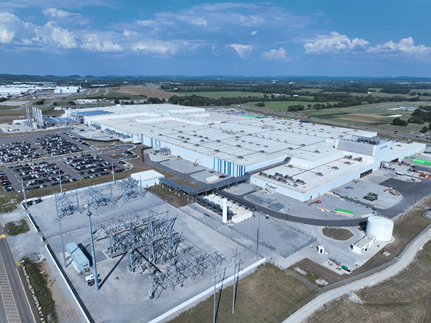
Ultium Cells, the battery joint venture between LG Energy Solution and General Motors, will upgrade its Tennessee plant to produce a new generation of batteries designed to lower costs and boost energy density for future GM electric vehicles, the companies said Monday.
The Spring Hill facility is expected to become the world’s first to mass-produce lithium manganese-rich, or LMR, cells in a prismatic format. Ultium Cells said the technology offers about 33 percent higher energy density than lithium iron phosphate, or LFP, batteries at a comparable cost.
Plant modifications will begin later this year and are scheduled for completion in 2028, creating 500 jobs alongside the facility’s existing workforce of about 1,200.
Investment in LMR production, LFP manufacturing and related plant improvements will total 1.36 trillion won ($1 billion) by 2030.
LMR batteries use more manganese and fewer expensive metals such as cobalt, helping reduce costs while maintaining relatively high energy density.
The project will broaden the Tennessee plant’s output across electric vehicles and energy storage. The site began producing LFP cells in June for energy storage systems supplied to customers of LG Energy Solution Vertech, the Korean battery maker’s energy storage integration subsidiary.
Once LMR production starts, the plant’s lineup will span high-nickel, LFP and LMR chemistries, with both pouch and prismatic formats.
LG Energy Solution has worked on LMR technology for more than a decade, securing its first related patent in 2010. It had filed more than 300 patent applications by the first half of this year.
The company and GM agreed in December 2024 to jointly develop prismatic cells and related materials, then announced plans in May 2025 to commercialize prismatic LMR batteries for GM vehicles.
Ultium Cells President Injae Pahk, a former LG Energy Solution vice president, said the investment would help the venture respond to shifting demand and strengthen its position in the US battery industry.
yejinlim@heraldcorp.com

![[Graphic News] S. Korea ranks 9th in noodle consumption](https://wimg.heraldcorp.com/news/cms/2026/09/29/news-p.v1.20260929.e3945338add94d57ab3f00f8e6781416_T1.gif?type=h&h=800)