[THE INVESTOR] Seoul would see the third biggest economic loss globally -- approximately $103.50 billion (116 trillion won) -- when faced with natural catastrophes and manmade economic shocks between the period of 2015 and 2025, a report showed Monday.
Based on the original research by the Cambridge Centre for Risk Studies at the University of Cambridge Judge Business School, UK insurance firm Lloyds’ City Risk Index 2015-2025 listed 301 major cities in terms of an expected loss to a selected location’s economic output -- average annual GDP -- from 18 types of natural and manmade threats.
The report showed that Taipei topped the list with a total GDP at risk calculated at $181.20 billion, followed by Tokyo with $153.28 billion.
Seoul was ranked third and was one of four Asian cities that topped the Index’s total GDP at risk rankings, followed by Manila, New York and Los Angeles.
According to the index, Busan showed $20.45 billion of total GDP at risk, followed by Daegu ($13.50 billion), Incheon ($10.59 billion), Daejeon ($9.86 billion) and Gwangju ($8.66 billion).
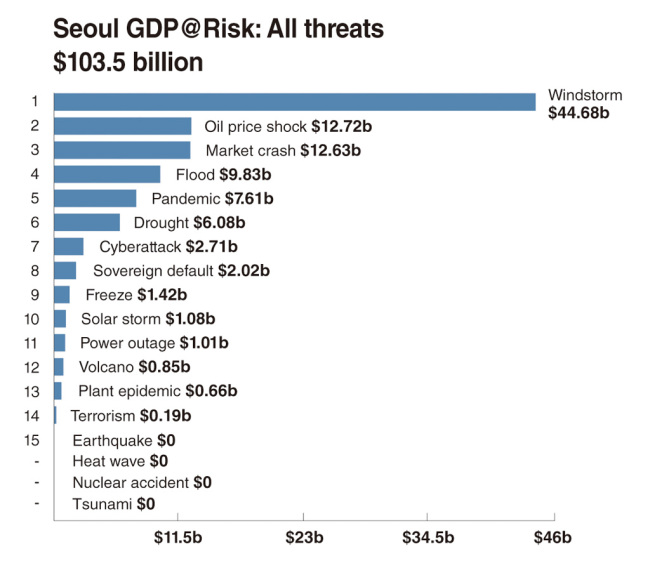
The report said that the South Korean capital could be hit hard by wind storm, mainly due to its geographical location in the North West Pacific typhoon belt.
By threat type, a wind storm was the highest risk factor for Seoul, with a potential economic loss calculated at $44.68 billion, followed by an oil price shock ($12.72 billion), market crash ($12.63 billion), flood ($9.83 billion), human pandemic ($7.61 billion) and drought ($6.08 billion).
Among 301 cities, Seoul was also the third most exposed city to potential losses from natural threats including a flood and drought. Seoul showed the world’s highest exposure to drought, due to the fact that the Korean peninsula suffered the worst drought in the past century in 2012.
But despite South Korea’s strongest earthquake last week, the report calculated the potential losses from earthquakes at $0.
In terms of manmade economic threats, the report said that as South Korea lacks oil and gas resources, Seoul was vulnerable to a market crash and an oil price shock, placing the country third for its highest exposure to an oil price shock in the world.
The report added that one-third of Seoul’s total exposure to economic threats come from emerging threats including a human pandemic, cyberattacks and solar storms.
“The nature of these threats is changing too. Certain extreme weather events linked to climate change are increasing in severity and frequency. Manmade threats, such as cyberattacks and market crash, are increasingly significant as companies expand into new markets and territories,” said Inga Beale, CEO of Lloyd’s.
“(In that sense, the report) is a wake-up call to us all, as disasters that have occurred in the past are likely to do so again in the future,” Beale added in the report.
By Kim Da-sol/The Korea Herald ()











