Buddhist rituals and temple visits help international students find a sense of belonging
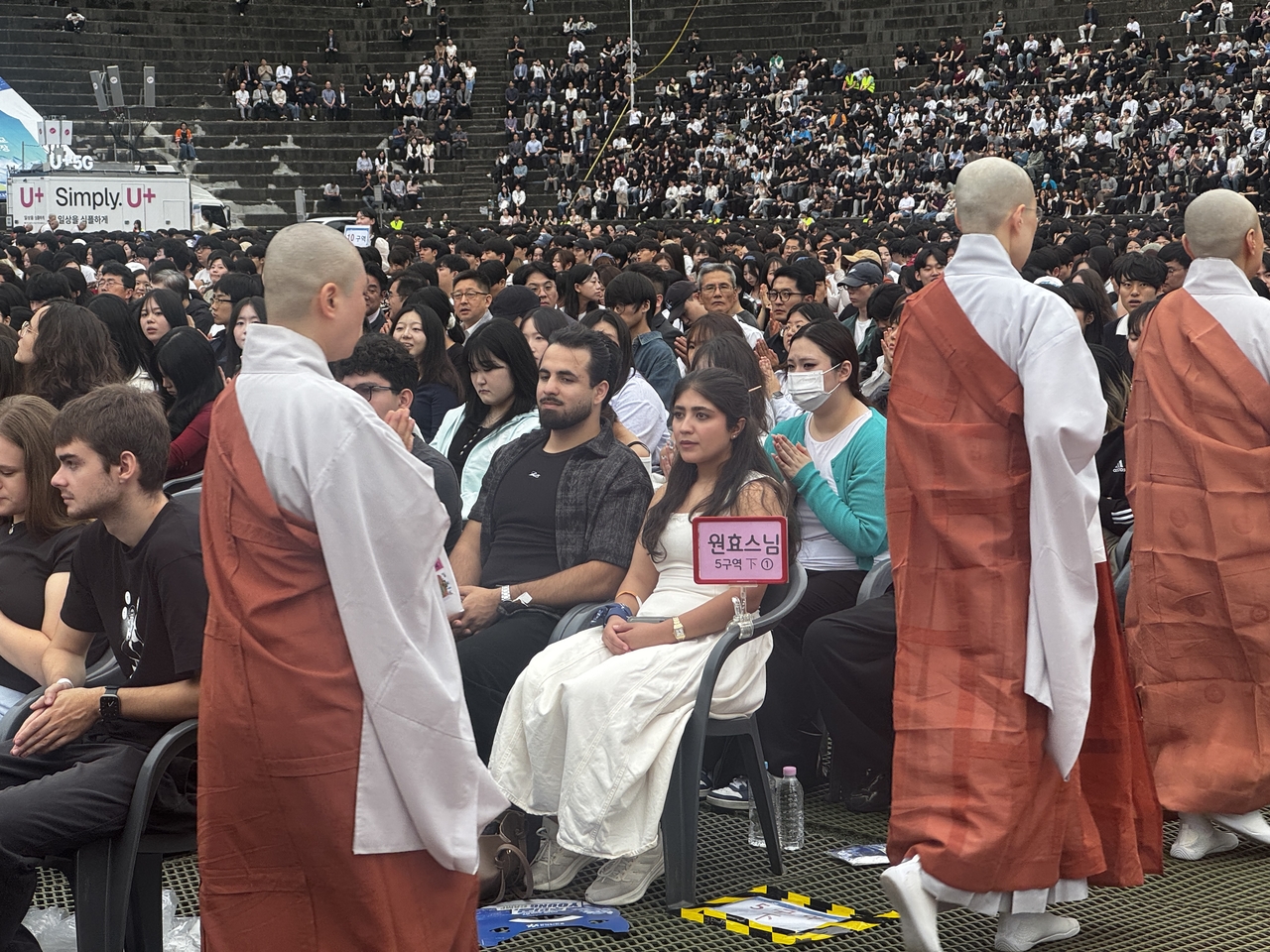
Rows of students stood shoulder to shoulder, then bowed in unison.
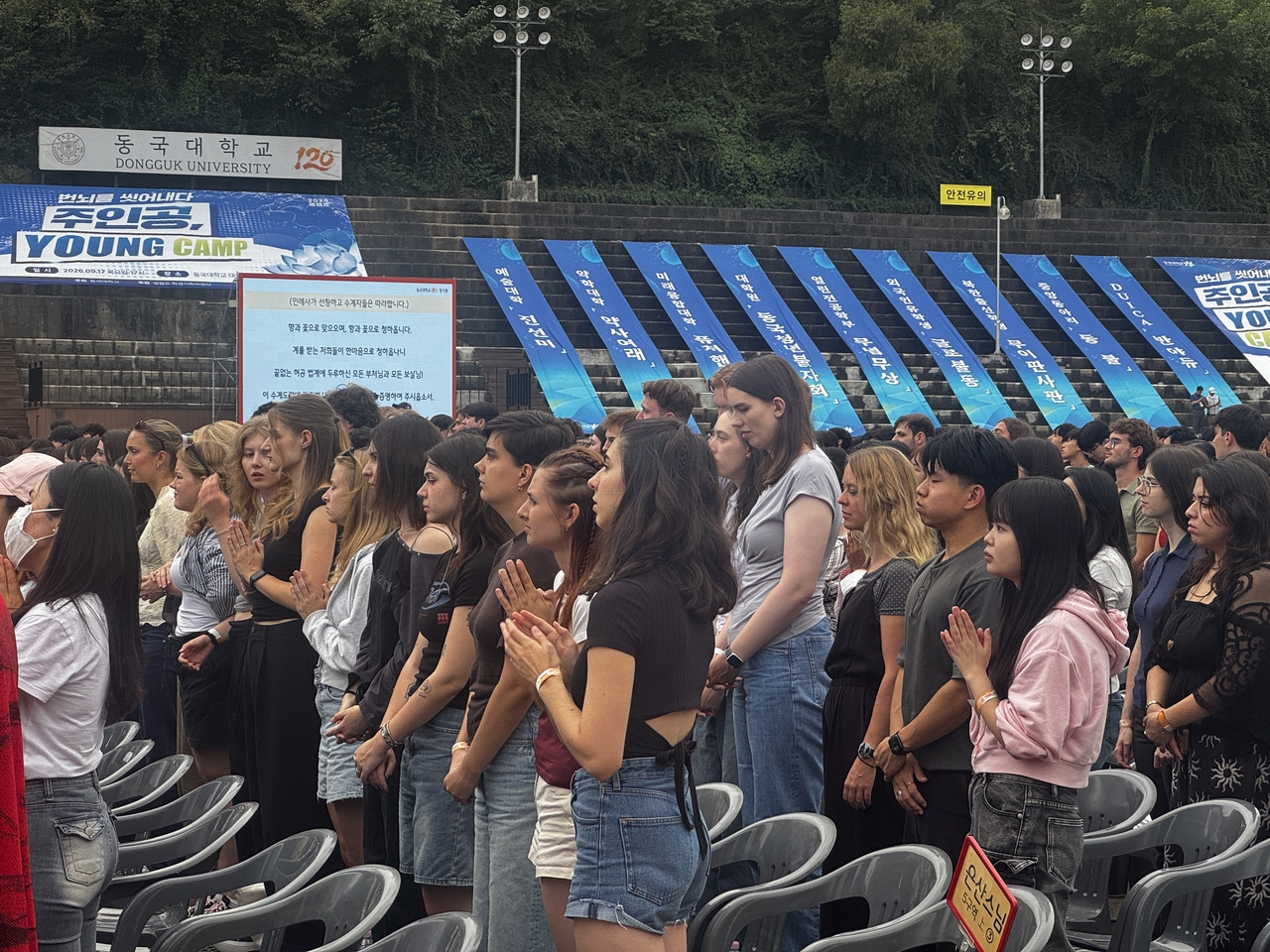
Among the roughly 10,000 students and faculty taking part in Buddhist prayers at Dongguk University’s recent Young Camp event were scores of international students — some Buddhist, many not.
For nearly an hour, they chanted centuries-old texts and repeated bows, joining a ritual far removed from the K-pop concerts and other pop-culture experiences often associated with studying in South Korea.
For Pooja Rajput, a 24-year-old Indian master’s student and a Hindu, the hour did not feel foreign.
“For some people, it was boring because there was a one-hour prayer,” Rajput recalled. “But for me, it was a kind of meditation.”
What fascinated her was discovering practices that reminded her of her own religious tradition.
“I don’t want just to be limited to my religion, to my country,” she said. “I didn’t know these things also happened in Buddhism.”
Nearby was Lidiya Garayeva, a 23-year-old mechanical, robotics and energy engineering student from Turkmenistan. She, too, is not Buddhist. But when asked which part of Young Camp she preferred — the Buddhist ceremony or the later K-pop performances — she chose the former.
“K-pop is good, but as I told you before, I’m not a big fan of K-pop,” she said, describing the Buddhist portion as more “energetic” and “interesting.”
Their experiences offer a glimpse of how some international students are discovering Korea beyond the interests that first brought them here.
The number of foreign students at Korean universities has surpassed 300,000, drawing attention to why they choose Korea and how they settle in once they arrive. Dongguk, a Buddhist university in central Seoul, has increasingly incorporated its Buddhist identity into programs for its growing international student community.
Last year, the university launched Globuldong, its first Buddhist club specifically for international students. It has drawn about 250 members from around 30 countries.
University officials said they hoped activities ranging from temple stays to Buddhist festivals would introduce students to Korean Buddhist culture while helping them form connections across national and cultural backgrounds.
Finding ‘another Korea’
For Garayeva, Buddhism was never part of the plan.
She came to Korea to study engineering, drawn in particular by her interest in the Korean automobile industry.
“I’m not a fan of K-pop and drama,” she said. “I’m very interested in motorsports.”
Hyundai and Kia helped shape her interest in studying engineering in Korea, she said.
She chose Dongguk for her major and said she did not know beforehand that it was a Buddhist university.
“When I came, I was surprised,” she said. “I was like, ‘Wow, Dongguk University is a Buddhist university.’”
Three years later, she has since taken classes in meditation and Buddhism and joined the Buddhist student club.
“For me, Buddhism is more about philosophy than religion,” she said. “Before coming to Korea, I knew nothing about Buddhism.”
The club has taken her beyond campus through temple visits and temple stays. She recalled one early visit as a respite from the pressures of engineering school.
“I felt relaxed because I could rest from my thoughts,” she said. “When you go to a temple, it kind of helps you to just forget everything and enjoy life.”
Garayeva said the activities allowed her to “see another Korea,” exposing her to religious traditions and cultural practices beyond the country’s contemporary pop culture.
She pointed to lantern festivities around Buddha’s birthday, when Buddhist clubs from universities across Seoul gather at Dongguk.
“They gather people to do something together, to make new friends,” she said.
Such events have given her opportunities to connect not only with Dongguk students but also with those studying at other universities.
A place to belong
Rajput’s connection to Buddhism began differently.
A Hindu from India, she had seen similarities between Hinduism and Buddhism before arriving in Korea, and Dongguk’s Buddhist identity was part of its appeal.
Rajput joined the Buddhist club during her first semester and said its openness to students of different religious backgrounds stood out.
“It doesn’t matter which religion you belong to. You are most welcome inside the Buddhist club,” she said.
Through the group, she has visited temples, joined outings and met Korean students she might otherwise never have encountered. Club leaders, she said, made international students feel they were more than visitors.
“It’s not like we are just students,” Rajput said. “We are part of Dongguk University.”
Garayeva said many international students she knows arrived with images of Korea shaped by dramas or online content, then encountered something different.
“When you expect something and when you come, there’s expectation and reality,” she said. “Korea is not about drama.”
The longer students live here, she said, the more that picture expands to include Korea’s technology, education, people and traditions.
Rajput has heard similar stories from younger students in the club who initially came because of Korean dramas. Her own path was different. She had studied Korean and spent around four years working with Koreans in India before moving to Seoul. Neither K-pop nor television dramas were her primary attraction.
What the club has given her is a way to participate in university life with people from different countries, academic programs and religious backgrounds.
For universities seeking to welcome growing numbers of international students, the two women’s experiences point to a question that enrollment figures alone cannot answer: whether students can find a sense of belonging after they arrive.
Three years after arriving without knowing Dongguk was Buddhist, Garayeva now works as a university global ambassador, helping newer international students navigate some of the difficulties she once faced.
“When I came here, I knew nothing,” she said. Three years later, she said, “I became a part of the university.”
seungku99@heraldcorp.com

![[Graphic News] Average parental age of S. Koreans rises](https://wimg.heraldcorp.com/news/cms/2026/09/27/news-p.v1.20260927.0bcbf944ca9043c4a6ad4401fcfae25c_T1.gif?type=h&h=800)