Vaccine maker and RIGHT Foundation seeking to achieve global health equity
EuBiologics, the Korean vaccine maker known as the largest supplier of oral cholera vaccines to global health programs for less-developed countries, is lining up its recently approved typhoid conjugate vaccine for international procurement to target an initial UNICEF allocation in the latter half of next year.
EuBiologics’ typhoid conjugate vaccine, EuTYPH-C, secured the World Health Organization’s prequalification, or PQ in August, becoming the very first vaccine backed by the Research Investment for Global Health Technology Foundation to clear that bar.
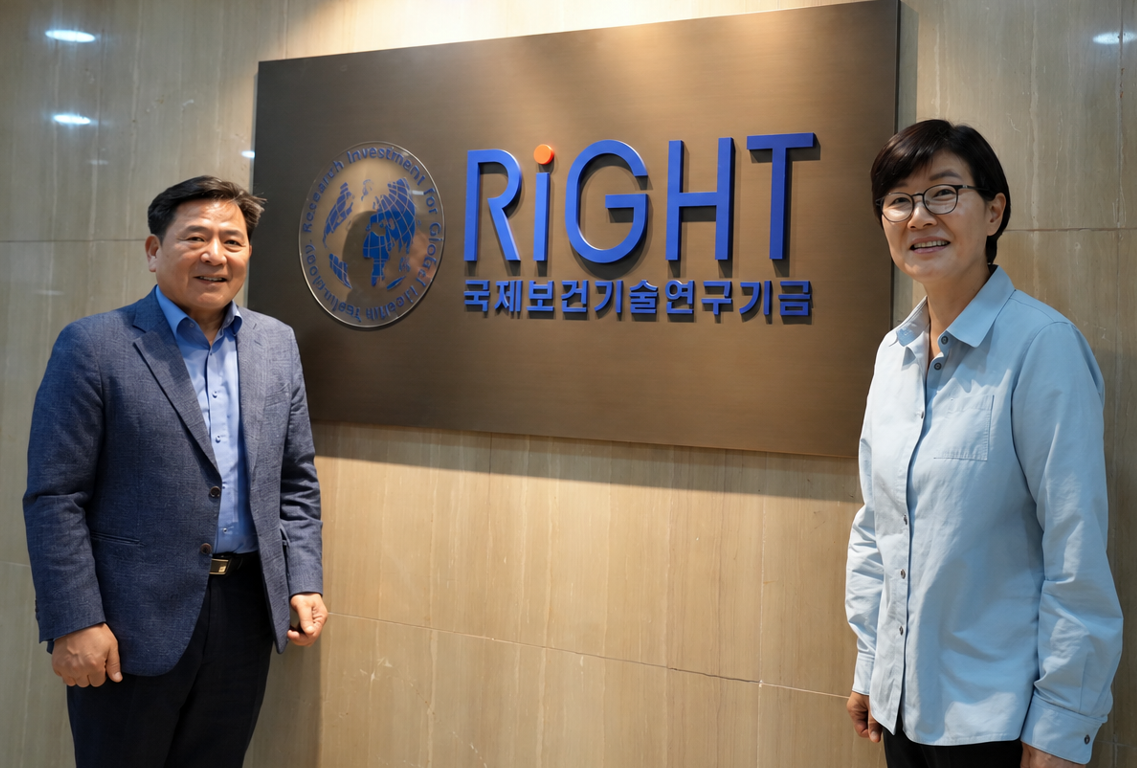
"We see the WHO PQ as the first step," Lee Min-won, executive director of the RIGHT Foundation, said in a joint interview with EuBiologics CEO Baik Yeong-ok at the foundation's office in Seoul on Wednesday.
"(The WHO) PQ gives you the basic qualification to enter public procurement by UNICEF and the like," Lee said.
Before EuTYPH-C, three suppliers from India took up most of the worldwide supply for the WHO PQ-certified typhoid vaccine.
"From the standpoint of international organizations, it is very important to diversify countries and companies and be able to supply reliably with lower-cost products," Lee said, noting that international procurement agencies' funding is shrinking.
Typhoid caused an estimated 6.2 million cases and 72,000 deaths worldwide in 2023, with most of the damage done in South Asia and sub-Saharan Africa, according to the Global Burden of Disease Study. As typhoid conjugate vaccines can be given from 6 months of age and have longer lasting effects than other vaccines, they are regarded as a key countermeasure to the bacterial infection.
EuBiologics' earlier bid for a WHO PQ, which was built on a phase 3 trial in the Philippines, stalled, and the company lacked the money to press on alone. The RIGHT Foundation then picked EuBiologics’ project through open competition in 2021 and decided to offer 4 billion won ($2.95 million) for a phase 3 trial in Kenya and Senegal.
The money came in milestone-based tranches, matched by the company's own 50 percent share. A follow-on 1.78 billion won has, since 2025, financed a study in Senegal on how long protection lasts.
Although EuBiologics entered a WHO-UNICEF tender late last year expecting approval as soon as mid-2026, it came up empty-handed as the incumbent suppliers from India won the orders.
EuBiologics plans to reopen talks with UNICEF before the year's end as it projects an allocation of 4 million to 5 million doses in the second half of next year, according to Baik.
“No matter how cheaply those in India offer it, we believe we can compete," he said.
A single-dose vial version of EuTYPH-C will ease registration in individual countries outside the UNICEF channel, and Baik pointed out that the company is expected to receive a Korean export license of the single-dose vial version around October with a plan to file for a WHO variation recognition in November.
The EuBiologics CEO likened the addition of EuTYPH-C to the firm’s list of WHO PQ-granted vaccines, including its oral cholera vaccine Euvichol, to an old Chinese tale of a parent fretting over two sons, one selling umbrellas, the other straw sandals.
"We were doing only cholera, and now with typhoid as well, we can sell products on rainy days and dry days alike," Baik said.
EuBiologics' meningococcal vaccine co-funded by the RIGHT Foundation and the Gates Foundation is set to finish phase 3 this year, with supply targeted from 2029. The company is also developing a cholera conjugate vaccine it plans to combine with the typhoid shot.
"Once the combination vaccine is out, we will sweep both markets," Baik said.
Set up in 2018 through the partnership between Korea’s Ministry of Health and Welfare, the Gates Foundation and Korean life science companies, RIGHT Foundation has committed a cumulative 145.7 billion won to 83 projects with 120 partners from both in and outside of the country.
"Our funding is really small," said Lee, who took the helm of the RIGHT Foundation in March after about three and a half years as a Korean government health representative at the WHO.
The RIGHT Foundation’s mostly foreign selection panel now clears more proposals than the budget can cover, and a third agreement with the Gates Foundation, due in 2028, is its chance to grow.
"We need to take a further leap," Lee said, calling the prequalification know-how Korean companies are accumulating an asset in itself.
"Our foundation’s ultimate goal is achieving global health equity. The main point is to support Korea’s health technologies that can make products for helping the public health of less developed countries.”
hwkan@heraldcorp.com