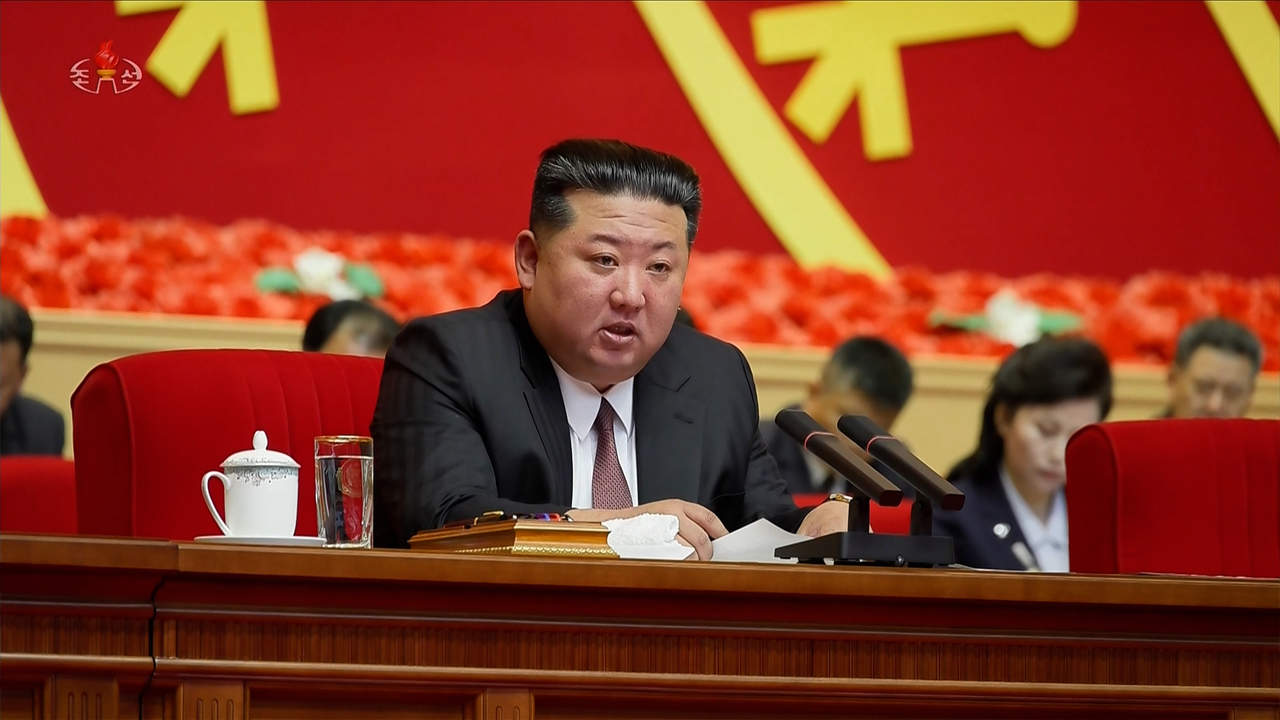
North Korea's most recent missile launches likely seek to increase pressure on the US ahead of major international developments and as speculation about US-North Korea dialogue rises.
Pyongyang fired two short-range ballistic missiles on Sunday from Wonsan toward the East Sea. The first missile, launched at around 3 p.m., flew about 450 kilometers, while the second, fired at around 5:50 p.m., traveled more than 600 km, according to Seoul's Joint Chiefs of Staff.
The timing has drawn particular attention as the launches took place just days before the UN General Assembly opens in New York on Tuesday and a summit between US President Donald Trump and Chinese President Xi Jinping.
South Korean President Lee Jae Myung will be attending the UN gathering, where he is expected to set out his administration's vision for peace and coexistence on the Korean Peninsula. At last year's General Assembly, Lee unveiled his "E.N.D. Initiative," centered on exchange, normalization and denuclearization, with an initial focus on halting the advancement of North Korea's nuclear and missile capabilities.
The recent missile launches could therefore be interpreted as an effort by Pyongyang to reiterate its refusal to negotiate on the premise of denuclearization and underscore its demand to be treated as a nuclear weapons state in any future talks with Washington.
They also come ahead of Thursday's US-China summit, where North Korea could again emerge as an issue between Trump and Xi. At their previous summit in Beijing in May, China did not publicly disclose whether North Korea's nuclear program had been discussed. Trump, however, said after the meeting that the two sides had discussed North Korea's denuclearization.
Pyongyang could be particularly sensitive to any indication that Beijing, its longtime ally and largest economic partner, remains open to the broader goal of a nuclear-free Korean Peninsula.
Trump has repeatedly expressed his willingness to reengage with North Korean leader Kim Jong-un, raising speculation that summit diplomacy between Washington and Pyongyang could resume.
Under that interpretation, Sunday's launches could serve to establish Pyongyang's preferred starting point for any future negotiations — that talks should focus on issues other than relinquishing its nuclear arsenal.
"North Korea has repeatedly followed a pattern of launching missiles after criticizing South Korea-US and South Korea-US-Japan military exercises through statements by (the North Korean leader's sister) Kim Yo-jong and others," said Yang Moo-jin, a distinguished professor at the University of North Korean Studies.
"The choice to launch short-range missiles toward the East Sea appears intended to demonstrate its short-range strike capabilities against South Korea and US Forces Korea while putting pressure on Washington ahead of any potential US-North Korea dialogue," Yang said.
"In terms of timing, it also appears aimed at signaling ahead of the UN General Assembly that denuclearization is not an option."
The launches came two days after Kim Yo-jong, the sister of North Korean leader Kim Jong-un, denounced the US-led multinational Pacific Vanguard maritime drills and warned that Pyongyang would take responsive action that could be proportionate or more forceful.
Pyongyang has stepped up its criticism of major military exercises involving South Korea, the United States and Japan in recent weeks. Its previous ballistic missile launch on Sept. 12 came a day after the three countries concluded their trilateral Freedom Edge exercise.
North Korean state media, meanwhile, remained silent Monday on Sunday's launches.
The Korean Central News Agency made no mention of the two missiles early Monday, continuing an increasingly inconsistent pattern in which Pyongyang has sometimes chosen not to publicly report its weapons tests.
Three missile launches last month went unreported by North Korean state media, while the Sept. 12 launch was disclosed two days later as part of a joint firepower strike drill involving artillery and missile units.
Asked about Pyongyang's silence, Seoul's Unification Ministry spokesperson Yoon Min-ho said Monday that Seoul would not attach particular significance to it.
"There have been several instances in the past in which such launches were not reported, so we will not offer a separate assessment," Yoon said during a regular briefing.
The US military also played down any immediate threat from the latest launches while reaffirming its defense commitments.
"We are aware of the recent missile launches and are consulting closely with our allies and partners," US Pacific Command said in a statement uploaded on its website Sunday.
"Based on current assessments, these events do not pose an immediate threat to US personnel or territory, or to our allies. The United States remains committed to the defense of the US homeland and our allies in the region."
US Pacific Command has issued similarly worded statements following previous North Korean missile launches this year, without explicitly condemning the launches.
mkjung@heraldcorp.com