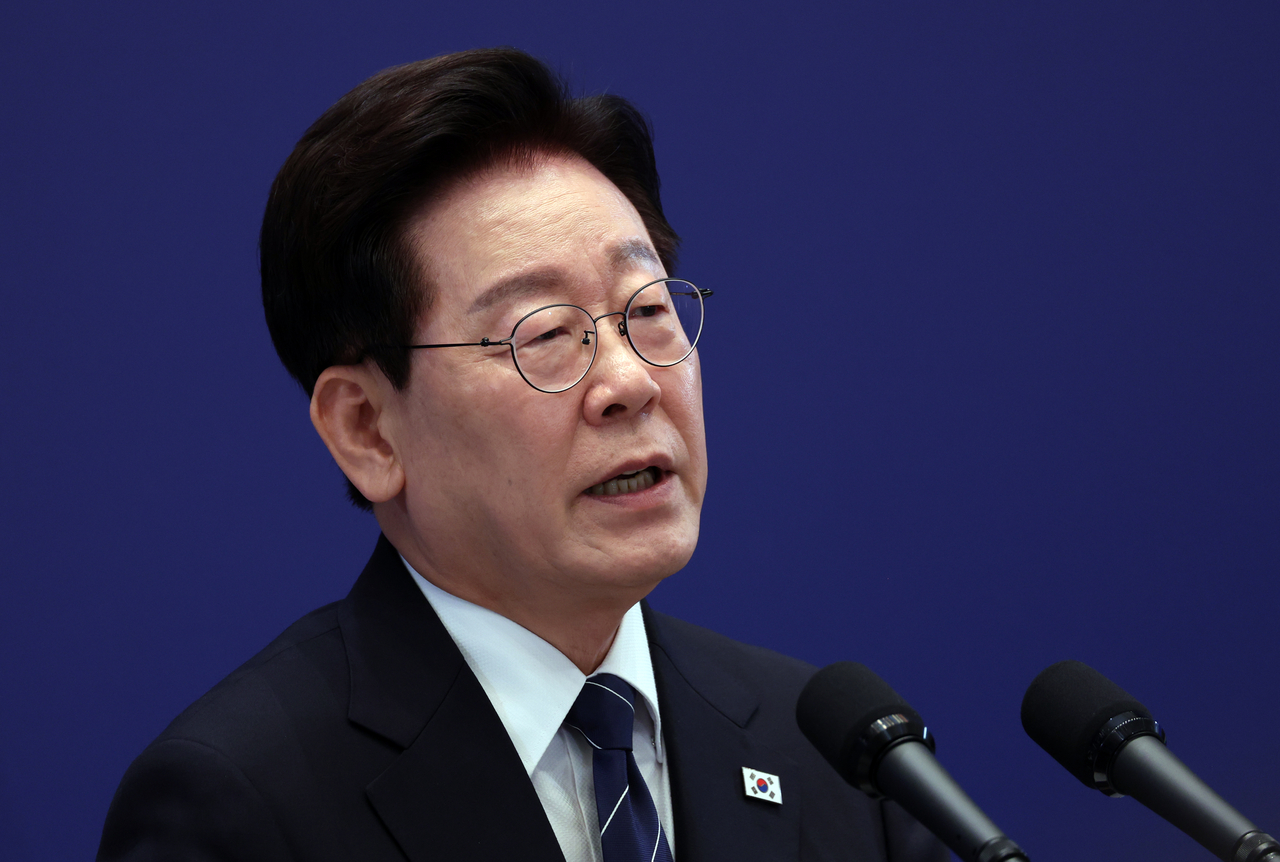
President Lee Jae Myung's approval rating rose to 34.8 percent, snapping a nine-week run of consecutive declines, a poll showed Monday.
In the Sept. 14-18 survey of 2,507 voters aged 18 and older, 34.8 percent gave a positive assessment of Lee's job performance, up 1 percentage point from the previous week.
Lee's approval rating had fallen for nine straight weeks after reaching 48.9 percent in the third week of July before reversing course in the latest survey.
His disapproval rating also edged up 0.1 percentage point to 63.4 percent, while 1.8 percent of respondents said they were unsure.
Realmeter attributed the rebound partly to Lee's latest press conference, saying controversies surrounding the vetting of government nominees and confirmation hearings had weighed on his ratings earlier in the polling period.
"The downward trend continued early in the week amid controversies over the vetting of government nominees and the fallout from confirmation hearings, but the trend appears to have reversed later in the week as the president stated his positions on major political issues, including reelection, the withdrawal of criminal charges and troop deployment, while emphasizing his commitment to overhauling state affairs," Realmeter said.
At Friday's press conference, his seventh since taking office, Lee sought to draw clear lines on several issues that had fueled political controversy in recent weeks. He said he had no intention of seeking reelection through a constitutional amendment and asked the National Assembly to remove a provision allowing the withdrawal of indictments from a proposed special counsel bill.
On the possibility of deploying South Korean troops to the Strait of Hormuz, Lee said there would be no deployment that could draw South Korea into an overseas conflict or war. He added, however, that Seoul was considering measures to strengthen efforts to protect South Korean nationals, commercial vessels and crude oil shipping routes in the region.
Lee also addressed criticism over recent personnel appointments, saying shortcomings on his part were responsible for the decline in his approval ratings and that his administration would review its personnel vetting system.
The rebound was particularly pronounced among younger voters. Lee's approval rating rose 5.4 percentage points among those in their 20s and 2.8 percentage points among those in their 30s. It also gained 2.9 percentage points among voters in their 60s.
By contrast, approval fell 2.3 percentage points among those in their 40s and 1.9 percentage points among those in their 50s.
Regionally, Lee's approval rating rose most sharply in Daejeon, Sejong and the Chungcheong provinces, gaining 3.9 percentage points. It increased 3.2 percentage points in Busan, Ulsan and South Gyeongsang Province and 2.2 percentage points in Incheon and Gyeonggi Province.
Approval, however, fell 4.1 percentage points in Gwangju and the Jeolla provinces.
By ideological orientation, Lee's approval rating rose 5.9 percentage points among progressive voters but fell 1.1 percentage points among conservatives.
A separate Realmeter survey, of 1,003 voters aged 18 and older conducted nationwide from Sept. 17-18, showed a shift in support for the country's two major parties.
Support for the ruling Democratic Party of Korea rose 4.1 percentage points from the previous week to 40.2 percent, while the main opposition People Power Party fell 3.6 percentage points to 38.5 percent.
This brought the gap between the two parties to 1.7 percentage point, within the survey's margin of error.
Realmeter said the Democratic Party's rise came from stronger support in the Seoul metropolitan area and among younger voters. It said the People Power Party's decline came amid weakening support among voters in their 20s and 30s as well as among centrist and conservative voters.
The presidential job approval survey had a margin of error of plus or minus 2.0 percentage points at a 95 percent confidence level and a response rate of 4.1 percent. The party support survey had a margin of error of plus or minus 3.1 percentage points at a 95 percent confidence level and a response rate of 3.5 percent.
Further details are available on the website of the National Election Survey Deliberation Commission.
mkjung@heraldcorp.com