President Lee Jae Myung called on South Korea and Central Asia to open a new 30-year chapter in their partnership, saying their complementary strengths could help each side meet the challenges ahead.
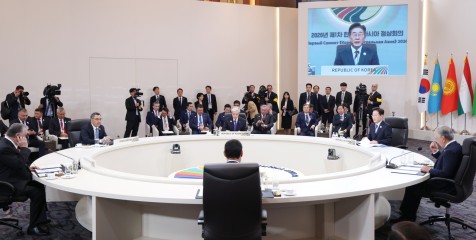
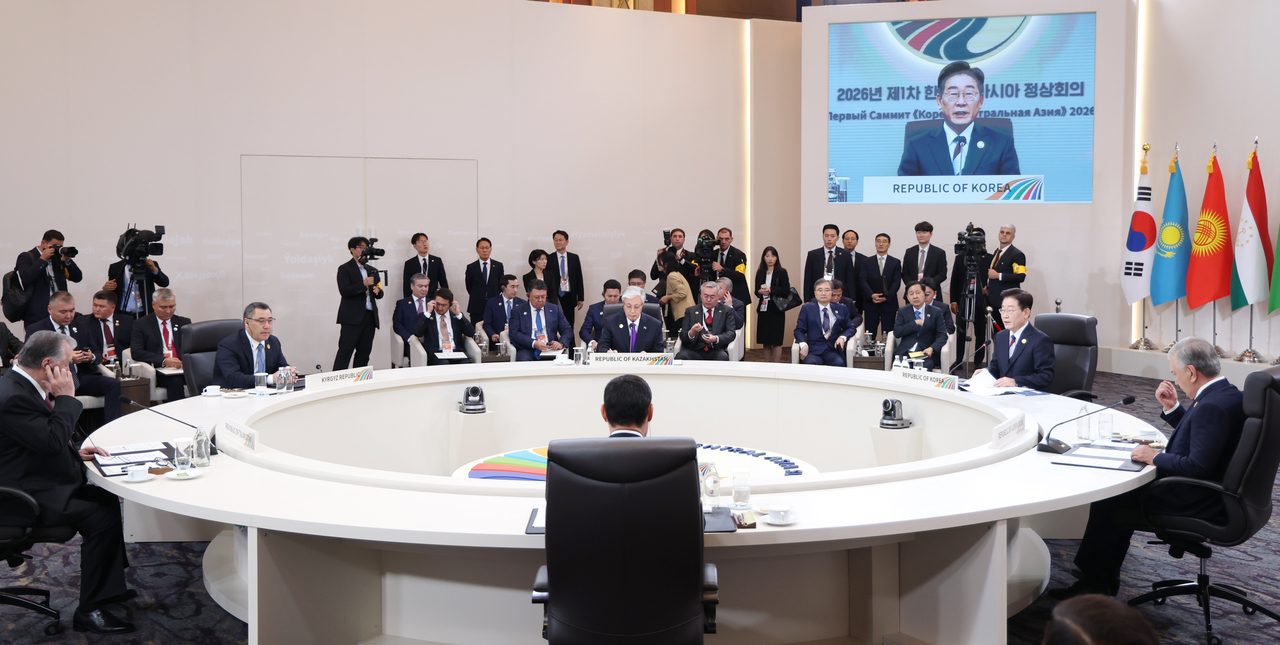
For the first time, the leaders of all five Central Asian countries gathered for the inaugural Korea-Central Asia summit in Seoul on Wednesday to map out a broad vision for the region’s partnership with South Korea.
Joining Lee in Seoul were Kazakhstan President Kassym-Jomart Tokayev, Kyrgyzstan President Sadyr Japarov, Tajikistan President Emomali Rahmon, Turkmenistan President Serdar Berdimuhamedov and Uzbekistan President Shavkat Mirziyoyev.
In his opening remarks, Lee underscored the significance of the inaugural gathering at a time when “the world is undergoing a transformation in which the economy and security are closely intertwined, from supply chains and energy to markets and technology.”
“The respective strengths of the Republic of Korea and Central Asia will offer boundless opportunities for us to work together to address our respective challenges,” Lee said.
“Above all, I am confident that when our cooperation expands beyond individual countries to the regional level, we can bring a future of shared prosperity closer.”
The summit capped three days of intensive diplomacy in Seoul, during which Lee held separate bilateral summits with the leaders of all five Central Asian countries before the inaugural regional meeting.
The gathering also marked the culmination of a gradual upgrading of South Korea’s ties with Central Asia over the more than three decades since the end of the Cold War.
Seoul launched the Korea-Central Asia Cooperation Forum in 2007 as a vice-ministerial-level regional dialogue, moving beyond bilateral engagement with individual countries toward cooperation with Central Asia as a region. The forum was elevated to the foreign ministerial level in 2020.
The summit represents the next step, bringing that regional framework to the heads-of-state level, while seeking to place Korea-Central Asia cooperation on a more sustained and institutionalized footing.
Lee underscored the summit's significance as an opportunity to “shape a new future and a new vision together.”
“We must now build on the foundation of cooperation laid over the past three decades and prepare together for a new 30 years ahead,” Lee said.
Lee further explained that “Korea and the five Central Asian countries have built broad cooperation and relations of trust across trade and investment, industry and infrastructure, education and culture based on longstanding historical ties.”
He invoked the history of the Koryo-saram diaspora, whose members were forcibly deported from the Soviet Far East to Central Asia under Stalin in 1937.
“Some 90 years ago, our Koryo-saram compatriots put down roots in Central Asia and began serving as a strong bridge connecting Korea and Central Asia,” Lee said.
“I hope today’s meeting will become an important milestone that leads to a new leap forward,” he added.
The Seoul Declaration, a key outcome of the summit, sets out a mid- to long-term vision for cooperation and provides a framework for sustained multilateral engagement between South Korea and the five Central Asian countries.
The inaugural meeting in Seoul grew out of a South Korean government’s proposal in June 2024 to create a leaders-level Korea-Central Asia forum, an initiative endorsed by all five countries.
Closer Korea-Central Asia cooperation reflects the complementary needs of the two regions and their shared interest amid a rapidly shifting geopolitical and economic landscape compounded by multifront wars.
South Korea seeks to diversify supply chains for critical minerals and expand into new markets, while Central Asian countries look to attract technology and investment, move beyond raw-material exports and broaden their external partnerships.
The regional format also allows the six countries to address cross-border issues that bilateral ties alone cannot easily resolve, including transport connectivity, customs, energy and climate-related challenges.
dagyumji@heraldcorp.com