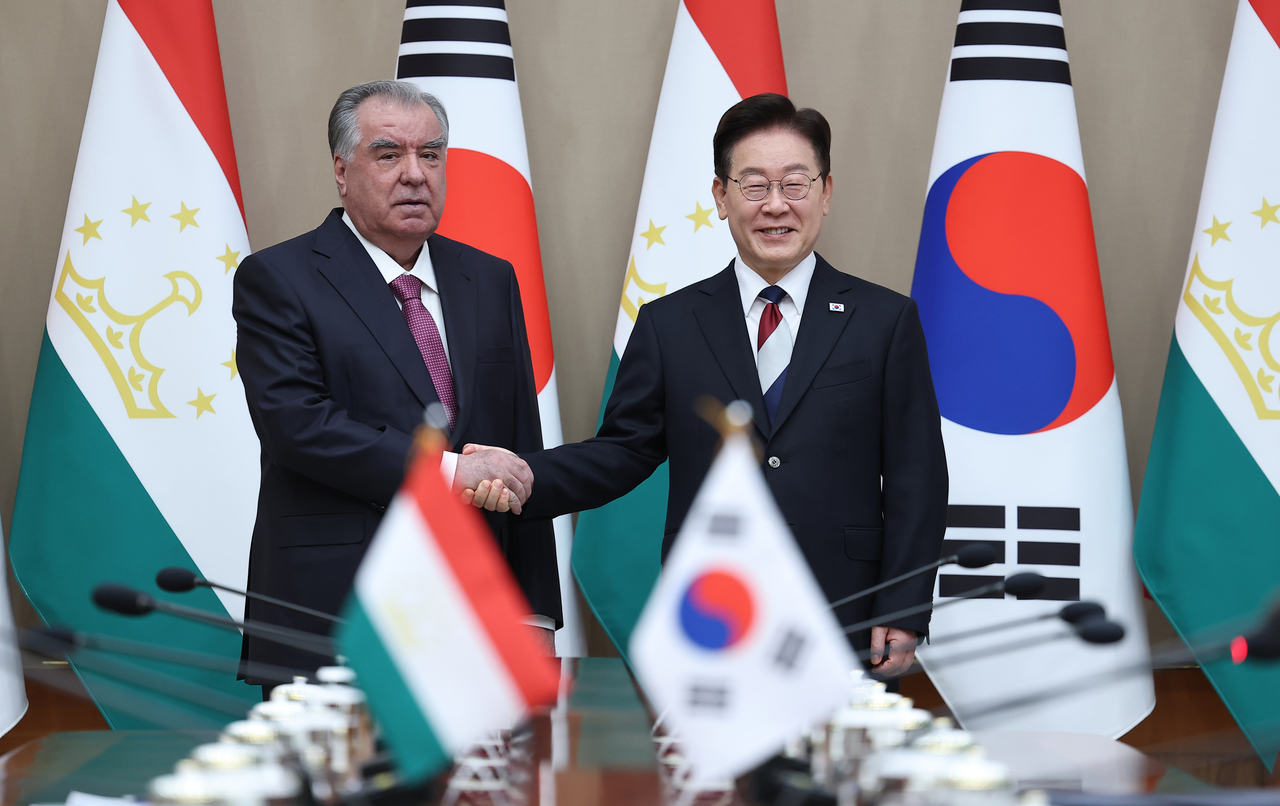
South Korea and Tajikistan established a comprehensive partnership Wednesday, elevating bilateral ties as Tajik President Emomali Rahmon made the first visit by a Tajik leader to Seoul in 11 years.
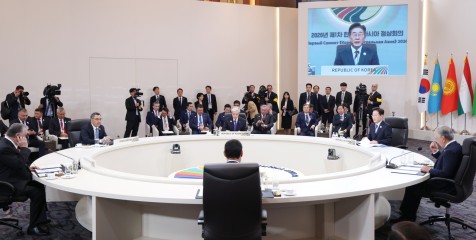
President Lee Jae Myung and Rahmon held a bilateral summit at Cheong Wa Dae in Seoul ahead of the first summit between South Korea and the five Central Asian countries.
Rahmon’s visit comes as the two countries approach the 35th anniversary next year of establishing diplomatic relations in 1992.
Seong Ghi-hong, senior presidential secretary for public relations and communication, said the leaders agreed to expand cooperation into trade and investment, railway and transport infrastructure, critical minerals, artificial intelligence and digital transformation, climate action and people-to-people exchanges in a written postsummit briefing.
Critical minerals formed another focus of the summit.
Seong explained that the leaders saw scope to build mineral supply chains by bringing together South Korea’s expertise in mineral exploration and development and Tajikistan’s rich resources, including antimony.
During the summit, Lee pointed to Tajikistan’s location linking Central and Southwest Asia, its abundant mineral resources and young population as sources of economic potential, pledging closer cooperation to support the country’s industrial upgrading, according to Seong.
“Korea, as a reliable partner, will actively cooperate for Tajikistan’s economic development,” Lee said during his opening remarks. “I hope our two countries will further expand mutually beneficial cooperation in areas including railways, critical minerals and digital technologies.”
Rahmon, in turn, described closer relations with Seoul as a priority for Dushanbe.
“Strengthening cooperative relations with Korea is one of the key priorities of Tajikistan’s foreign policy,” Rahmon said.
Rahmon also underlined the importance of the summit, noting that the peoples of the two countries are connected through historical ties, friendship and shared humanitarian values.
“Today’s summit will provide a good opportunity to discuss the current state of bilateral cooperation and its future prospects,” he said.
Rahmon also stressed that “establishing the legal and institutional foundations needed to elevate bilateral cooperation to a new level of partnership is an important and essential step.”
The two countries also signed 17 agreements and memorandums of understanding, laying the institutional groundwork for broader cooperation in key infrastructure, from railway and electricity networks to critical minerals, AI and transnational crime.
Among them, the two countries signed three railway-related memorandums covering railway policy and technology, modernization of urban and existing rail lines, workforce training, infrastructure management and cooperation on a planned urban railway project in Dushanbe.
Seong explained the leaders viewed the sector as particularly well suited to mutually beneficial cooperation, given landlocked, mountainous Tajikistan’s push to improve domestic and international connectivity and support economic growth.
Economic cooperation will extend into industry, advanced technology, critical minerals and energy.
The two sides agreed to cooperate in light industry, textiles, sericulture, leather processing, food and chemicals, while exchanging scientific and technological information and pursuing joint research in AI.
The two sides also signed a memorandum on broad industrial and innovation cooperation, aimed at sharing South Korea’s industrial technology and expertise in sectors such as textiles, chemicals, food and light manufacturing, while expanding exchanges in advanced technologies and joint research in AI.
The agreement is also intended to create new opportunities for Korean exports and help Korean companies expand into Tajikistan’s AI and digital sectors.
Trade, critical minerals and energy formed another pillar of the package.
Korea Electric Power Corp. agreed to cooperate on smart-grid technology, including remote metering infrastructure aimed at reducing power losses, power-grid digitalization and energy storage.
The Korea Trade and Investment Promotion Agency and Tajikistan’s export promotion agency signed a memorandum to establish a cooperation framework between the two countries’ export promotion agencies and help expand bilateral trade and investment.
Security cooperation will focus on transnational crime, reflecting Tajikistan’s more than 1,300-kilometer border with Afghanistan. South Korea’s National Police Agency and Tajikistan’s Interior Ministry agreed to share information and experience in combating terrorism, drug trafficking and cybercrime, as well as cooperate in fugitive investigations.
The two sides also agreed to exchange financial intelligence on suspected money laundering and terrorist financing and strengthen customs cooperation on customs valuation, origin verification and illicit trade.
Other agreements cover anti-corruption, civil-service administration, education, industrial safety and digital forest restoration using satellite and information and communication technology.
Bilateral ties developed at a more gradual pace than Seoul’s relations with some other Central Asian countries, but gained momentum under the Moon Jae-in administration through a series of high-level visits to Tajikistan.
The relationship was further institutionalized as Tajikistan opened its embassy in Seoul in 2015 and South Korea upgraded its mission in Dushanbe to a full embassy in March 2021.
dagyumji@heraldcorp.com