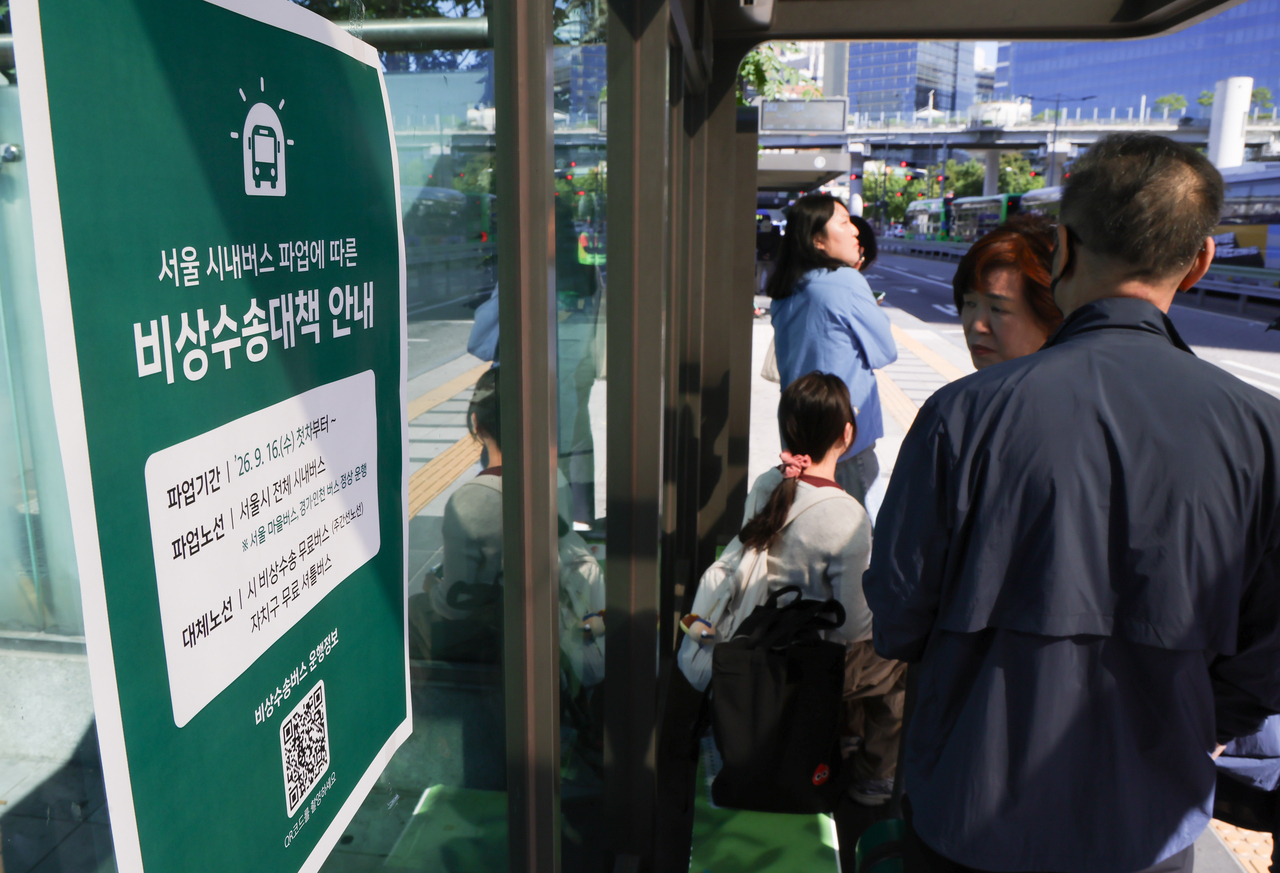
Seoul's city buses will stop running from the first departures Wednesday after the union and bus operators failed to reach a wage deal, setting up the capital's second citywide walkout in eight months.
Mediation at the Seoul Regional Labor Relations Commission in Yeongdeungpo-gu, western Seoul, broke down around 10 p.m. Tuesday, roughly eight hours after the two sides sat down. The Seoul Bus Workers' Union said it would begin a full strike at 4 a.m. Wednesday as planned.
Seoul's 64 private bus operators run a fleet of 7,383 buses on about 390 routes, carrying an average of more than 3.79 million passengers a day.
At issue is whether drivers' ordinary hourly wages should be calculated using 176 or 209 working hours a month. The lower benchmark produces higher hourly pay and, in turn, higher overtime, night and holiday allowances.
The union says a 176-hour benchmark used by the Seoul High Court in a lawsuit filed by employees of Dong-A Transportation, and left undisturbed by the Supreme Court in April, should apply across the city's bus companies. Operators and the Seoul Metropolitan Government say no industrywide standard was established and that related lawsuits are still pending.
The union is separately seeking a 7.85 percent increase in hourly wages. Operators have proposed restructuring the wage system in a way they say would lift overall pay by 10.32 percent.
The same dispute drove a 44-hour strike in January that ended without a settlement on the calculation method.
The Seoul Metropolitan Government will run up to 1,500 free shuttle buses, more than twice the number deployed in January. The city's 25 district offices will operate up to 1,300 of them between residential areas and subway stations, while the city government will directly deploy about 200 chartered buses on 10 major arterial routes, including Gangnam-daero, Tongil-ro and Dobong-ro.
The subway will add 202 trips a day, with peak service extended by two hours in the morning and evening and late-night service running until 2 a.m. Ttareungi public bicycles will be free during the strike, restrictions on village buses will be eased and curbside bus-only lanes will open to regular vehicles.
Schools have been asked to consider delaying start times by an hour, and private companies have been encouraged to use remote or flexible work.
yoohong@heraldcorp.com