The Korean staging tests how a musical rooted in Black and Latino New York — and built around Alicia Keys’ familiar songs — can travel

There are some inevitable hurdles to bringing the Broadway musical "Hell's Kitchen" to the Seoul stage as a Korean-language production.
Rooted in Alicia Keys’ music and her semi-autobiographical story of growing up in New York’s Hell’s Kitchen, the musical arrived in Seoul just two years after its Broadway opening as its first non-English-language licensed production. The Korean production, which opened July 24 at the GS Arts Center, offers an early test of what happens when a story so rooted in its original language and culture crosses both linguistic and cultural boundaries.
The first hurdle is the show's racial and cultural specificity. "Hell's Kitchen" doesn't treat its 1990s Black and Latino Manhattan Plaza community as period backdrop — it runs the culture through the show's vocal arrangements, its choreography, and numbers like "Perfect Way to Die," which addresses police violence directly.
A Korean cast performing characters who are black, white and mixed-race asks the audience to do work no subtitle can do for them: hold the characters' racial diversity as fact rather than feel it as texture.
The first hurdle, luckily, is eased by an audience already accustomed to the conventions of foreign musicals. Korean audiences have long been exposed to Broadway and other overseas musicals and are familiar with the theatrical convention that a performer's race does not always have to mirror that of the character.
Korea is becoming more diverse: people from migrant backgrounds accounted for more than 5 percent of the population as of the end of 2024. Yet that shift has not been fully reflected in the professional performing-arts pool, where genuinely racially diverse casting remains uncommon.
The second hurdle belongs to Alicia Keys's music. Her songs have been loved in Korea for a long time — and that familiarity can pose a challenge onstage. Rendering familiar lyrics into Korean risks more than losing nuance; it asks an audience to unlearn words they already know by heart.
The same problem applies to the songs themselves — "Fallin'," "If I Ain't Got You," "No one" "Girl on Fire," and "Empire State of Mind" arrive with decades of studio recordings attached. Any live restaging invites direct comparison to an original the audience is unlikely to forget mid-number.
The second hurdle is solved by giving new life to familiar songs.
The translated numbers do not always feel like compromises. “Fallin’,” for instance, is sung by Ali’s unreliable and absent father, Davis, and her single mother, Jersey, turning a song audiences may already know into something with a different emotional meaning. Other hits similarly find their own context and interpretation onstage, rather than simply reproducing the recordings audiences know.

One particularly good decision was to leave one song untranslated: “If I Ain’t Got You,” Davis’s ballad to Ali, stays in English. It’s a quiet way of solving the familiarity hurdle for the one song where the loss in translation would have been most conspicuous. Released in 2004, the hit may already carry memories and associations for audiences of its own. In "Hell's Kitchen," it acquires another layer of memory: Davis composed the song for Ali and used to sing it to her when she was younger, so when he sings it to her again now, it carries a private father-daughter history as well as a familiar pop song for the audience.
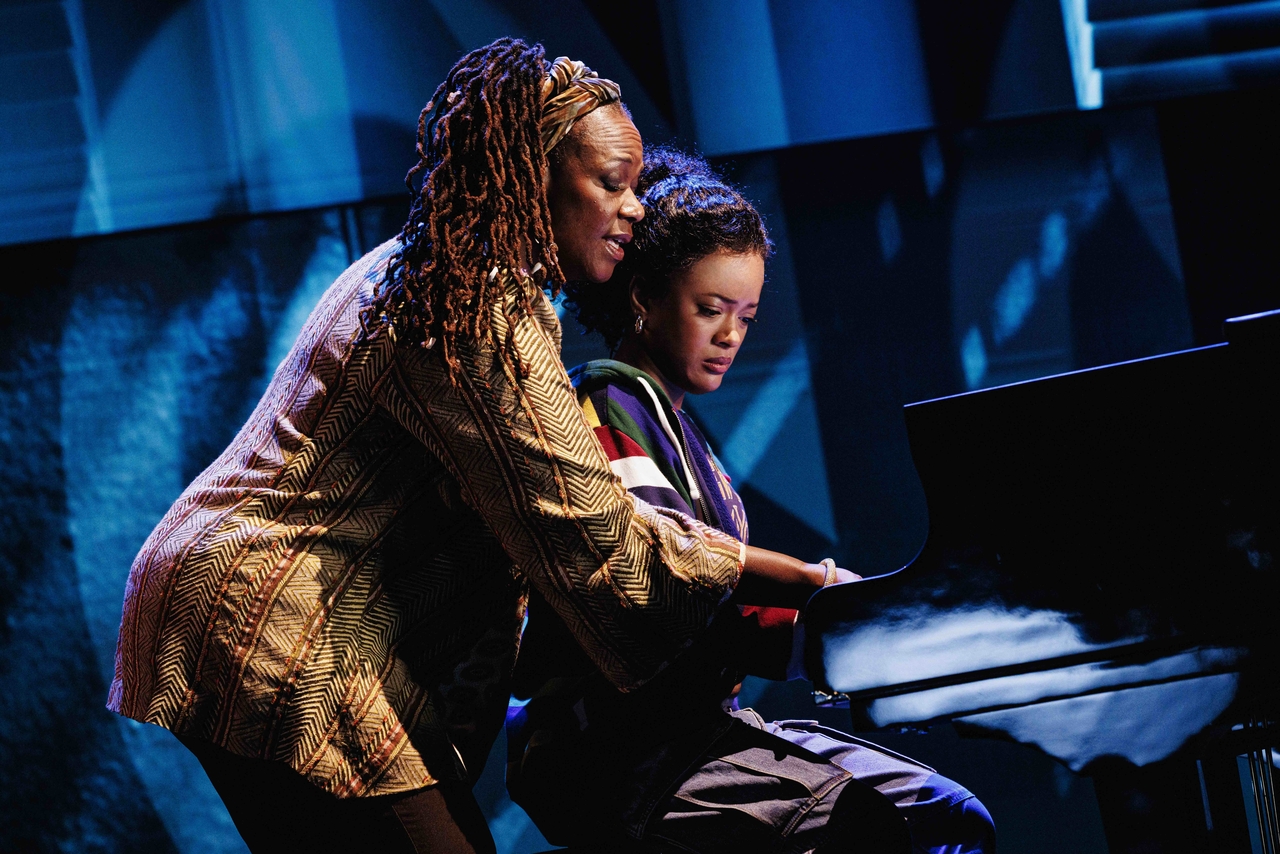
At Wednesday’s performance, Kim Soo-ha as Ali, Park Hye-na as Ali’s mother Jersey, Jung Young-joo as Miss Liza Jane and the ensemble made Ali’s coming-of-age story feel intimate and recognizable: the push and pull between a child and a parent, the influence of those who guide us, and the first relationships that make adulthood feel within reach. Many audience members were seen wiping away tears.
It is a story many can relate to, but perhaps not one theater creators are eager to put at the center of a musical — or one that would immediately bring an audience to the theater. A mother-daughter relationship on its own may seem too familiar, too ordinary, to provide enough dramatic tension without another hook — the mystery surrounding the father in “Mamma Mia!,” for example, or the mental illness and family trauma at the heart of “Next to Normal.”
Yet that may be precisely why there is something valuable about giving such ordinary experiences a place onstage: it is rare. Audiences may come for Keys’ music, but they may leave thinking about the parents, mentors and other people who helped shape who they became.
The Korean production of “Hell’s Kitchen” cannot reproduce every aspect of its original world literally — and perhaps it does not need to. What ultimately crosses the linguistic and cultural distance is not the world itself, but the emotional architecture built around it: the feeling of growing into yourself while trying to understand the people who shaped you.

gypark@heraldcorp.com








