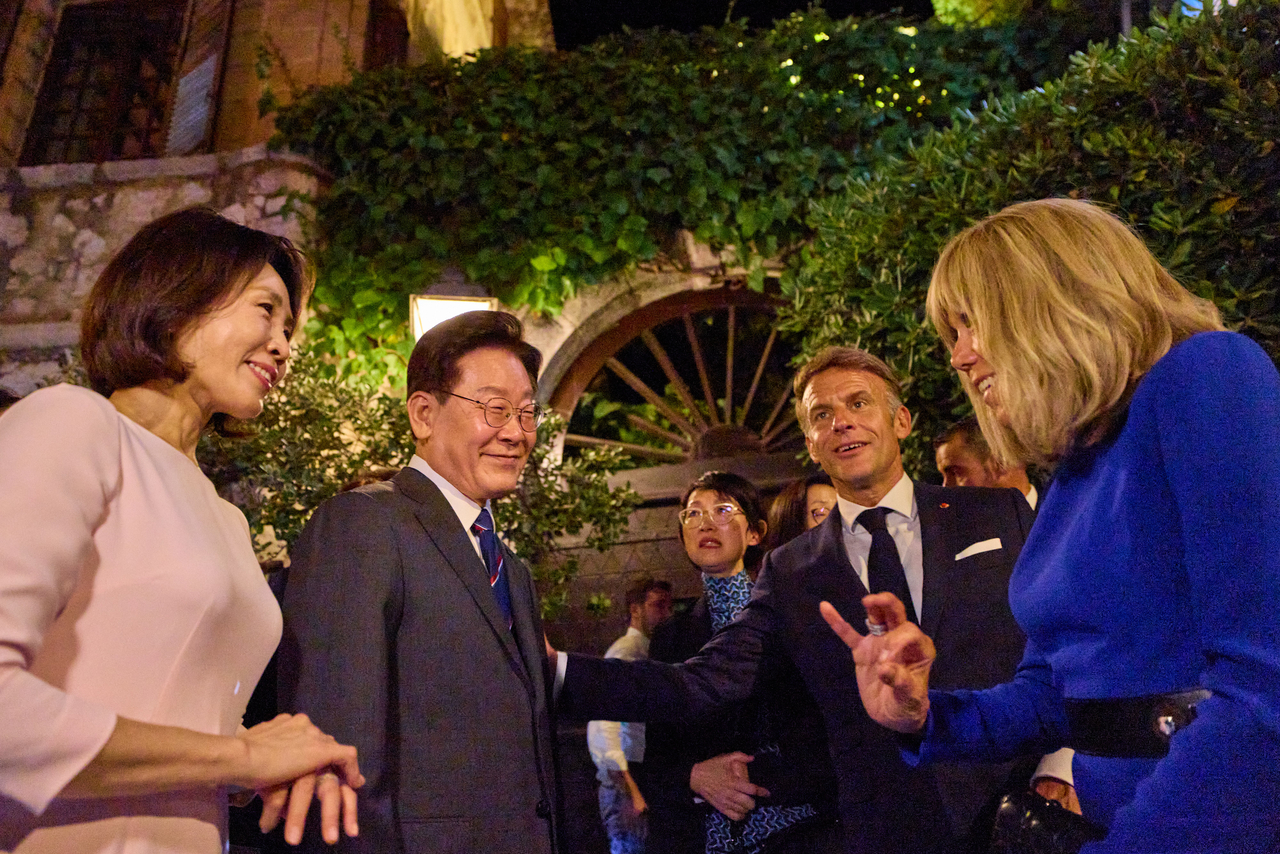
President Lee Jae Myung underlined South Korea’s pursuit of pragmatic and open cooperation among countries that share common values and work together across sectors to complement and advance the existing rules-based global order.
Lee laid out the approach in an interview with French newspaper Le Monde published Sunday, responding to French President Emmanuel Macron’s proposal for a “coalition of independents” during his state visit to Seoul in April.
Macron has advocated bringing together middle-power countries seeking greater strategic autonomy rather than dependence on either the United States or China.
Lee stressed the importance of “close cooperation among states, particularly among those that share common values such as democracy, human rights and the rule of law.”
Lee explained that the solidarity South Korea seeks is “pragmatic and open cooperation in which capable countries work together in specific areas to complement and further develop the existing international order.”
“We are also working to strengthen our capacity to defend ourselves by our own strength, while deepening and further developing our existing alliances in ways that reflect changing times and realities,” Lee said.
Lee is on a five-day visit to France, where he was set to co-chair the inaugural Lumiere Summit devoted to discussing the future of cinema and audiovisual industries, with Macron in Saint-Paul-de-Vence on Monday.
The Lee-Macron summit is set for Tuesday, with security, economic cooperation, artificial intelligence, nuclear energy and cultural ties among the areas expected to be discussed.
Lee explained his broader foreign policy as grounded in pragmatism, saying the approach seeks to “uphold the principle of promoting regional peace and prosperity while safeguarding the national interest, and to respond flexibly and adapt quickly to a changing environment.”
That approach, Lee suggested, extends to South Korea’s alliance with the US at a time when President Donald Trump has pressed allies to shoulder greater responsibility for their own defense.
Lee said he did not view Trump’s calls as calling into question the “durability of the alliance,” underling that the alliance is evolving into a “comprehensive strategic, future-oriented” partnership, such as cooperation in shipbuilding and the global artificial intelligence ecosystem.
“Rather, I see in his approach a willingness to move beyond a traditional conception of the alliance in order to adapt it to the realities of a changing era,” Lee said.
In this context, Lee further explained that his administration “is working to strengthen the role and responsibilities of the Republic of Korea within the alliance, notably by increasing our defense spending and progressively strengthening the military capabilities essential to our security.”
Lee’s summit with Macron is also drawing attention as Seoul weighs possible contributions to international efforts to safeguard freedom of navigation through the Strait of Hormuz, a critical energy choke point through which roughly 70 percent of South Korea’s crude oil imports pass.
The Lee administration has said it is reviewing a range of possible contributions, including military options, but that no decision has been made. Officials have said any military contribution would have to take into account South Korea’s defense readiness against nuclear-armed North Korea as well as domestic legal requirements.
Under South Korean law, even the dispatch of one or two military personnel would constitute an overseas troop deployment and require National Assembly consent.
France, together with the United Kingdom, has been spearheading efforts to establish a defensive multinational maritime mission aimed at protecting civilian shipping, conducting mine-clearance operations and restoring freedom of navigation through the strategically vital waterway.
The issue could therefore figure in Tuesday’s summit, particularly after Lee and Macron agreed during their April meeting in Seoul to cooperate in efforts to ensure safe passage through the Strait of Hormuz.
On North Korea, Lee reiterated his commitment to reviving long-stalled dialogue while acknowledging that years of mistrust could not be overcome quickly.
“I do not think that, with a few gestures and overnight, we can bring down the walls of mistrust that have been built up over many years,” Lee said.
Lee referred to his Aug. 15 Liberation Day address, in which he laid out three principles for peaceful coexistence on the Korean Peninsula: “inclusive peaceful coexistence” based on mutual respect; “stable peaceful coexistence” that makes confrontation unnecessary; and “responsible peaceful coexistence” that contributes to global peace.
Lee also reaffirmed his intention to “encourage the resumption of exchanges between North Korea and the United States by playing the role of a ‘pacemaker,’” referring to a facilitator who helps keep diplomacy moving.
Lee said he viewed the process as a means “to examine concrete and effective measures to put an end to the strengthening of North Korea’s nuclear capabilities.”
dagyumji@heraldcorp.com