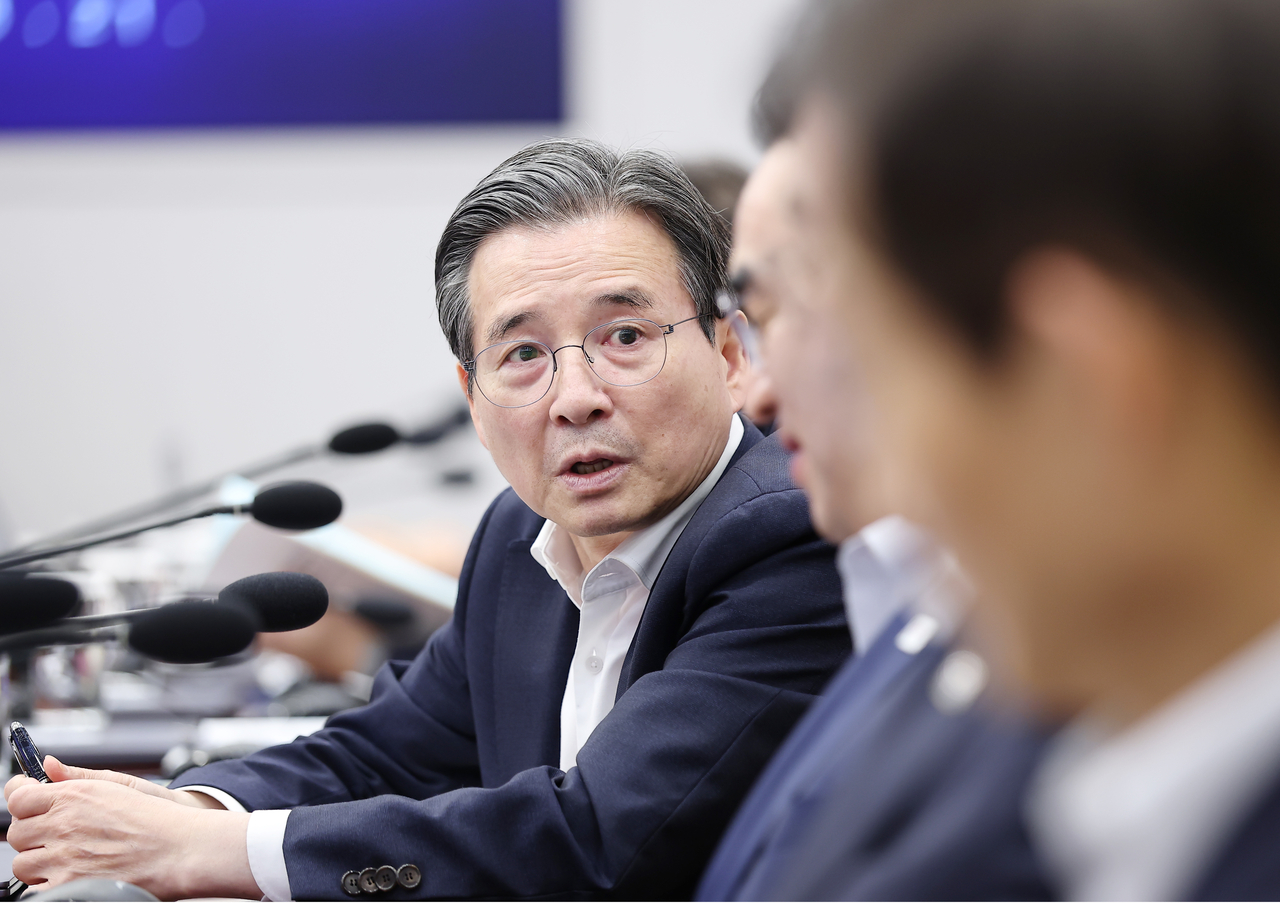
President Lee Jae Myung has accepted the resignation of Kim Yong-beom, his top policy adviser and a key architect of the administration’s economic and financial agenda, Cheong Wa Dae announced Tuesday.
Senior presidential spokesperson Kang Yu-jung said Kim tendered his resignation Monday and that Lee accepted it the following day during a morning briefing.
A senior Cheong Wa Dae official later in the day placed Kim’s departure in the broader context of Lee’s Cabinet reshuffle on Sunday, which replaced six ministers, including the ministers of finance and economy as well as land, infrastructure and transport.
The official, speaking to reporters on condition of anonymity, cast Kim’s resignation as “a move to accelerate the revitalization of the administration’s second-term economic policy team.”
“The average tenure of Cheong Wa Dae aides is roughly 14 to 18 months,” the official explained. “This can be seen as a reshuffling of the presidential staff aimed at keeping policy implementation on track.”
The reorganization comes at a delicate juncture, with the government confronting a range of economic and financial challenges, including high interest rates, persistent inflation and a weak won, while also seeking to stabilize the housing market through expanded supply and tax measures.
Asked when a new presidential chief policy secretary would be named, the official said, “We plan to move forward with a successor appointment to ensure there is no disruption to the administration of state affairs.”
Kim’s is the first of Lee’s three most senior presidential aides — the chief of staff, chief policy secretary and national security adviser — to leave their post since the administration kicked off in June 2025.
Kim had served as Lee’s chief policy secretary since his inauguration, overseeing economic policy at home and abroad across industry, finance, trade and housing.
Kim spearheaded South Korea’s tariff negotiations with the United States and played a central role in mapping out the Lee administration’s three flagship megaprojects in semiconductors, physical artificial intelligence and AI data centers, drawing massive private sector investment.
The abrupt nature of Kim’s departure, announced at an unusually early, hastily arranged briefing shortly before a Cabinet meeting, has raised questions over the circumstances surrounding the decision.
His resignation notably came just after the government cleared one of its biggest annual policy hurdles, with the Cabinet approving next year’s budget proposal Tuesday, effectively allowing Kim to step down from the post.
But his departure also follows months of mounting political pressure over a series of economic and financial policy controversies, as well as differences between Cheong Wa Dae and the ruling Democratic Party of Korea over proposed changes to real estate taxation.
Kim faced particularly fierce criticism, as well as a criminal complaint, over the introduction of single-stock leveraged exchange-traded funds tied to Korean chip giants Samsung Electronics and SK hynix. The products that launched in late May are designed to deliver multiples of the daily gains or losses of a single stock.
Critics and opposition politicians accused the government of opening the door to highly speculative products that amplify volatility in the domestic stock market and expose individual investors to heavy losses.
Kim also came under fire following the government’s Aug. 3 announcement of proposed changes to real estate taxation.
The main opposition People Power Party has stepped up its attacks on Kim, arguing that the measures fueled uncertainty in the housing market, imposed excessive tax burdens on actual homeowners and could encourage speculative demand.
The dispute came amid growing public discontent over the government’s housing policy, the issue has dragged down feelings on the job Lee is doing. His approval rating fell to 38.9 percent in a Realmeter poll released Monday, dropping below 40 percent for the first time after seven consecutive weeks of decline. Worsening sentiment over housing policy has been cited as a key factor behind the slide.
The opposition repeatedly called for Kim to step down, arguing that a series of policy missteps had eroded confidence in the administration’s handling of the economy.
However, the main opposition People Power Party said Tuesday that Kim’s resignation alone was not enough.
“This is not something that should end with his resignation,” People Power Party Chair Rep. Jang Dong-hyeok said. “The single-stock leveraged ETFs were Kim Yong-beom’s creation. The stock market was turned into a gambling den, ordinary people saw their savings drained and only securities firms made money.”
Rep. Na Kyung-won also criticized Kim’s resignation, saying it amounted to an attempt to evade responsibility.
“Although this is the first resignation by a senior presidential aide in the Lee Jae Myung administration, it is not merely long overdue,” Na said. "It is a cowardly resignation aimed at escaping responsibility."
dagyumji@heraldcorp.com