The Korea Arboreta and Gardens Institute is building partnerships with private companies to turn corporate environmental, social and governance commitments into measurable biodiversity and forest restoration projects.
Rather than relying on companies solely for financial sponsorship, the public institution is combining their technologies and resources with its expertise in native plants, seed conservation and ecosystem recovery.
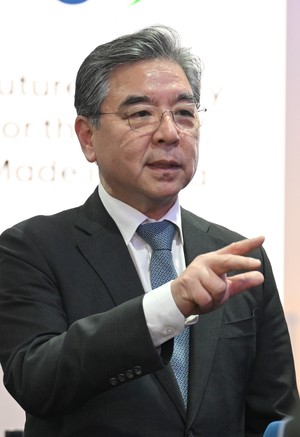
“Partnerships with private companies go beyond simple sponsorship,” KoAGI President Shim Sang-taek said. “They connect corporate ESG practices with the creation of public ecological value.”
A key example is the development of the “K-Seed Ball” with Hyundai Motor Group and Seoul National University researchers.
Seed balls typically contain seeds wrapped in soil and other materials, allowing them to be dispersed over areas that are difficult to reach. KoAGI’s version is shaped like a "jegi," a traditional Korean shuttlecock, to improve landing and planting accuracy in mountainous terrain.
Researchers tested the seed balls in June using drones as part of a project to restore 20 hectares of forest damaged by wildfires in Uljin, North Gyeongsang Province.
The project follows a 2024 agreement among KoAGI, Hyundai Motor Group and social venture Tree Planet. Field research has also involved Hyundai’s Ioniq 9-based Drone Station concept.
KoAGI plans to conduct further field trials in large wildfire-damaged areas, with the goal of overcoming the limits of conventional spherical seed balls and developing a model suited to Korea’s steep terrain.
The institute is also working with the Hope Bridge Korea Disaster Relief Association on a three-year restoration project in Cheongsong, North Gyeongsang Province.
Under the Green Hope program, 40 university students will receive 80 hours of training between 2026 and 2029 at a 4-hectare wildfire-damaged site and the Baekdudaegan National Arboretum.
Participants will assess the site and design a restoration plan during the first year. In the second year, they will take part in planting, seeding and fieldwork before monitoring ecological changes and managing the restored site in the final year.
“Forest restoration does not end with planting trees,” Shim said. “Companies and the public need to participate in the restoration process and be able to see its results.”
KoAGI has pursued other corporate partnerships in biodiversity education and garden technology.
Last year, it worked with Yuhan-Kimberly to hold a three-day Green Camp for 80 university students. The program included biodiversity lectures, a special exhibition on Korean fir trees, mentoring, team discussions and nature-observation activities.
The Green Camp has expanded steadily since its launch in 2022, when it was held as a one-day program for 20 participants. It drew 42 students in 2023 and 60 in 2024 before shifting to the residential format last year.
With Korean cryptocurrency exchange operator Dunamu, KoAGI developed a digital healing garden for the 2025 Seoul International Garden Show at Boramae Park in southern Seoul. The project combined digital platforms with therapeutic garden programs, with the facility later relocated to the Korean National Garden Culture Center.
KoAGI is also working with Hyundai Motor Group on monitoring forest restoration, an area Shim views as critical to ensuring corporate biodiversity projects produce lasting ecological benefits.
Alongside restoration programs, the institute is helping companies test and commercialize technologies for forestry and garden management.
Through its K-Testbed program, launched in 2021, KoAGI has completed 48 demonstrations involving products such as soil conditioners and autonomous grass-cutting robots.
Three technologies, including a cellulose-based soil conditioner, were selected as innovative products by the Public Procurement Service, while two received national excellent-product designations.
The commercialization rate for technologies transferred by the institute rose 7.4 percentage points from a year earlier to 56.5 percent.
“Another important role is to take the value of forest biological resources beyond conservation and develop technologies that can be used in the field,” Shim said. “By testing and commercializing them with companies, we can create new value from those resources.”
KoAGI plans to expand its corporate partnerships across wildfire restoration, biodiversity conservation and climate adaptation while developing a broader model linking public expertise with private-sector innovation.
“When the expertise of public institutions meets the technology and resources of private companies, we can create a sustainable conservation model,” Shim said.
kwonhl@heraldcorp.com