HIT Forum keynote speaker Alexander Treves says wider earnings growth and tangible Value-Up results are essential for durable foreign inflows
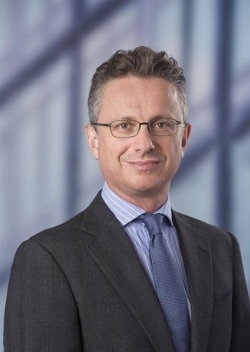
J.P. Morgan Asset Management says Korea must turn its semiconductor-led surge into a broader “Korea rally” to attract foreign capital that stays beyond the memory cycle.
“A trigger for more durable inflows would be evidence of broader earnings growth across non-memory tech, industrials, financials and consumer. In other words, a ‘Korea rally’ rather than a ‘memory rally,’ along with a wider uplift in turnover,” Alexander Treves, managing director at J.P. Morgan Asset Management and head of investment specialists for its Emerging Markets and Asia Pacific Equities team, said in a written interview with The Korea Herald.
Treves remains bullish on Korean equities over the longer term, citing improvements in corporate quality, technological innovation, more diverse business models and corporate governance.
In the near term, however, he said the market must become less dependent on Samsung Electronics, SK hynix and other technology giants.
“When index returns are driven by a narrow set of mega-caps, many global active managers run into concentration limits and risk-budget constraints,” he said.
Korea’s semiconductor dominance is itself a source of structural risk because it leaves the broader market heavily exposed to swings in the global chip cycle.
“Korea’s semiconductor dominance is a meaningful source of market-level concentration and cyclicality risk,” Treves said.
Where the rally could broaden
Treves sees opportunities beyond technology hardware in defense, shipbuilding and biotechnology, which are benefiting from export demand and favorable domestic conditions.
Financial stocks could gain from Korea’s Value-Up reforms, share buybacks, higher dividends and relatively low valuations. Power and electrical infrastructure companies stand to benefit from the expansion of artificial intelligence and data centers.
K-beauty companies, department stores and luxury consumption stocks are also supported by the domestic wealth effect and an increase in inbound tourism, he said.
These sectors could help turn Korea’s semiconductor-driven market advance into a broader rally, improving market breadth and making the country more attractive to global investors facing limits on concentrated exposures.
That does not mean the semiconductor cycle has run its course. The outlook for Samsung Electronics and SK hynix remains closely tied to whether the AI investment boom can be sustained.
“Currently, the most important durability signal for the AI cycle is hyperscaler and data-center capital expenditure,” Treves said.
Investors are also watching whether chipmakers maintain supply discipline and memory prices remain supportive.
“As long as capex momentum, supply tightness and memory pricing are intact, the outlook for these stocks remains robust,” he said.
A slowdown in AI-related investment, faster-than-expected supply growth or weakening memory prices would pose risks to the earnings cycle and Korea’s broader market momentum.
Reform must show up in results
Beyond individual industries, Treves said the durability of Korea’s rally will depend on stronger corporate earnings, better capital allocation and a willingness to share profits with investors.
“Ultimately, the duration of market gains will rest on a combination of corporate profitability growth; evidence that management teams are making good decisions around reinvesting in growth; and, in parallel, the willingness of companies to share their profits with investors,” he said.
Korea’s Value-Up initiative could become a structural catalyst for a market rerating, but only if companies translate reform pledges into measurable action.
“Korea’s ongoing rerating case becomes more convincing when shareholder returns show up in outcomes rather than headlines,” Treves said.
He pointed to completed share buybacks, treasury-share cancellations and sustained dividend growth as evidence investors want to see.
For foreign investors, implementation matters more than further announcements. Stronger board oversight, greater transparency and accountability, and more disciplined capital allocation will be needed to narrow the long-standing “Korea discount,” he said.
Treves said the government should create conditions that allow companies to thrive without dictating how individual businesses are managed.
“The optimal approach can involve the government enabling the conditions for a thriving corporate sphere, and then stepping back and allowing private-sector management teams to run their businesses,” he said.
Further upside possible
Treves remains constructive on Korean equities in the second half, supported by the AI and memory earnings cycle, strong exports and capital market reforms.
MSCI Korea is trading at low forward price-to-earnings multiples, although Treves cautioned that its valuation discount must be viewed in the context of the index’s cyclical composition.
The question is whether Korea’s earnings cycle can last long enough — and spread widely enough — to justify a sustained premium.
“If the earnings cycle has longer duration — with AI-related demand and reforms sustaining a more structural improvement in profitability and capital discipline — the foundations are in place for a constructive stance with room for further upside,” he said.
Treves will deliver the global keynote address at The Korea Herald’s 2026 HIT Forum on Sept. 8 at the Korea Chamber of Commerce and Industry in Seoul.
Held under the theme “Korea Premium: Connecting Korean Opportunities with Global Capital,” the forum will bring together Korean and global market experts to discuss what would strengthen Korea’s appeal as a long-term investment destination. Following his keynote, Treves will join a panel discussion titled “Korea Premium: What will make global capital stay?”
ch0221@heraldcorp.com