One of the year's most anticipated meteor showers will be lighting up Korea's night skies this week, with particularly favorable viewing conditions as its peak coincides with a new moon.
The Perseid meteor shower will reach its calculated peak at around noon Thursday, according to the Korea Astronomy and Space Science Institute. While the peak itself will occur during daylight hours in Korea, stargazers will have two good opportunities to catch the display: from Wednesday night into early Thursday morning and again from Thursday night into early Friday morning.
Under ideal conditions, as many as 100 meteors per hour could be visible, according to estimates from the International Meteor Organization. The figure, however, assumes a dark sky with minimal light pollution, meaning the actual number visible from urban areas is likely to be considerably lower.
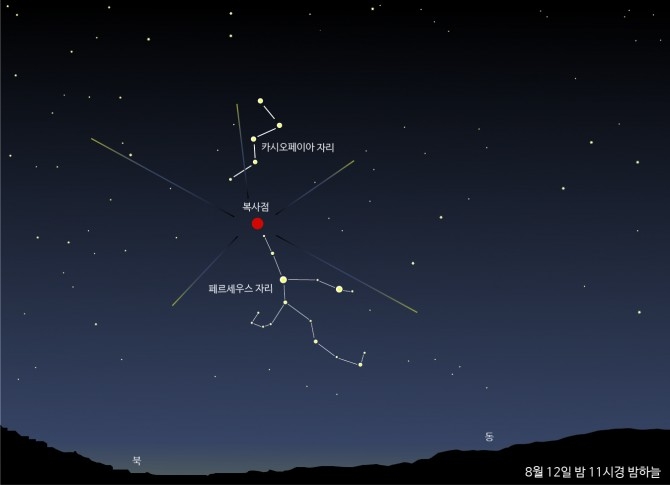
How to get the best view
Experts and NASA recommend finding a dark, open area away from city lights and observing the shower with the naked eye rather than through a telescope or binoculars, which can narrow the field of view.
For those unable to escape Korea's city lights, the Gwacheon National Science Museum plans to livestream the Perseids on YouTube from Wednesday night into Thursday morning.
The Perseid meteor shower is one of several astronomical events unfolding this week. Six planets – Mercury, Jupiter, Mars, Uranus, Saturn and Neptune – appeared above the horizon in Korea's predawn sky Wednesday.
A total solar eclipse will also take place early Thursday Korea time, though it will not be visible from Korea. Totality will instead be visible along a narrow path crossing parts of Greenland, Iceland and Spain.
tammy@heraldcorp.com