Allegations of political interference by the religious sect Shincheonji have once again risen, this time engulfing the ruling Democratic Party of Korea’s leadership race after former Prime Minister Kim Min-seok vowed to prevent interference by the religious group.
Kim first raised the issue on July 19, describing the leadership race as a confrontation with disguised anti-Lee Jae Myung forces, divisive factionalism and Shincheonji.
“The essence of this convention is ultimately a major battle against disguised anti-Lee divisiveness and Shincheonji,” Kim said.
At a seminar held at the National Assembly in Seoul on Saturday, Kim again stressed the need to sever improper ties between political parties and religious organizations, and to prevent organized groups from distorting party elections.
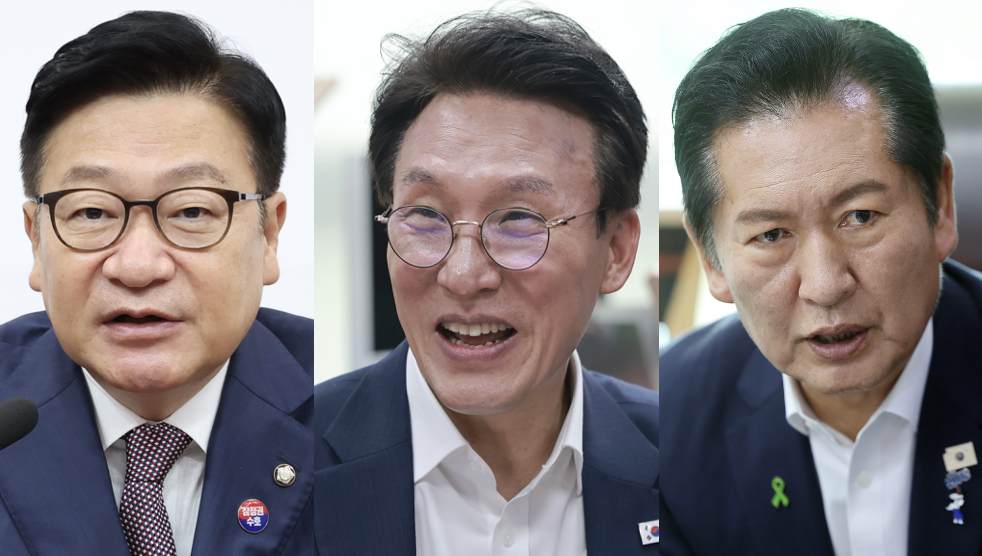
Kim, who stepped down as prime minister to enter the race, has said he has substantive grounds for the allegations, though he has yet to disclose evidence publicly. He is contending with Reps. Jung Chung-rae and Song Young-gil, each of whom formerly led the party.
Kim’s claims come as a joint prosecution-police investigation team examining suspected ties between religious organizations and political circles has reportedly detected signs that some Shincheonji members joined the Democratic Party in an organized manner.
According to local reports, investigators suspect that Shincheonji officials and members in parts of the Greater Seoul area — comprising the capital, Gyeonggi Province and Incheon — sought political assistance with administrative matters. Allegedly, they sought to secure approval to change the designated use of commercial buildings so they could be used for religious activities.
It has not been publicly established whether Shincheonji’s central leadership ordered the alleged membership drive or whether it was intended to support a particular candidate.
Kim’s main rival, Jung, has long been associated with former President Moon Jae-in and is often described as being outside President Lee’s core political circle.
Should the allegations be substantiated, they could place additional pressure on Jung, who championed the one-person, one-vote system being used for the first time in the Aug. 17 leadership election.
Under the new system, ballots cast by national delegates and dues-paying party members carry equal weight. Previously, a delegate’s vote was worth about 17 times that of a dues-paying member.
There is no publicly disclosed evidence that Jung was involved in the alleged drive or introduced the system to secure votes from Shincheonji members. Jung has also called on the party to cut any ties with Shincheonji and demanded that Kim produce evidence.
Within the party, only figures aligned with Jung, including Supreme Council candidates Reps. Choi Min-hee, Han Min-soo and Lee Seong-yoon, have similarly challenged Kim’s allegations.
The main opposition People Power Party, meanwhile, has also seized on the dispute to increase pressure on the ruling bloc.
“An allegation made by someone who served as prime minister until recently cannot be taken lightly,” People Power Party Floor Leader Rep. Jeong Jeom-sig said.
“The joint investigation team must immediately begin investigating allegations that Shincheonji interfered in the Democratic Party’s national convention,” he added, urging Kim to disclose his evidence.
In response, Democratic Party veteran Rep. Park Jie-won supported Kim, saying he had a responsibility to substantiate his claims.
“Kim Min-seok is not someone who makes things up,” Park said in a radio interview Wednesday. “If Shincheonji also entered our party, that must be uncovered.”
The allegations are not the first involving a suspected Shincheonji attempt to influence party politics.
The group’s founder, Lee Man-hee, was indicted under detention in June on charges of forcing at least 56,400 followers to join the People Power Party between 2021 and 2024 to influence its presidential and parliamentary primaries.
The case is also part of wider scrutiny of ties between religious organizations and political parties in South Korea.
Separate allegations involving the Unification Church gained national attention in July 2025, when a special counsel investigating former first lady Kim Keon Hee raided the church’s headquarters and the office of then-People Power Party Rep. Kwon Seong-dong over suspected political favors and illegal funding.
The investigation later expanded into allegations that church members were mobilized to join the People Power Party ahead of its 2023 leadership election.
flylikekite@heraldcorp.com