During forum, Lee repeatedly stresses urgency of cooling overheated housing market, warns of long-term consequences
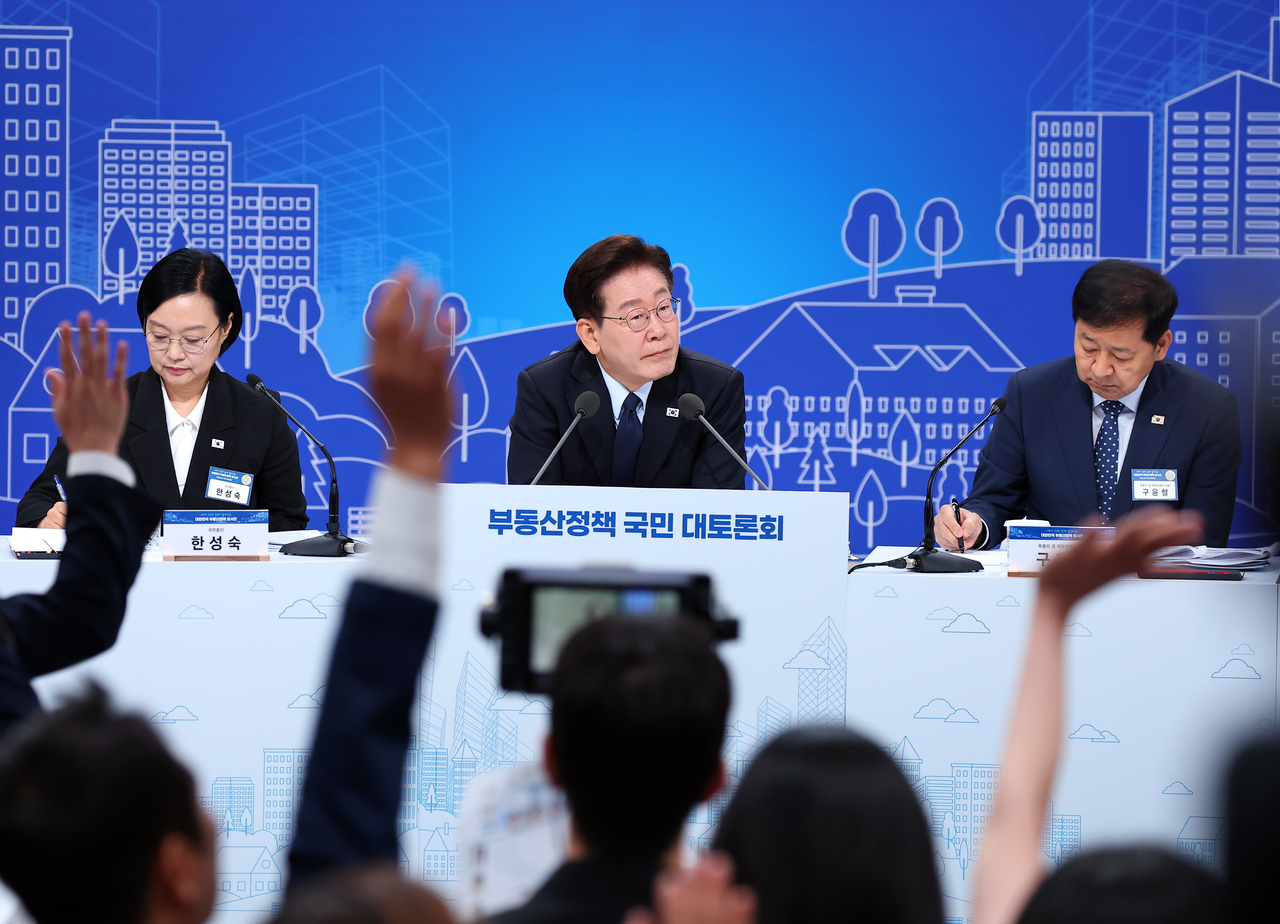
President Lee Jae Myung pledged to push ahead with housing policy reforms despite expected “conflict and resistance” and even at a “political cost,” warning that without urgent action, a property bubble could plunge South Korea into decades of economic stagnation.
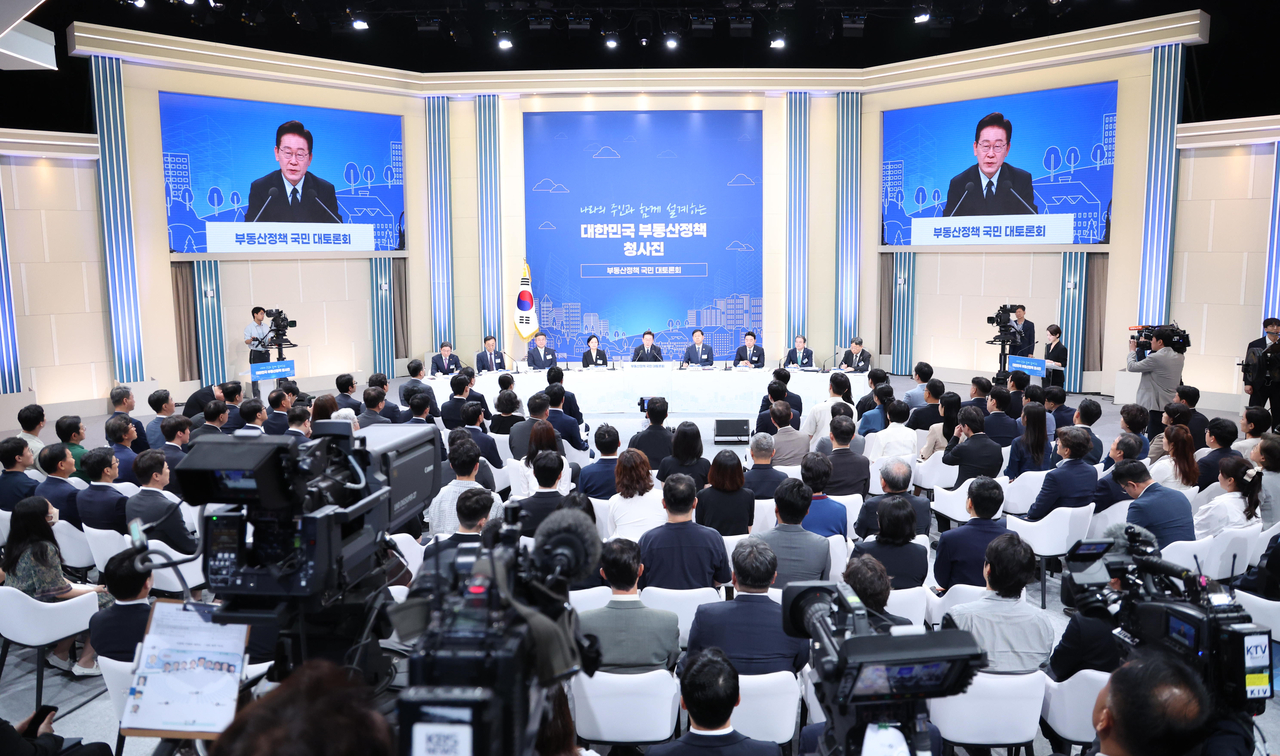
Speaking at a 195-minute, live-broadcast policy forum Thursday, Lee weighed changes to property holding and capital gains taxes and mortgage lending rules as his government moves to overhaul real estate policy to curb speculative demand and stabilize the housing market.
The president noted that real estate accounts for the largest share of South Korean household assets, calling the issue “one of the Republic of Korea’s greatest challenges.”
Lee pointed to Japan as a cautionary example, saying that limited land and the concentration of population and demand in particular areas had fueled a prolonged rise in property prices.
“Japan once went through a difficult period. Prices continued to rise until they eventually reached a certain limit, and then the so-called bubble burst, just like a balloon,” Lee said during the forum. “That is why people began talking about ‘lost 20 years’ or ‘lost 30 years.’”
Lee said there were growing concerns that South Korea could be heading toward a similar tipping point.
“Quite a few people worry that we, too, may be racing toward that peak,” Lee said. “There is broad public agreement that some form of action is necessary. That is what makes this issue so difficult.”
Lee traced the problem in part to a shift in the role of housing from a basic necessity into a vehicle for accumulating wealth.
“A home should be a physical space where a family can live comfortably and one that is reasonably accessible,” Lee said. “But at some point, it seems to have become not only a place to live but also a means of making money.”
Lee said he would “bear responsibility commensurate with the authority exercised” as he pushes ahead with housing policy reforms.
“I have always believed that the greatest virtue of a public official is taking responsibility. There are times when one must endure criticism, as well as a certain degree of conflict and resistance,” Lee said.
Lee underlined that "elected officials are given considerable authority to reconcile competing interests among the public,” while cautioning that "such power must not be wielded indiscriminately.”
“Of course, I will not decide this solely based on majority opinion. But it is extremely important to listen to the public,” Lee said. “If the majority view is reasonable, we should of course follow it, even in the face of conflict and resistance.”
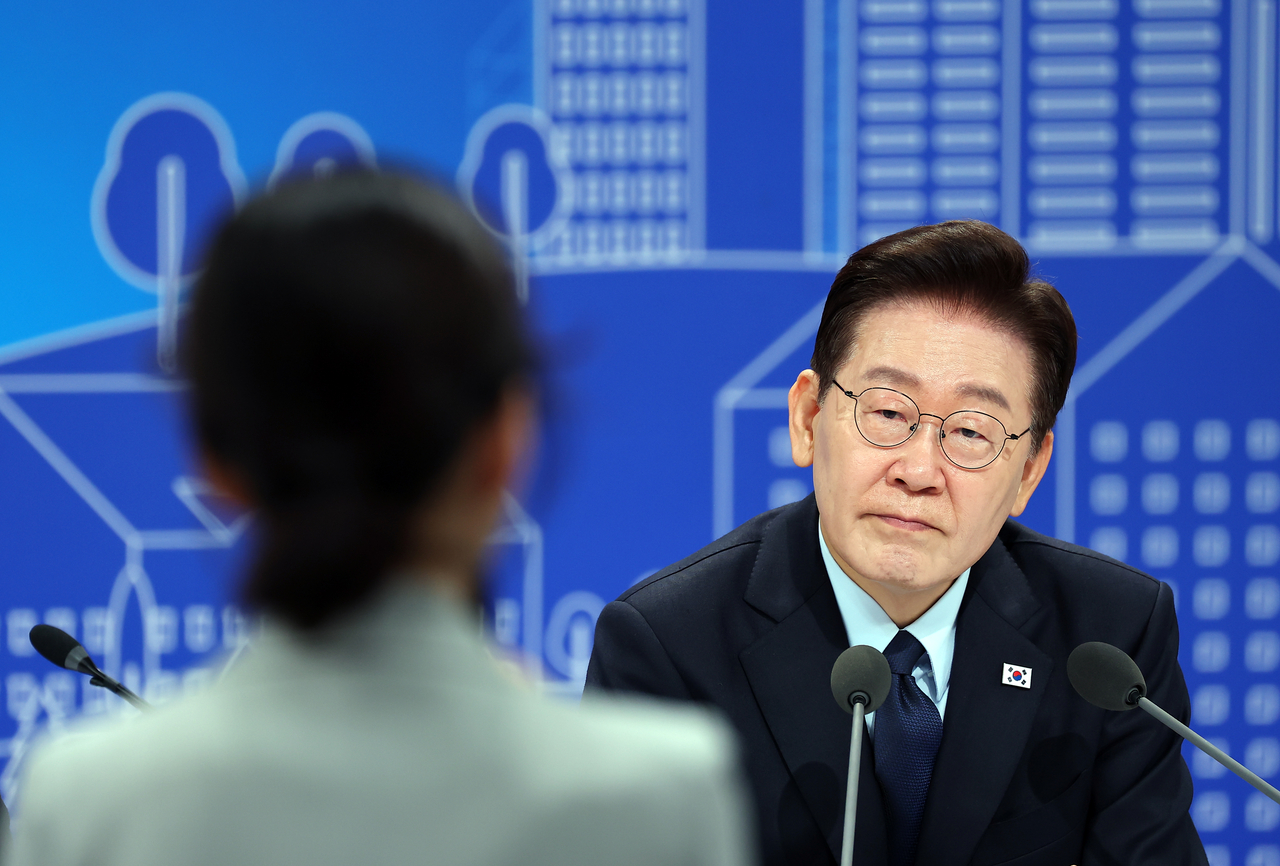
Even at political cost
During the forum, Lee said there was “broad agreement on the need to raise property holding taxes,” but that the key questions were “how broadly and by how much they should be raised, and how rates should be differentiated.”
Lee noted that the taxes would have to be tripled to bring them in line with levels in advanced economies.
“However, if we were to triple them now, wouldn’t it provoke something close to an uprising? This is something that should have been done in the past,” Lee said, pointing to low property holding taxes as a major cause of the overheated housing market.
Lee repeatedly stressed the urgency of stabilizing the housing market, warning that mounting pressure was bringing the country “ever closer to the point” at which the bubble could burst.
“This (bubble) will burst someday. We do not know which generation will bear the brunt, but it would deal an enormous blow to the Republic of Korea,” Lee said. “That is why I believe we must prepare for it, even if doing so comes at a political cost.”
In his closing remarks, Lee acknowledged that real estate is “an extremely explosive issue” and that housing policy has often been distorted by electoral considerations.
“Policy resolve is important, and there are times when bold action is necessary,” Lee said. “Because of the political environment — votes, for example — politicians sometimes set aside their convictions or values in the face of political realities. As a result, policies are often distorted or altered, creating confusion.”
Lee nevertheless reaffirmed his commitment to reform despite concerns about the “major disruption and conflict” that changes to housing policy could cause.
“Tax issues have an enormous impact on politics,” Lee said. “Even so, for the future of the Republic of Korea, I believe we must be prepared to endure considerable difficulty.”
Targeted taxes, tighter rental loans
During the forum, Lee suggested a two-track approach: targeted property taxation and tighter lending rules, with protections for those most in need.
Under his proposal, property taxes would be calibrated around ordinary single-home owners. Owner-occupiers, lower-income households and owners of homes outside the capital region would receive tax relief. Multiple-home owners and holders of ultrahigh-priced or speculative properties would face heavier burdens.
Lee called for tighter restrictions on rental-deposit loans, arguing that excessive lending had fueled home-price increases and rental fraud. Exceptions would be made for young people, newlyweds and other households in genuine need.
He responded positively to a proposal that rules governing property holding and capital gains taxes be written into law rather than set by enforcement decree, which the president and government can revise without National Assembly approval.
“I think that is a much-needed suggestion,” Lee said. “The suggestion that we should enact as much of the policy as possible through legislation is a valid one.”
Lee suggested that Prime Minister Han Seong-sook convene further discussions if Thursday’s forum failed to address the issues fully. The government faces a statutory deadline for submitting its proposed tax revisions and is expected to finalize a broader real estate policy package later in July or in early August.
dagyumji@heraldcorp.com