K-pop agencies deepen engagement with Latin American fans through languages, festivals, localized promotions

As K-pop strengthens its foothold in Latin America — from Spanish-speaking countries to Portuguese-speaking Brazil — artists are increasingly weaving Spanish lyrics into their songs.
Recent releases have showcased the trend across a wide range of artists.
Le Sserafim’s “Boompala” features the lyrics “saving the shame for manana (tomorrow),” while Aespa’s “Lemonade” includes the Spanish phrase “muchas gracias mi amor (thank you very much, my love).”
ATEEZ's "Bad," from its latest EP "Golden Hour: Part.5," features Spanish-language lyrics, including "Tu me tienes loco" ("You drive me crazy") and "ritmo peligroso" ("dangerous rhythm"). Another track on the EP, "Mamacita," also incorporates Spanish lyrics alongside flamenco guitar and Latin percussion, reflecting the group's growing embrace of Latin musical influences.
Although Spanish has appeared in K-pop before, including GFriend’s 2015 hit “Me Gustas Tu” and Nmixx tracks such as “O.O,” “Dice” and “Sonar.” Still, its growing prominence in recent releases reflects shifts in K-pop’s global marketing strategy.

One of the biggest drivers is K-pop’s growing focus on Latin America.
As competition in major overseas markets such as China, Japan and Southeast Asia intensifies, entertainment companies look to Latin America as a new source of growth. The region has long been home to a passionate K-pop fan base, but historically has received fewer promotional campaigns and artist activities.
The timing also coincides with broader challenges facing the industry.
According to Circle Chart, K-pop album sales declined globally from 115 million in 2023 to 85 million in 2025, fueling concerns over slowing growth. However, demand for K-pop has continuously risen in Latin America.
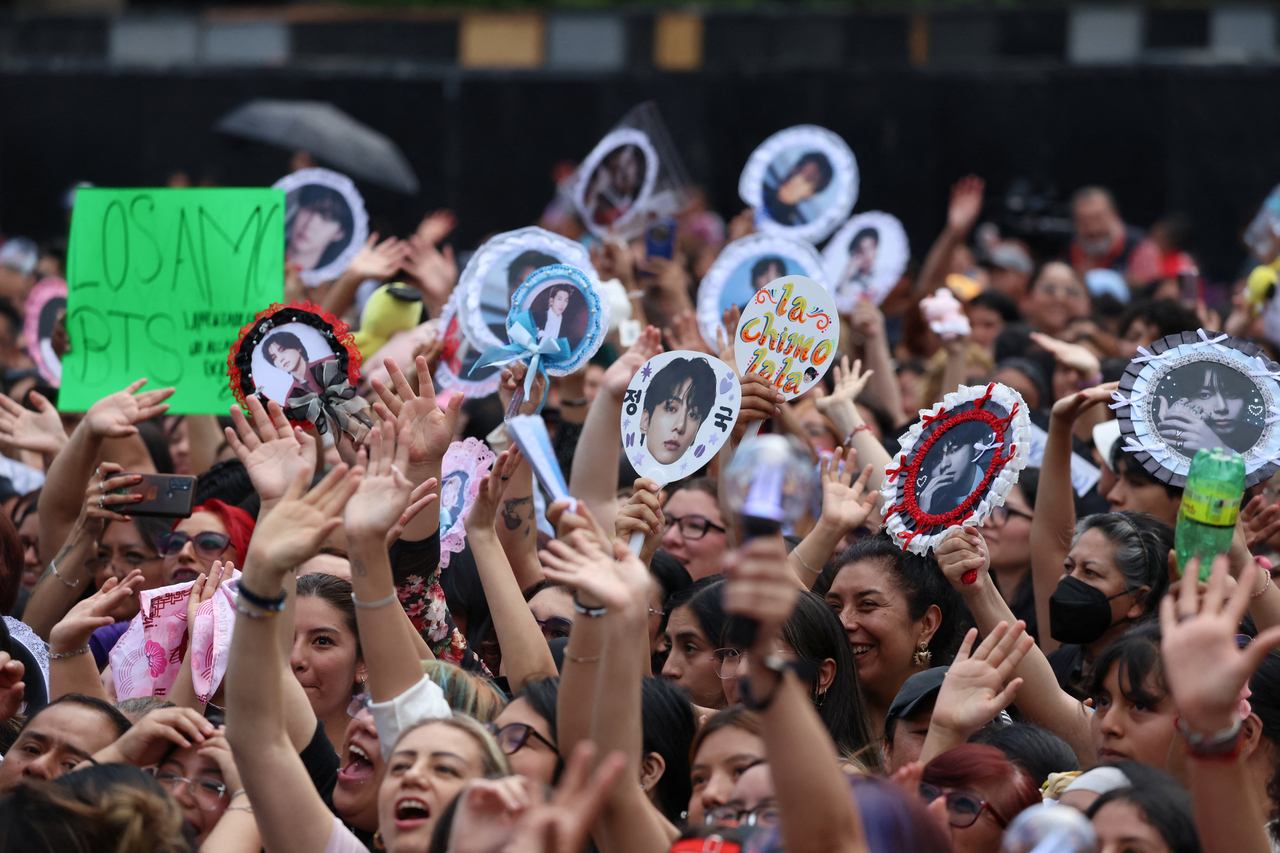
Data from the Korea Customs Service indicated that exports of recorded media — including K-pop albums — to major Latin American countries such as Argentina, Chile and Brazil increased steadily between 2023 and 2025. Exports to Argentina alone nearly doubled during the period, rising from $98,000 in 2023 to $182,000 in 2025.
“The combination of growing consumer demand and relatively limited promotional activity in Latin America has made the region one of K-pop’s most promising untapped markets,” music critic Lim Hee-yun told The Korea Herald Thursday.
Rather than relying solely on world tour stops, agencies have increasingly begun developing localized strategies aimed at strengthening ties with fans across the region.
JYP Entertainment and Live Nation are set to launch “Straycity,” a new festival built around the agency’s boy group Stray Kids, in Bogota, Buenos Aires and Mexico City in September. Stray Kids is also set to headline Rock in Rio, becoming the first K-pop act to headline one of the biggest music festivals in Brazil. Ateez, NexZ and Hwasa are also set to perform at Rock in Rio.

Earlier this year, Nmixx became the first K-pop act to perform at both Sao Paulo's Carnival and Chile's Vina del Mar International Song Festival. In Brazil, Nmixx performed "Mexe” and “Tic Tic,” a collaboration with Brazilian pop star Pabllo Vittar that features lyrics in Korean and Portuguese. In Chile, the members performed the Spanish version of “Sonar” and addressed the audience in Spanish.
The industry's growing investment extends beyond touring. Hybe has also expanded its regional presence through Hybe Latin America, which debuted the Latin American boy group Santos Bravos in October 2025, reflecting broader efforts to establish a longer-term foothold in the market.
“As agencies devote greater attention to Latin America, Spanish and Brazilian Portuguese have become more than a stylistic flourish in K-pop lyrics,” added Lim. “While fans across the region have long embraced Korean-language music, the growing use of Spanish and Portuguese reflects an effort to connect more directly with one of the industry's fastest-growing and enthusiastic global audiences.”
lee.jungjoo@heraldcorp.com