By Korean Food Promotion Institute
Tangpyeongchae takes its name from the Tangpyeong policy of 18th-century King Yeongjo, who sought to end the factional infighting that had consumed the Joseon court and, by his own account, driven him to condemn his son Crown Prince Sado to death. The term refers to rule without partiality.
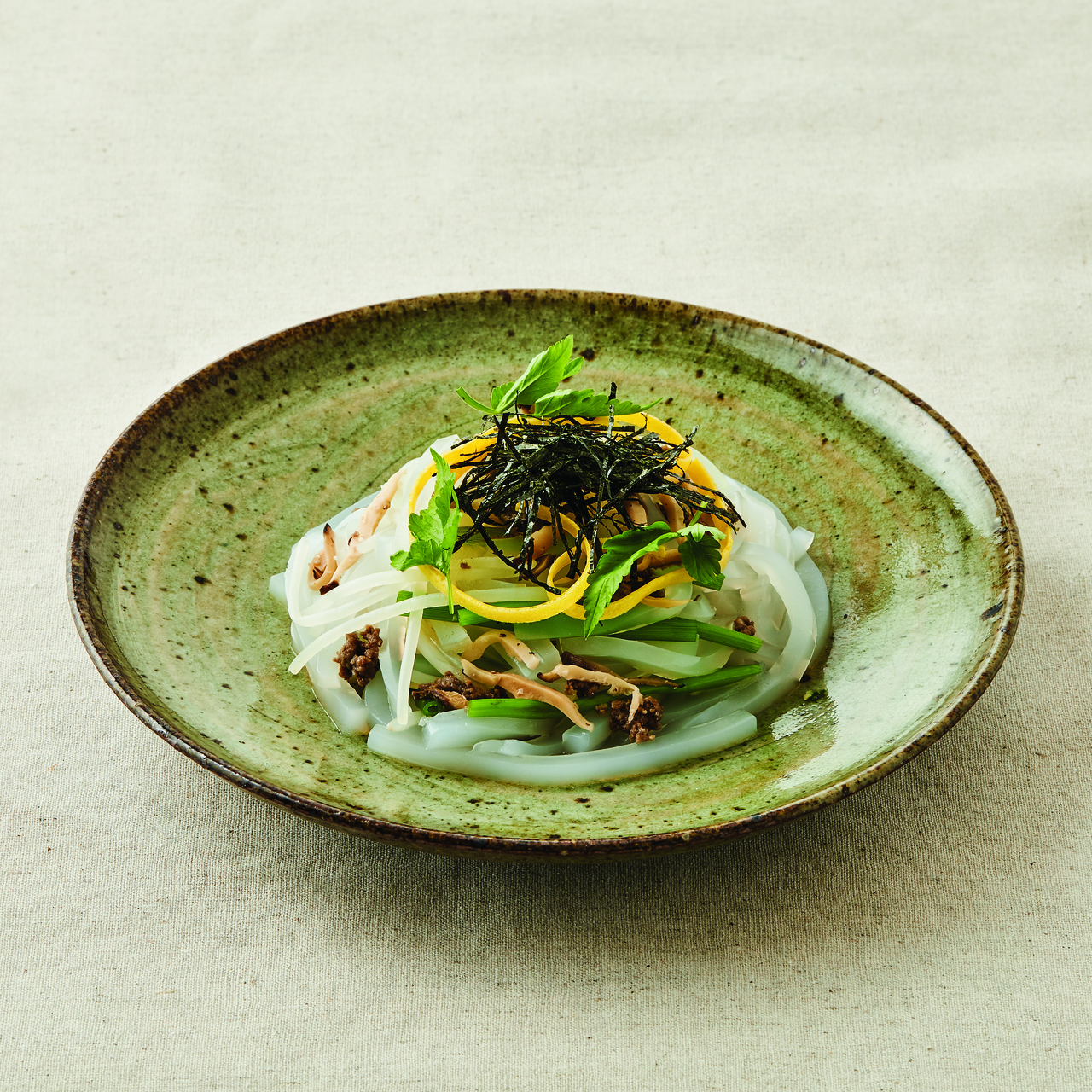
According to the 19th-century reference work "Myeongmulgiryak," the dish was named for this principle of balance, with the four political factions of the era represented through ingredients in contrasting colors. It also draws on obangsaek, the five cardinal colors of traditional Korean cosmology. Red beef, black toasted laver, white mung bean jelly and sprouts, green watercress and yellow egg appear together, dressed in cho-ganjang, a soy-vinegar sauce.
Mung bean jelly, or cheongpomuk, is sold refrigerated at Korean grocery stores.
Ingredients
- 500 grams mung bean jelly
- 90 grams beef (top round)
- 90 grams Korean watercress
- 150 grams mung bean sprouts
- 1 red chili pepper
- 1 egg
- 1 sheet dried laver salt
- Vegetable oil as needed
Marinade for beef
- 1 tablespoon soy sauce
- 2 teaspoons sugar
- 1 teaspoon minced green onion
- ½ teaspoon minced garlic
- ½ teaspoon sesame oil
- ½ teaspoon toasted sesame seeds, crushed, pinch of ground black pepper
Cho-ganjang (Soy sauce with vinegar)
- 1 tablespoon soy sauce
- 1 teaspoon sugar
- 1 tablespoon white vinegar
- 1 tablespoon water
Preparation
Slice off the hardened top of the mung bean jelly and cut into 6-centimeter-long sticks. Blanch them in boiling water with salt and drain.
Cut the beef into julienne along the grain. Combine all the ingredients of the marinade for beef in a small bowl and add the beef. Marinate the beef for 10 minutes.
Tear the leaves off from Korean watercress and blanch the stems in boiling water. Shock in cold water and drain. Cut them into 4 centimeter segments.
Remove the heads and tails from the mung bean sprouts. Blanch them in boiling salted water. Shock in cold water and drain.
Halve the red chili pepper lengthwise and remove the seeds. Julienne them finely.
Separate egg yolks and egg whites into two bowls and beat them well with a pinch of salt.
Toast the dried laver. Place it in a plastic bag and break it into small pieces.
In a small bowl, combine all the ingredients of the cho-ganjang.
Cooking
In a skillet, heat the vegetable oil over high heat and stir-fry beef quickly. Set aside to cool.
Pan-fry the yolks and whites separately on a lightly greased skillet over low heat into very thin sheets. Julienne them into 4-centimeter pieces.
In a big bowl, combine all the prepared ingredients, except some of the stir-fried egg strips. Add cho-ganjang and toss them lightly.
Arrange them on a serving plate and garnish with the remaining stir-fried egg pieces on top.
Tip
Muk is made by boiling starch in water to make paste and then letting it cool. Originally, this dish was mixed with cho-ganjang for a sour taste, it can also be freshly seasoned with salt and sesame oil instead.
Serve 4.
yoohong@heraldcorp.com

![[Survive & Thrive] When freelance teachers count as workers](https://wimg.heraldcorp.com/news/cms/2026/10/13/news-p.v1.20261007.26cd3a795b4c45fa94726129c5a30119_T1.jpg?type=h&h=800)