Samsung Electronics leads rout as foreign selling sends won to 16-year low
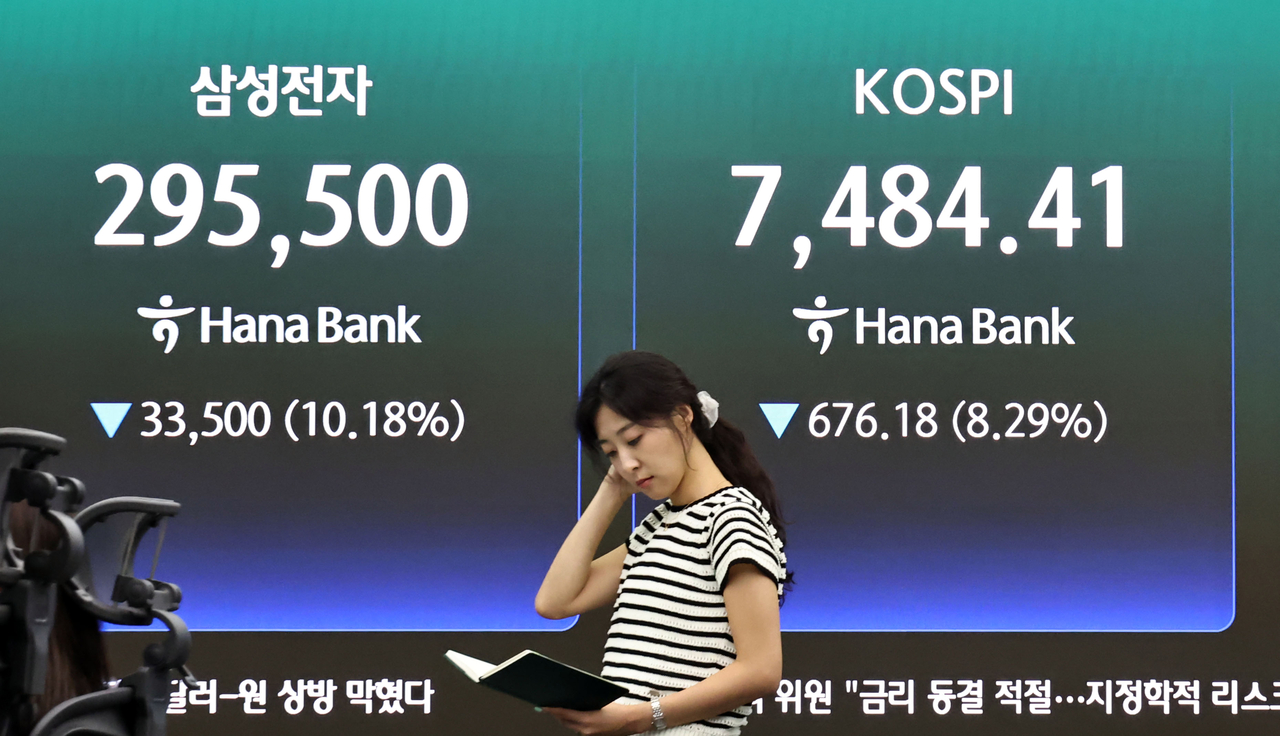
The South Korean benchmark Kospi suffered an over 8 percent decline Monday as chip stocks tumbled, mirroring a rout in US semiconductor shares on Wall Street. Market heavyweights Samsung Electronics and SK hynix dragged the market lower, falling 7 to 10 percent.
The index closed at 7,484.41, down 8.29 percent from the previous session. The drop was the steepest since March 4, when the benchmark tumbled a record 12.06 percent amid the outbreak of the Iran war.
Although it opened just 1.38 percent lower on-session at 8,048.09, selling pressure intensified in early trading, dragging the benchmark below the 8,000 level and later through the 7,500 mark.
A circuit breaker was triggered shortly after the opening bell, suspending market-wide trading for 20 minutes. Minutes after trading resumed, a sell-side sidecar, a five-minute curb on program trading, was activated.
Retail investors scooped up a net 1.76 trillion won ($1.15 billion) worth of shares on the main board, but their buying was overwhelmed by broader sell-offs. Foreign investors offloaded a net 354.3 billion won, while institutions dumped a net 1.62 trillion won.
The junior bourse Kosdaq was not spared from the sell-off, ending at 911.39, down 9.08 percent and falling below the 1,000-point threshold. The finish was its lowest close this year. A sell-side sidecar was triggered early in the session, followed by a circuit breaker shortly before the market close.
With Monday's rout mirroring the semiconductor-led selloff on Wall Street Friday, local chipmakers bore the brunt of the decline. Samsung Electronics plunged 10.18 percent to 295,500 won, while SK hynix fell 7.68 percent to 1.911 million won.
The sell-off spread across other heavyweight stocks as well. SK Square tumbled 11.13 percent to 1.118 million won, while Hyundai Motor dropped 8.71 percent to 639,000 won.
Amid sustained foreign selling in Korea's stock market, Bloomberg reported Sunday that international investors are growing more cautious on Korean equities and increasing hedging after a sharp market rally.
While the Korean market "captured global attention as a combination of the AI boom and the government’s successful corporate reform," the extended rally has left the market "vulnerable to abrupt reversals," the report said.
"Concerns are growing that valuations have already priced in much of the rosy outlook, leaving the market vulnerable as it enters a phase where lofty expectations could become a burden," Yang Hyeong-mo, analyst at DS Investment & Securities, said.
Despite Monday's foreign selling being relatively contained compared with earlier outflows, the Korean won continued to struggle.
The won was quoted at 1,535 per dollar as of daytime trading's close, recovering roughly 20 won from its opening level of 1,555.2 per dollar in the onshore market, but the recovery did little to alter its broader weakening trend.
In recent weeks, the won has remained under heavy pressure, hovering above the psychologically important 1,500-per-dollar level. The currency even briefly weakened beyond 1,560 won per dollar during overnight trading on Saturday, when thin liquidity amplified market moves.
The foreign exchange authorities are said to believe that persistent foreign outflows from the local stock market have been a key driver of the currency’s weakness. They are also pointing to activity in the non-deliverable forward market as an additional source of pressure.
"Recent volatility in the forex market appears to have been amplified not only by supply and demand factors but also by speculative foreign exchange transactions, including those in the non-deliverable forward market," senior officials from the Bank of Korea and the Finance Ministry said in a joint statement issued shortly before noon.
The statement further stressed the authorities will not tolerate excessive volatility or one-sided market movements in the forex market that are inconsistent with economic fundamentals.
While forex authorities are said to be considering tighter oversight of the NDF market, they are not assessing current conditions as crisis-level stress, as dollar funding costs remain manageable compared with past crisis episodes such as the global financial crisis and the Covid-19 pandemic, according to sources.
Yet concerns over won volatility persist, as the currency has struggled to meaningfully appreciate against the greenback over a prolonged period.
"Exchange rates can be particularly volatile because expectations of further depreciation of the won often lead to one-way dollar buying, creating supply-demand imbalances that reinforce pressure in a self-fulfilling cycle," said Moon Da-woon, an analyst at Korea Investment & Securities.
silverstar@heraldcorp.com