Cheong Wa Dae urges Samsung, union to make last-ditch effort for deal
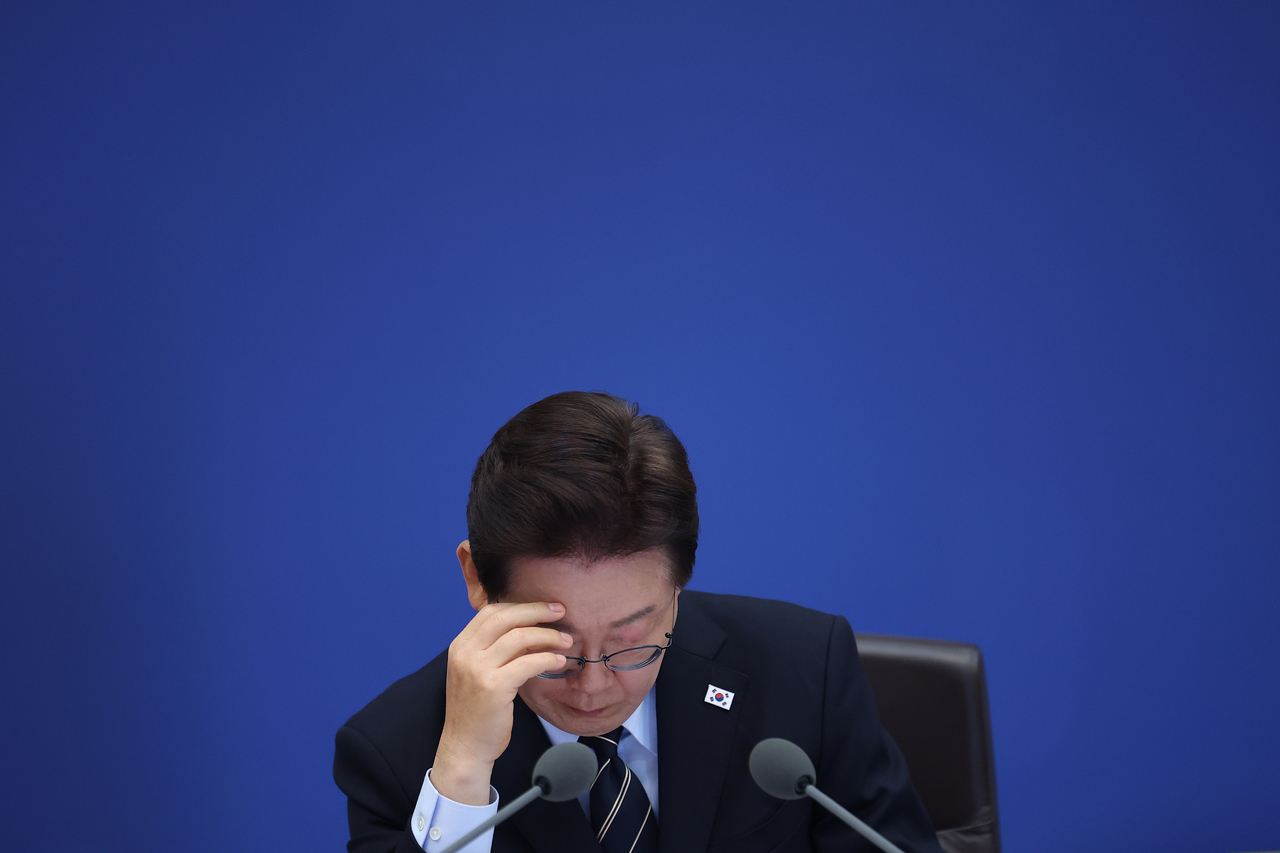
President Lee Jae Myung sharply criticized Samsung Electronics’ labor union over its profit-sharing demands Wednesday, signaling that the government could invoke its emergency arbitration authority if a strike goes ahead.
Lee’s remarks came shortly after Samsung Electronics and its union failed to reach an agreement in a second round of wage negotiations mediated by the National Labor Relations Commission, a quasi-judicial agency tasked with resolving labor-management disputes.
Speaking at a weekly Cabinet meeting, Lee publicly singled out the labor union over its proposal to allocate 15 percent of annual operating profit to a bonus pool that would also be distributed to workers, including those in loss-making divisions. The proposal has been a key sticking point in negotiations between management and the union.
“Some unions are, of course, entitled to engage in collective bargaining through their rights to organize and take collective action, and to seek to advance their own interests. But there should still be an appropriate line,” Lee said during the meeting. “Receiving a share of operating profit is what investors do. That is what shareholders do.”
Lee questioned the union’s demand to institutionalize a fixed share of operating profit before taxes are paid.
“But to institutionally divide and take a certain percentage of operating profit even before taxes, which can be considered the public’s shared portion, are paid, that is something even investors cannot do,” Lee said. “Don’t investors also receive dividends from net profit after taxes are deducted?”
Lee added: “For my part, I find this somewhat difficult to understand.”
The president went on to underscore the government’s responsibility to intervene when labor disputes exceed an appropriate boundary, in remarks that appeared to signal the possibility of invoking emergency arbitration authority.
“The government’s role is to allow members of society to freely exercise their rights and express their views within appropriate boundaries,” Lee said. “But when those boundaries are crossed, the government must fulfill its responsibility for the entire community and for everyone.”
Lee underlined that “this is one of the major roles of government,” saying, “In the end, the ultimate responsibility for all such coordination lies with the government.”
Earlier in the day, Cheong Wa Dae urged Samsung Electronics and its union to keep negotiating until the last minute Wednesday, after government-mediated talks collapsed on the eve of a planned strike.
“We find it deeply regrettable that the NLRC’s post-mediation process broke down,” senior spokesperson Kang Yu-jung said in response to the breakdown of talks. “Even before the final deadline, we ask both labor and management to do their utmost until the very end to reach an agreement, taking into account concerns over the impact on the Korean economy.”
As the deadline for a walkout involving more than 50,000 workers looms, Minister of Employment and Labor Kim Young-hoon stepped in directly as a mediator in the labor dispute.
The Labor Ministry said talks between Samsung Electronics management and the union, personally mediated by Kim, began at 4 p.m. Wednesday at the ministry’s Gyeonggi Regional Employment and Labor Office.
Hong Kyung-ui, the ministry’s spokesperson, earlier in the day reiterated its position that resolving the issue through dialogue between Samsung and its union should be the priority, pledging to “provide maximum support at the government level without being bound by formalities” to that end.
Asked about the possibility of invoking the labor minister’s emergency arbitration authority, Hong said: “It would be premature to comment specifically on such measures at this stage.”
According to the NLRC, a mediation proposal was presented to both sides, but while the union accepted it, management declined to sign the proposal.
Samsung's labor union stated negotiations had collapsed and that it would “legally launch a general strike as planned” on Thursday.
In contrast, Samsung Electronics said it failed to reach a last-minute agreement because of the union’s “demand for a socially unacceptable level of compensation even for loss-making business divisions.” The company said it had “accepted most of the union’s demands on the size and structure of performance-based bonuses.”
The government had already publicly signaled the possibility of invoking emergency mediation measures before Lee’s latest remarks. Prime Minister Kim Min-seok said in a public address Sunday that “the government cannot help but consider all possible response measures, including emergency arbitration, in order to protect the national economy.”
Lee also addressed the dispute in a post on X, formerly Twitter, on Monday, saying that “labor should be respected as much as businesses, and corporate management rights should be respected as much as labor rights,” while noting that constitutional rights may be restricted for the public good.
dagyumji@heraldcorp.com