Ambassador highlights areas where cooperation with Korea could grow amid rising geopolitical and trade uncertainty
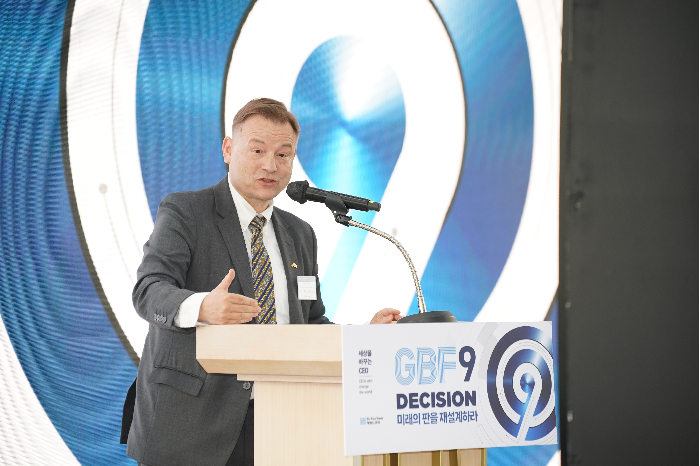
German Ambassador to South Korea Georg Wilfried Schmidt stressed his country’s potential as a key economic partner for Korea amid rising geopolitical and trade uncertainties in his opening speech at the 9th Global Business Forum in Seoul on Wednesday.
Referring to the ongoing Middle East conflict and growing concerns over energy security, the German envoy said that Germany’s path toward renewable energy may hold lessons for Korea in pursuing a greener future.
“More than 50 percent of our electricity consumption comes from renewables,” he said, noting that Germany’s energy transition extended beyond wind and solar power to include energy efficiency measures, storage systems and decentralized grid structures.
The ambassador underscored that renewable energy required an entirely different system of production and distribution, one that Germany has spent decades building through sustained investment in engineering and technology.
He also pointed to mounting uncertainty in both the Chinese and US markets, noting that the European Union is becoming an increasingly attractive and stable business destination for Korean companies.
“You have the EU, a very large and prosperous market. Also, Germany is the country with the largest Korean community in Europe,” he said. The ambassador added that Europe is expected to move toward deeper economic integration in response to mounting global pressures, particularly in areas such as capital markets.
Speaking on the subject of artificial intelligence, Germany may appear quieter than Korea in consumer-facing AI applications, but underscored that the country remained highly advanced in industrial AI through its "Industry 4.0" initiative, the envoy said.
He pointed to technologies such as digital twins — virtual replicas used to simulate factories and industrial systems before they are built — as an area in which German companies have developed significant expertise.
In a separate lecture on "surviving the dollar stablecoin tsunami," Rep. Min Byung-deok of the Democratic Party of Korea called on Korea to move swiftly to secure a leading position in the global stablecoin market, warning that regulatory delays could leave the country lagging behind in digital finance.
He said Korea could not rival the US through the dominance of a reserve currency and should instead capitalize on its strengths in cultural influence and digital innovation.
“We are not a reserve currency country. What we need is content,” Min noted.
The lawmaker suggested that Korea develop multiple won-based stablecoins tied to industries in which the country holds global influence, particularly in cultural content. He said digital currencies integrated into Korean cultural platforms and services could be attractive and convenient payment tools for consumers worldwide.
Min also called for swift legislation related to stablecoins, describing this year as a “golden opportunity” for Korea to take the lead in setting standards for the emerging digital payments market.
“If we fail to take the lead in setting the standard, we will end up following rules made by others,” he said.
Delivering a talk on AI, Kim Duk-jin, CEO of IT Communication Lab, said AI was rapidly evolving into a workplace collaborator, urging businesses to rethink how they structure workflows and daily operations.
“AI should become an opportunity, not a crisis,” Kim said, encouraging people to actively experiment with emerging technologies.
The GBF, organized by The Korea Herald and Herald Business, runs weekly in Seoul from April through July 8 that brings together business leaders, diplomats and industry experts to discuss emerging global trends and challenges shaping the future economy.
The ninth edition of the event is being held under the theme “Reshape the Future Landscape.”
junheee@heraldcorp.com