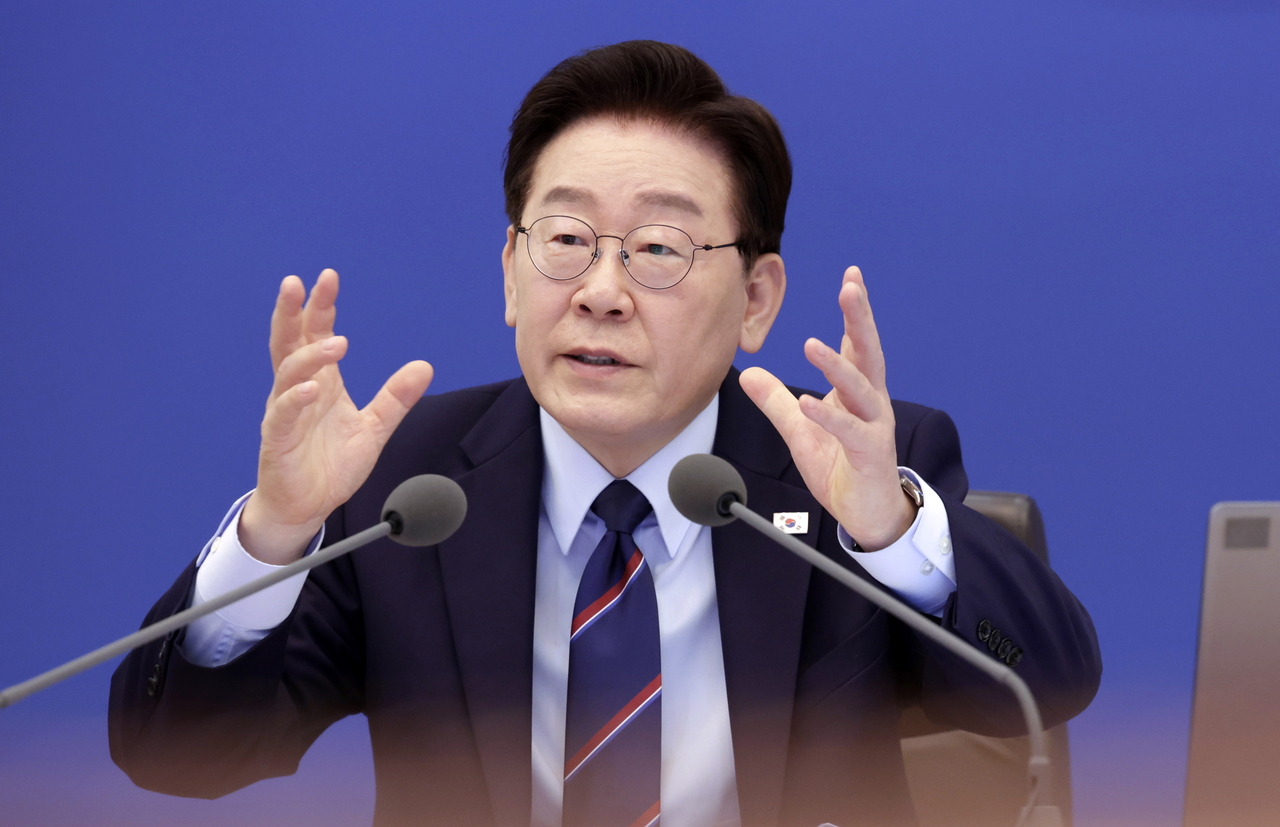
President Lee Jae Myung called for South Korea to pursue an expansionary fiscal stance in its second-half economic strategy and next year’s budget, rejecting the “trap of populist fiscal austerity.”
Lee underscored that “bold fiscal spending implemented in a timely manner boosts domestic demand and injects vitality into the broader economy” during a Cabinet meeting and emergency economic review session held Tuesday at Cheong Wa Dae in Seoul.
Lee rebutted calls for an austerity budget as “irresponsible voices calling for the government to stand by and do nothing about people’s suffering while using national debt as a justification.”
“There were times when frugality was considered a virtue — not spending, saving money and tightening one’s belt,” Lee said. “But now is an era in which consumption is a virtue. Society has now become one in which the problem is that money is not circulating.”
Lee underscored “the government’s role in making the economy circulate through investment at times like this,” defending the need for stimulus spending, including the distribution of public relief consumption coupons.
“We must not fall into the trap of populist fiscal austerity theories that deceive the eyes of the people. This does not mean we should just spend recklessly anytime. We absolutely should not do that,” Lee said. “If the economy is normalizing and becoming revitalized, there would be no reason to keep borrowing and spending.”
Lee reiterated the need for expansionary fiscal policy to boost the country’s growth potential through investment during what he described as a “time of crisis.”
“The government should concentrate its capabilities on laying the foundation for a great leap forward in the national economy through proactive fiscal policy,” Lee said. “Based on this stance, I ask that you approach the formulation of the second-half economic growth strategy and next year’s budget planning accordingly.”
Lee cited analysis by the Seoul-based Fiscal Reform Institute, which noted that the International Monetary Fund’s Fiscal Monitor released in mid-April projected South Korea’s net debt-to-gross domestic product ratio this year at around 10 percent — a fraction of the G20 average of 89.6 percent.
The net debt-to-GDP ratio measures not only the numerator — debt — but also the denominator, GDP. If nominal GDP grows faster than anticipated, the debt ratio can improve even if the total amount of debt continues to rise.
“By revitalizing domestic demand through expansionary fiscal policy and increasing economic growth and GDP itself, the denominator grows, which can actually lower the national debt ratio,” Lee said.
“In particular, if this process improves potential growth and productivity, the revenue base also expands, and the debt ratio declines over the long term, making it possible to realize a virtuous cycle in which economic growth becomes even more solid.”
Lee previously cited the same report by the Fiscal Reform Institute in an X post on May 5 aimed at rebutting what he called “strange people who constantly sing the song of austerity.”
Kim Yong-beom, presidential chief of staff policy, previously signaled an expansionary fiscal stance amid expectations of a record surge in tax revenue driven by a semiconductor supercycle in a Facebook post on Friday.
Kim explained that if the semiconductor boom continues through 2027, "Korea’s tax revenue in 2026 and 2027 could reach historic levels," driven not only by corporate tax payments from Samsung Electronics and SK hynix, but by income taxes from semiconductor workers and spillover effects from a trade surplus.
“Then the question is how quickly the policy system can reflect this reality. The revised 2026 economic outlook due in the second half of this year will be the first turning point,” Kim said. “That is because the level to which the forecast is raised will determine the direction of the 2027 revenue estimate and the overall budget size.”
Kim underscored that the government should not respond belatedly while trapped in old-style economic and fiscal frameworks as Korea enters a new growth phase centered on semiconductors.
“The issue is how flexibly the policy system can absorb industrial changes on a scale that is difficult to explain with existing frameworks,” Kim said.
The Korean government approved guidelines for drafting the 2027 budget proposal during a Cabinet meeting chaired by Prime Minister Kim Min-seok on March 30. Based on those guidelines, ministries are required to submit their budget requests to the Ministry of Planning and Budget by the end of May. The Budget Ministry will then hold consultations with relevant ministries and local governments before submitting next year’s budget proposal to the National Assembly in September.
dagyumji@heraldcorp.com