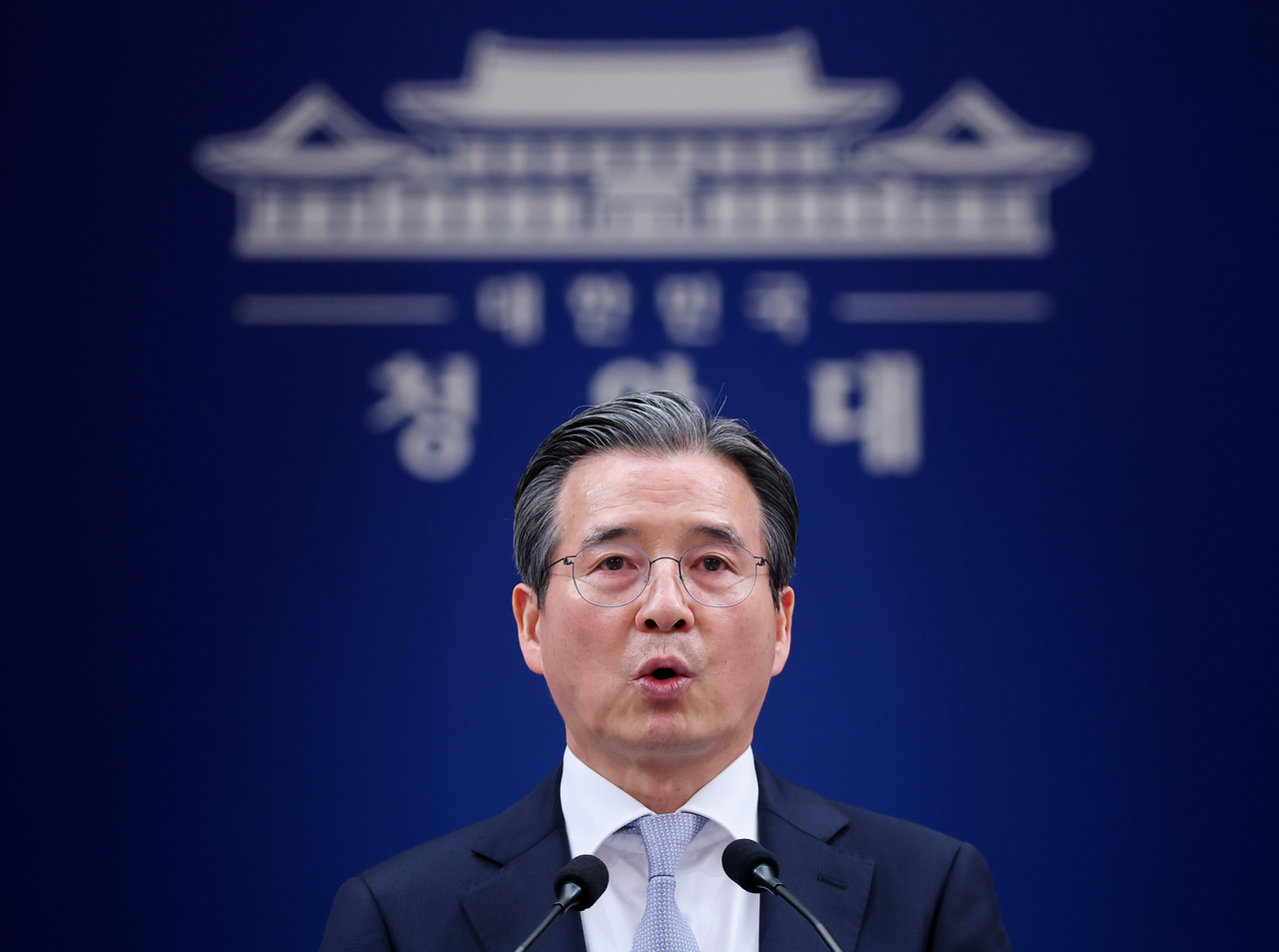
Cheong Wa Dae reiterated Monday that it will push ahead with a 60,000-home plan in the greater Seoul area, seeking to calm fears of a housing squeeze and keep anxious buyers from rushing into the market.
“We are working to ensure that the previously announced (construction of) 60,000 units proceed without disruption,” Kim Yong-beom, senior presidential secretary for policy, said during a press briefing at Cheong Wa Dae.
In January, the government announced a plan to supply 60,000 public housing units for young people and newlyweds using idle land in key urban areas, including Gwacheon in Gyeonggi Province, and major sites such as the Yongsan International Business District and Taereung Country Club in Nowon-gu, Seoul.
Kim acknowledged a mismatch between housing supply and demand following a sharp drop in housing starts in 2022 and 2023, which he said was driven by a breakdown in the housing supply mechanism, including fallout from project financing risks.
“The economy and asset prices, including real estate, have risen to levels we have not experienced before while supply remains constrained, leaving us with the difficult task of managing this situation,” Kim said.
Kim noted that the earlier drop in housing starts will inevitably lead to tighter supply this year and next, but stressed that it does not point to a fundamental or permanent shortage.
Kim urged the public not to rush into the market out of anxiety.
“We will make every effort to ensure that housing is supplied according to the announced schedule so that people do not feel compelled to engage in so-called panic buying,” Kim said.
Kim held a press briefing on the real estate market to share recent market developments and the government’s assessment, as attention focuses on the scheduled May 9 expiration of a temporary suspension of heavier capital gains taxes on multiple-home owners.
Kim stressed that the current situation is different from 2021 and is unlikely to repeat, downplaying the prospect of a sharp housing market jump after the tax relief expires.
In 2021, the introduction of higher capital gains taxes on multiple-home owners increased the cost of selling, prompting many to hold back their listings and consequently driving up house prices
Kim said the government now has stronger safeguards in place — including tighter household debt controls and lending restrictions under the June 27 policy, as well as market stabilization and anti-speculation measures under the Oct. 15 package — making it harder for the market to follow the same trajectory.
Kim added that future price movements will largely depend on market expectations.
“If people expect prices to rise, they may hold on to properties. But if they believe the government will not tolerate excess returns from speculative or investment-driven holdings, that expectation could lead to more listings coming onto the market,” Kim said. “That is why expectations about the future direction of housing prices are important.”
Kim reaffirmed the government’s policy stance against real estate speculation.
“We will not tolerate gains derived from speculative activities that deviate from the intended use of housing, land or corporate assets,” he said. “We are determined to reform the system so that assets are used for their intended purposes.”
Kim said the government would stick to its current hardline policy direction.
“The real estate market has entered a very difficult path toward normalization, and we are making policy efforts in that direction,” Kim said. “We will manage the market on the basis that there can be no deviation from this policy direction.”
dagyumji@heraldcorp.com