The artificial intelligence capital spending boom has spilled past memory and logic chips into the component tier of the supply chain, and Samsung Electro-Mechanics has become the Korean name with the clearest leverage to it.
Shares of the Samsung group affiliate jumped 93.37 percent between March 31 and April 24, closing Friday at 788,000 won ($536) after opening Monday at 792,000 won, according to Korea Exchange data. The stock hit an intraday record of 816,000 won on April 22 and set fresh peaks repeatedly through the month, far outpacing the Kospi's 28.17 percent gain and its electronics sub-index, which rose 31.42 percent over the same stretch.
The rally has lifted Samsung Electro-Mechanics' market capitalization to 58.93 trillion won, placing it 12th on the Kospi as of Monday morning and within roughly 1 trillion won of Kia at No. 11.
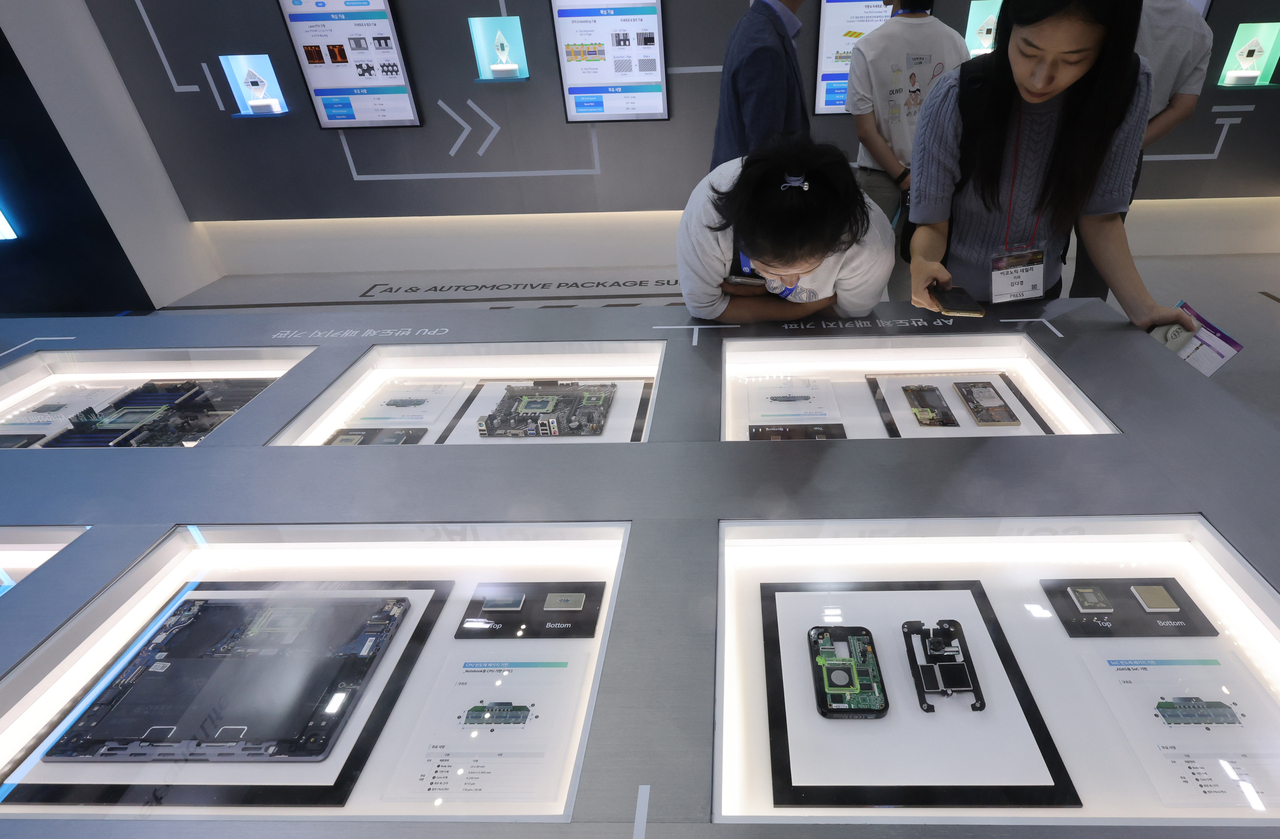
Long overshadowed by Samsung Electronics and SK hynix in the AI trade, Samsung Electro-Mechanics has drawn investor attention as one of a handful of producers globally capable of making flip-chip ball-grid array (FC-BGA) substrates, the high-end packaging boards that connect AI accelerators and server processors to mainboards. As Nvidia and other chip designers move to larger, multilayered packages for next-generation graphics processing units, the substrates required have grown more complex and harder to produce, leaving capacity in the hands of a small group of Japanese, Taiwanese and Korean suppliers.
It also shares a high-end duopoly in multilayer ceramic capacitors, or MLCCs, with Japan's Murata Manufacturing. The tiny passive components stabilize power delivery in electronics, and AI servers require three to four times the MLCC content of conventional servers at unit prices three to five times higher, given the high-temperature, high-voltage tolerances involved.
Both products are running into structural shortages as Nvidia, Google, Amazon and Apple build out AI infrastructure. CEO Chang Duck-hyun told shareholders in March that customer demand for FC-BGA exceeds the company's current capacity by more than 50 percent.
The company recently secured first-vendor status for FC-BGA substrates on the Groq 3 language processing unit, an inference accelerator integrated into Nvidia's upcoming Vera Rubin platform, with mass production slated for the second quarter. To expand capacity, Samsung Electro-Mechanics is investing about $1.2 billion at its Vietnam plant, after receiving an investment certificate from Vietnamese authorities for AI-related FC-BGA production.
"A structural shortage in FC-BGA for AI servers and data centers is set to continue this year," said Park Kang-ho, an analyst at Daishin Securities, who projected the company could "leap to the global No. 1 position" in the segment through additional investment.
Ko Eui-young at iM Securities said rising technical difficulty in MLCCs is "cementing the duopoly between Samsung Electro-Mechanics and Japan's Murata," and forecast the company's industrial MLCC revenue to more than double to 2 trillion won in 2027 from 950 billion won this year.
The company reports first-quarter earnings Thursday.
mjh@heraldcorp.com