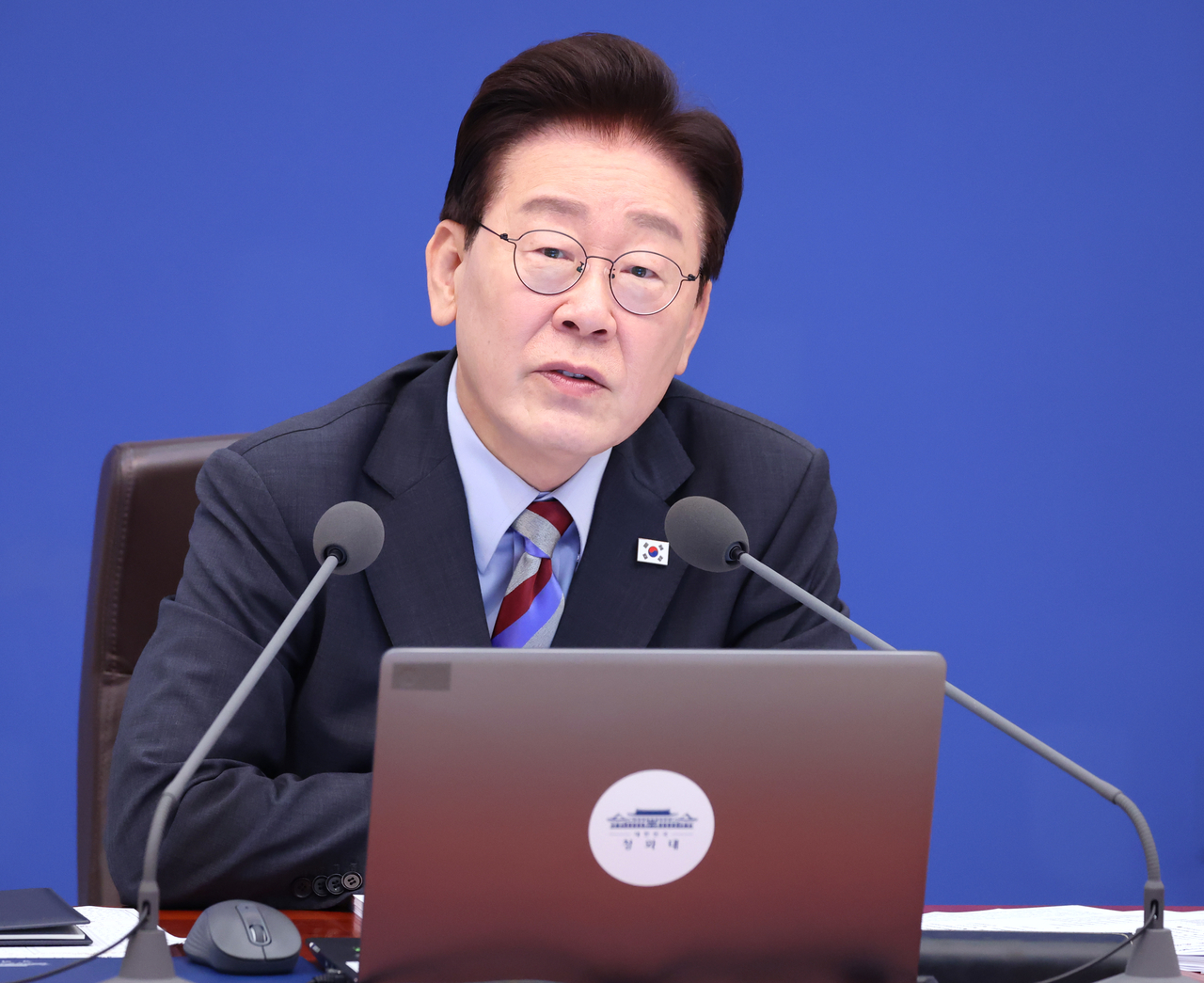
President Lee Jae Myung on Tuesday called for a swift and thorough investigation into last week's Demilitarized Zone land mine explosions while warning against disinformation.
"The military authorities should transparently uncover the truth through a swift and thorough investigation in close cooperation with the United Nations Command," Lee said during a Cabinet meeting at Cheong Wa Dae in Seoul.
"We will take necessary measures depending on the findings," he added, while also urging political circles not to fuel groundless conspiracy theories over the incident.
Earlier in the day, Cheong Wa Dae rejected claims that the investigation was delayed to avoid affecting Lee's address to the United Nations. It maintained the Joint Chiefs of Staff and the UNC determined the schedule based on military considerations and on-site conditions.
The presidential office's response came amid mounting criticism from the main opposition People Power Party, which has alleged that the delay in investigating the Sept. 21 explosions was linked to Lee's North Korea policy and political pressure on the military.
People Power Party chief spokesperson Rep. Park Sung-hoon pointed out Monday that the military's announcement came a week after the accident.
"It is truly a cowardly and pathetic late response," Park said, calling on the government to release body-camera footage and forensic findings and explain why the investigation and announcement took so long.
People Power Party leader Jang Dong-hyeok went further, claiming that the delayed investigation and alleged efforts to downplay the accident "would have been impossible without the president's instructions." Floor leader Rep. Jeong Jeom-sig also argued that Lee's approach toward North Korea had placed political pressure on the military.
The ruling Democratic Party of Korea has rejected the accusations, arguing that the military needed time to ensure the safety of investigators entering a heavily mined and difficult section of the DMZ.
The accident occurred while 18 personnel were opening a new search route for a UNC inspection of terrain changes near the Military Demarcation Line suspected to be linked to North Korean mine-laying activity. Two personnel were seriously injured and one sustained minor injuries.
According to the JCS, the first two days after the accident were spent treating and stabilizing the injured. The military then prepared for the investigation on Thursday and Friday and conducted a rehearsal with the UNC on Saturday.
The on-site investigation began Sunday, but investigators initially could not reach the blast points because of the risk of additional land mines. They approached within about 2 meters of the second blast site Monday.
The National Assembly's National Defense Committee also visited the Army's 25th Division area Monday. The delegation was led by committee chair Rep. Jin Sung-joon of the Democratic Party and included ruling party lawmakers and Reform Party Rep. Chun Ha-ram.
People Power Party members did not participate, saying the committee should first convene a plenary meeting to question military officials over the accident.
North Korean land mines likely cause
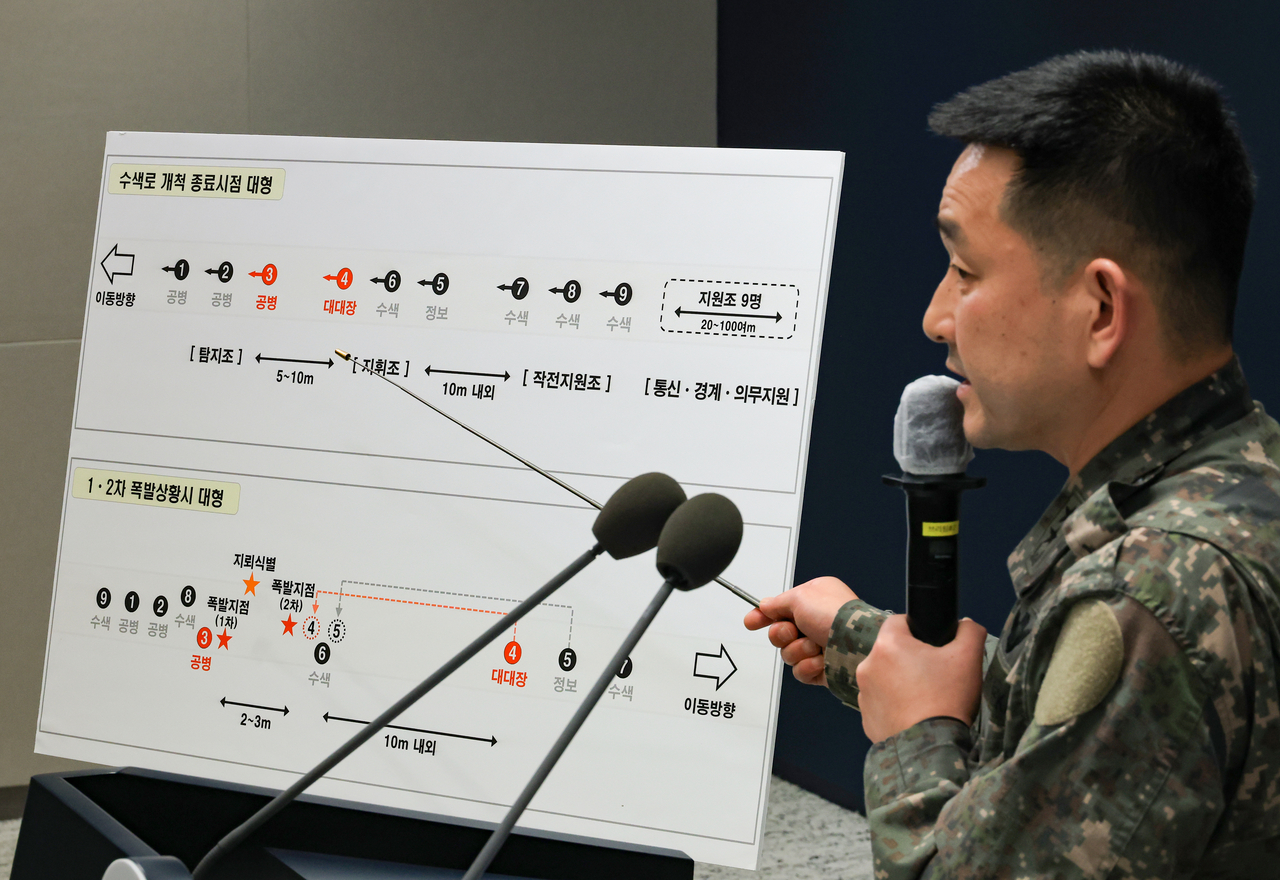
On Monday evening, the JCS announced there were no records of South Korean land mines being laid at the site, but signs of North Korean mine-laying activity had been detected nearby in September 2025.
A preliminary National Forensic Service analysis also detected TNT and brown-colored foreign material on protective equipment recovered from the scene, but no metal fragments.
The military cited testimony that a brown, rectangular object resembling a North Korean plastic antipersonnel mine was spotted about 1 meter from the first blast site.
"We determined that there is a very high possibility that the cause of the mine explosions was North Korean mines," Army Lt. Gen. Kwon Dae-won, vice chairman of the JCS, said Monday.
The explosions occurred about 10 meters south of the MDL. The JCS has yet to determine whether the mines were deliberately planted there by North Korean troops or had been displaced from elsewhere.
Kwon said North Korea would bear full responsibility if the final investigation confirms that Pyongyang laid the mines.
"All responsibility for this lies with North Korea," Kwon said. "Our military will take appropriate and corresponding measures."
The military has not specified what those measures could entail. Maj. Gen. Yang Jin-hyuk, the JCS director of operations, said the military and Defense Ministry would consider "all necessary options" before deciding.
The National Assembly's National Defense Committee was scheduled to hold a plenary session at 3 p.m. Tuesday, with the cause of the explosions, the timing of the investigation and the military's handling of the case expected to be key issues.
Rep. Lim Jong-deuk, the People Power Party's ranking member on the committee, said lawmakers would examine when the military first received reports of the suspected unexploded mine and how it assessed the possibility that the mine was North Korean.
flylikekite@heraldcorp.com