Industry stakeholders convene for Economic Contribution Report unveiling as writers' association raises residual concerns
Korean dramas routinely top Netflix charts across continents. "KPop Demon Hunters" drove Halloween costume sellouts worldwide last year. "Squid Game" remains the streamer's most-watched series ever. But what does it all add up to, in Korean won and jobs?
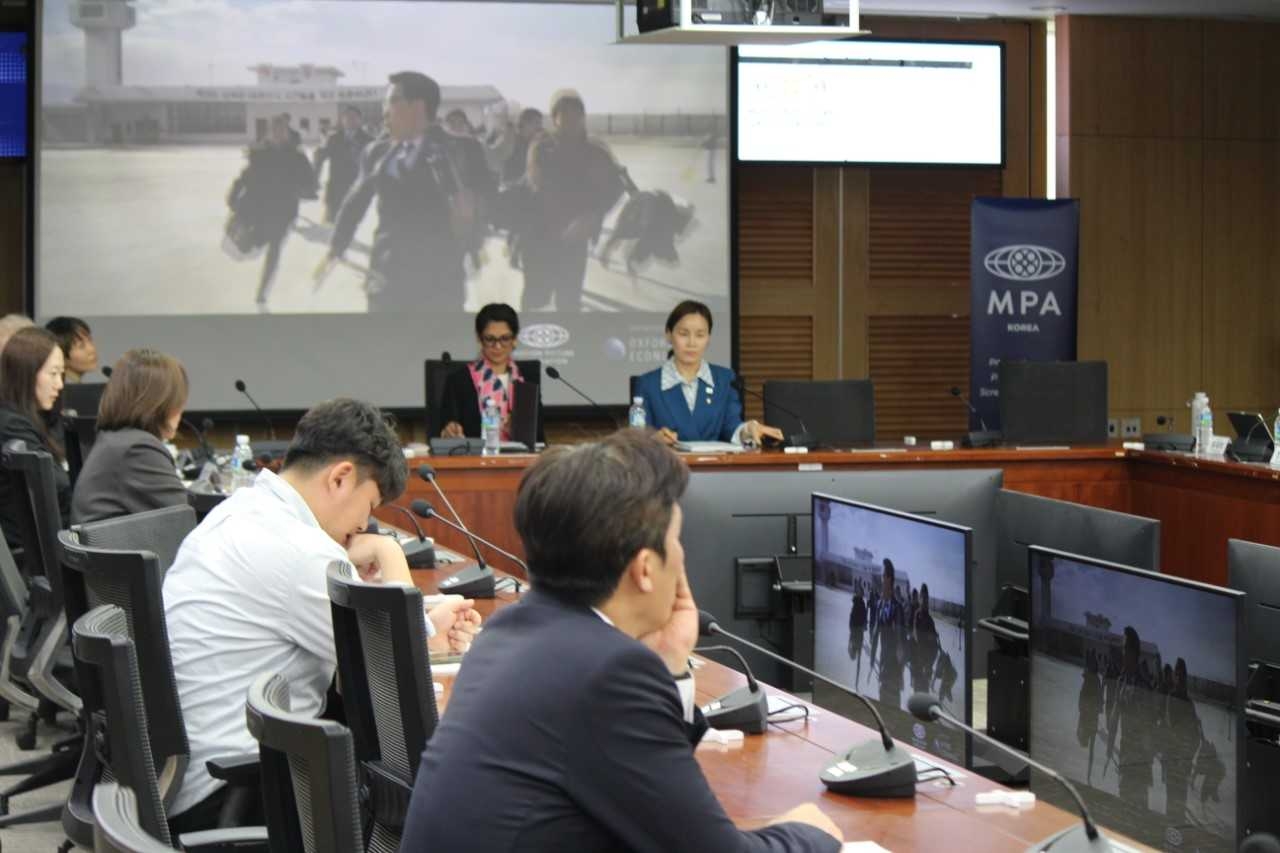
That was the question MPA Korea put to lawmakers and industry players Tuesday at the National Assembly Members' Office Building in Seoul, where the Korean branch of the Motion Picture Association unveiled its first Economic Contribution Report on Korea's audiovisual industry, commissioned from Oxford Economics.
Co-hosted by Reps. Lim O-kyeong and Kim Won-yi of the Democratic Party of Korea, the seminar drew lawmakers, producers, streaming executives, policy researchers and government officials, alongside representatives of creators' associations.
"Korea is not simply, from our perspective, a leading market. It's more than that," Urmila Venugopalan, president and managing director for the Asia-Pacific region at the MPA, said in her opening remarks. "It is a reference point for what an outward-looking creative economy can achieve."
Choi Sung-hee, director general for content and media policy at the Ministry of Culture, Sports and Tourism, read remarks on behalf of Minister Chae Hwi-young, who called the content industry "a core growth engine" of the national economy.
MPA Korea head Son Bo-young then walked attendees through the report's headline numbers.
According to the report, Korea's audiovisual sector generated some 24 trillion won ($17.1 billion) in GDP in 2025 and supported close to 300,000 jobs, nearly 80 percent of them at small and medium-sized businesses.
Every 1 billion won contributed directly to GDP was shown to produce another 2.1 billion won across the broader economy, and every 100 direct jobs supported another 240 in related sectors.
The report also found that streaming is the fastest-growing segment, with television remaining the industry's backbone and multiplexes showing signs of a gradual recovery.
A panel discussion of industry executives and researchers followed, moderated by Sangmyung University professor Kim In-chul.
Jung Kyung-jae, senior vice president at Hive Media Corp — the Seoul-based film production company behind "12.12: The Day" and "The Man Standing Next" — argued that expanded investment from global streamers would help rebuild breadth in a theatrical slate thinned in the aftermath of the pandemic.
"The range of works has shrunk significantly. Without investment from global platforms, the market would be even smaller," he said, adding that broader financing structures would lift the industry as a whole.
Hong Jae-hee, senior vice president of content business at streamer Viki, pointed to music rights clearance as a recurring obstacle for exporting Korean variety programming.
"In entertainment programs, we often have to remove or replace a lot of the music for overseas distribution, and that significantly diminishes the appeal of the content," she said, calling for post-production support on rights clearance and dubbing.
Park Shin-young of the Hyundai Research Institute urged a shift from localization to what she called "glocalization" — combining expertise overseas with Korean production methods.
"Simply exporting K-content is no longer enough," she said. "What's needed is to export the Korean production system itself."
During the Q&A session, a representative of the Korea Television and Radio Writers Association raised a question with Venugopalan.
Writers in the US and UK receive residuals when their work streams repeatedly, he noted, and those in the EU and Latin America are guaranteed additional payments by law whenever their work is reused.
Korean writers, by contrast, are typically required to sign buyout contracts with global platforms such as Netflix and Disney+, assigning away all rights at commission.
Why, he asked, are Korean creators excluded from comparable arrangements, and would MPA member companies be willing to open a dialogue?
Venugopalan said Netflix and Disney+ represent only two of MPA's seven member companies, with "very diversified business models," and cautioned against "simplistic comparisons" between regions or between streaming and theaters.
"I'm not privy to specific negotiations and specific commercial transactions. I cannot be," she said.
moonkihoon@heraldcorp.com