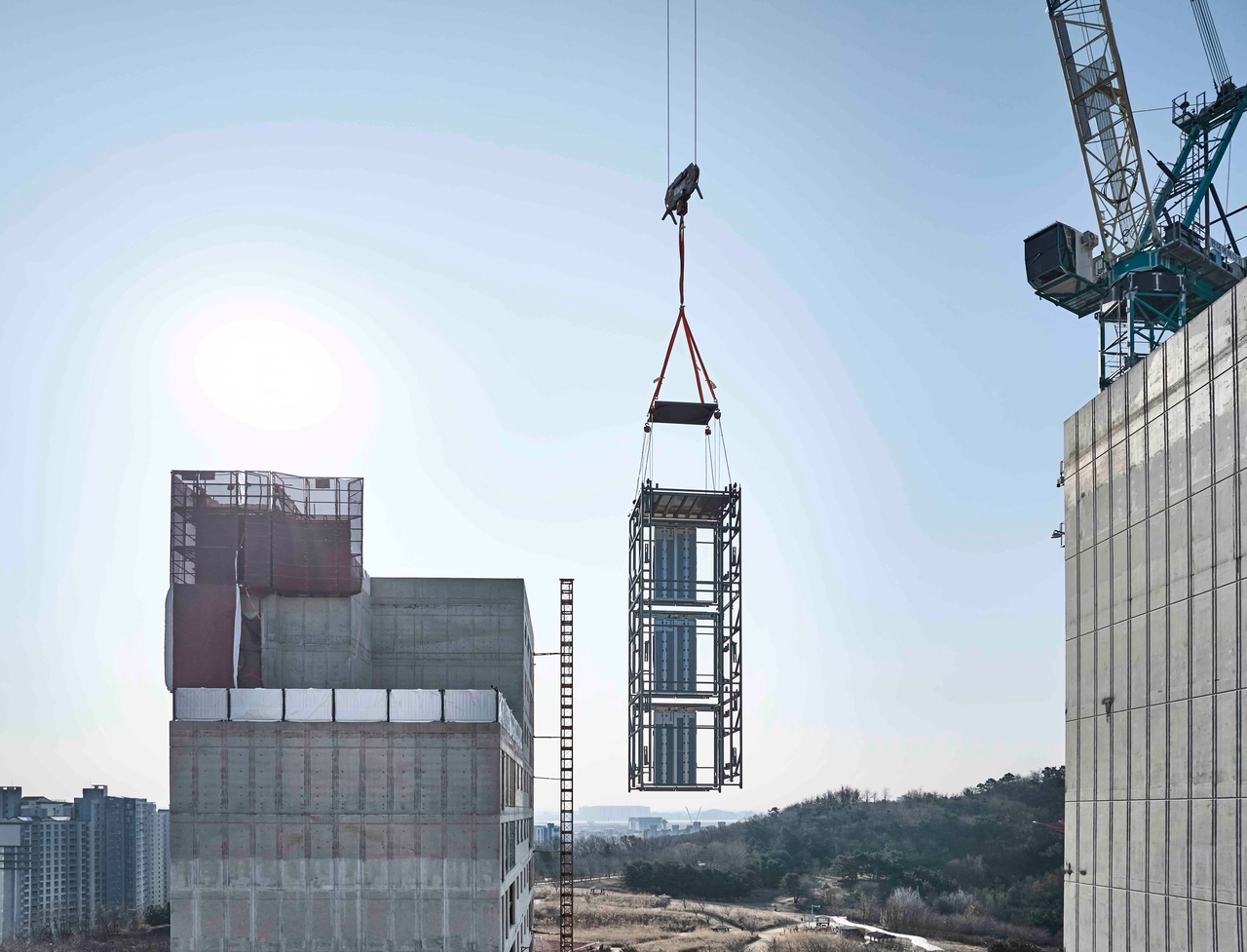
Hyundai Elevator became the world’s first to successfully install and commercialize an elevator for high-rise buildings using modular construction.
The company on Sunday announced the official launch of its proprietary modular construction system ENOBLOC, which stands for Elevator Innovate Block Construction. On Friday, Hyundai Elevator completed a quality control inspection for its 27-story ENOBOC application at the Songdo Hillstate Centerpark construction site, becoming the first to commercialize a modular elevator system for buildings higher than 20 stories.
“ENOBLOC is a groundbreaking system that alleviates high risks, boosts efficiency and lowers environmental impact, and will shift the paradigm of construction and development” said Cho Jae-cheon, CEO of Hyundai Elevator.
With ENOBLOC, the company manufactures components in advance which are then assembled on-site. According to Hyundai, the system introduces a “mobile assembly station” that is tailored to high-rise building construction while reducing spatial limitations.
The system functions as a mini-factory while occupying less than 33 square meters of the construction site, and transports components in plane units, allowing for a compact construction process.
A notable aspect is ENOBLOC’s enhanced safety. Elevator construction methods often include high-risk procedures; ENOBLOC eliminates such hazards by pre-fabricating 90 percent of the key components in its factories. This allows field operations to focus on final assembly, the company said.
ENOBLOC also reduces elevator installation time by up to 80 percent, streamlining the entire construction process, reducing construction costs and enabling earlier move-ins.
Through partial application, ENOBLOC reduced the Songdo Hillstate Centerpark construction period by 40 days, and is projected to shorten construction by more than two months upon full scale implementation, Hyundai added.
Hyundai Elevator has applied for approximately 50 patents linked to its modular system, high-rise building application and mass-production technologies. It further plans to lead global market dominance of what its calls “K-elevators” by applying for technology patents in the US and Middle East as well as Korea.
stlee0329@heraldcorp.com