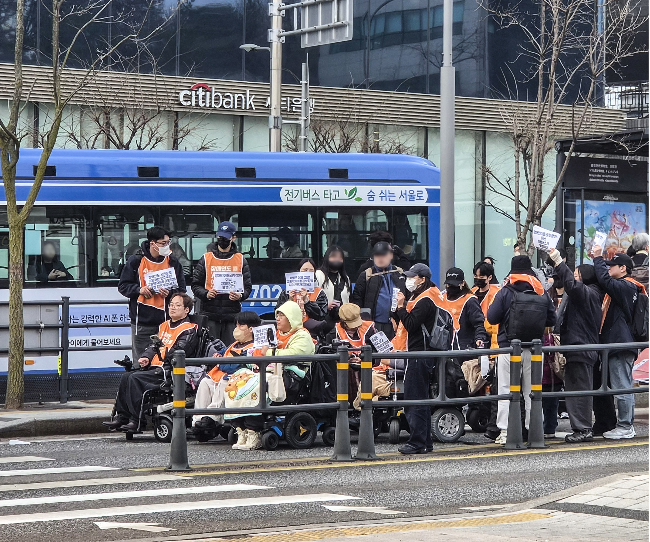
Police said Sunday they had launched a preliminary investigation into a disability rights group on suspicion of violating protest laws and obstructing traffic, after the group staged guerrilla-style demonstrations that blocked buses during rush hour in central Seoul.
Solidarity Against Disability Discrimination has held protests every weekday for the past three weeks since March 26, calling for the wider deployment of low-floor buses.
During the protests, members stage sit-ins in a bus-only lane near Gwanghwamun Square in Jongno-gu, Seoul, whenever a bus with steps arrives, blocking it for about five minutes at a time.
The protests have caused disruption during the morning commute, with buses lining up in the dedicated lane or veering out of it to get around the stalled vehicles.
Police said they have begun a preliminary probe into some of the group’s leaders, including SADD standing co-chair Park Kyung-seok, and have summoned several members for questioning.
Founded in 2007, SADD has led protests calling for stronger mobility rights for people with disabilities and greater budget support for deinstitutionalization.
Public complaint over inconvenience
The group has faced public criticism for tactics such as occupying roads and public spaces and staging mass boarding protests on subways, which have disrupted services and inconvenienced commuters.
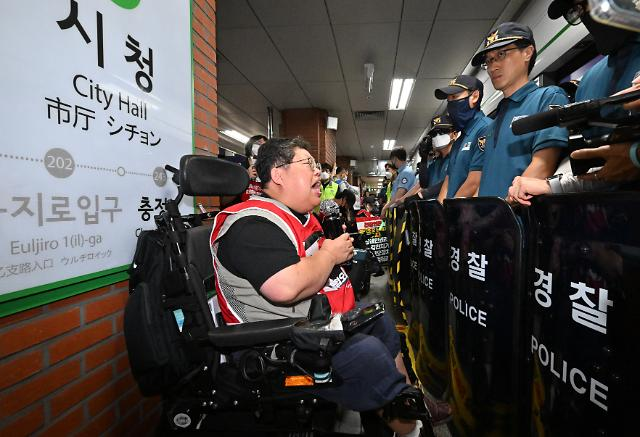
SADD had said in January that it would suspend its subway boarding protests until South Korea’s local elections, set for June 3. Criticism resurfaced, however, after the group began bus-related protests in March.
Comments on the group’s YouTube livestream accused it of “taking ordinary citizens hostage,” while some commuters who missed their buses complained of inconvenience.
The group, however, said the protests must continue to secure stronger mobility rights for people with disabilities.
“It is a fight to raise awareness that people with disabilities are not objects of sympathy or charity, but rights holders,” Park told Yonhap News Agency by phone.
“Demonstrations always cause inconvenience, regardless of whether they are large or small in scale,” Park said. “We are only expressing the voices of marginalized people. I want to ask why people take issue only with SADD’s methods.”
Park also noted that the Seoul Metropolitan Government had pledged in 2022 to introduce low-floor buses on 100 percent of city routes by 2025. As of January, however, the rate stood at 76.7 percent.
“I hope society reflects together on why these long-standing problems still remain in 2026,” Park said.
The city, however, said there are realisitic hurdles in implementing low-floor buses in a short period of time on all its routes, citing difficulties in acquiring funding and the steep, narrow and curved roads that some routes have to navigate.
seungku99@heraldcorp.com