‘Ban in principle’ rule to take effect by June with strict exceptions
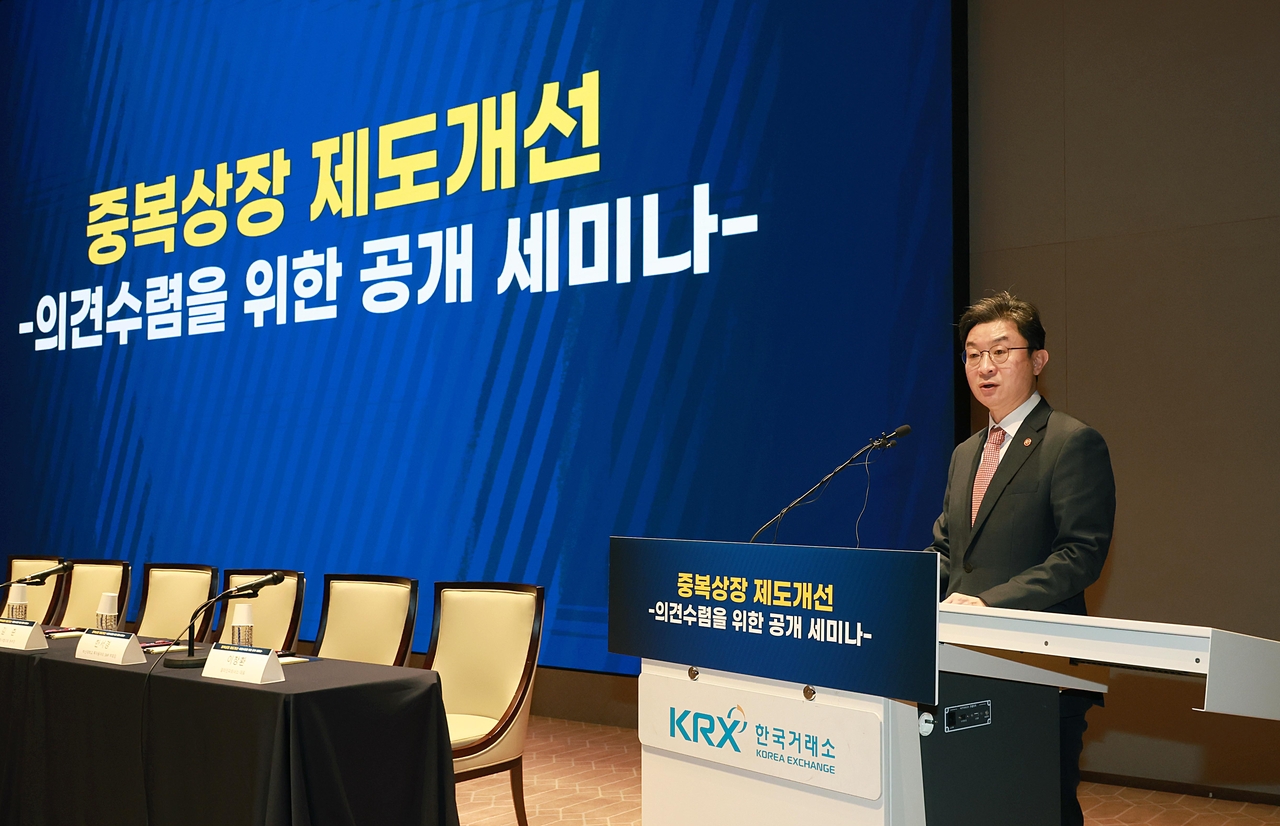
South Korea’s financial authorities plan to tighten rules on dual listings under a “ban in principle, exceptions allowed” approach, stepping up scrutiny to better protect investors.
The Korea Exchange on Thursday unveiled new screening criteria, saying listings will be rejected if companies fail to meet any of three conditions: operational independence, management independence and investor protection.
“The rule is a ban in principle, with exceptions allowed only under strict conditions,” Lim Heung-taek, executive director of the Kospi Market at KRX, said at a seminar in Seoul.
The move follows a policy announced last month by the Financial Services Commission aimed at curbing listings that dilute parent company shareholder value.
FSC Chairman Lee Eok-won said regulators will distinguish between dual listings that benefit a small group of shareholders and those that create value for all investors.
KRX plans to revise its listing and disclosure rules by June to formalize the framework.
Under the proposal, parent company boards must assess the impact on shareholders and introduce protection measures before pursuing a listing. Reviews will focus on whether subsidiaries operate independently, maintain separate governance and demonstrate a clear need for listing.
Dual listings are relatively common in Korea. According to Korea University professor Na Hyun-seung, they account for about 18 percent of listed firms, with roughly 20 percent of new listings involving subsidiaries.
“While widely used for fundraising, dual listings can lead to shareholder dilution and conflicts of interest,” Na said.
Some market participants are calling for stricter safeguards. Lee Chang-hwan, founder of Align Partners Capital Management, urged detailed disclosure and approval from a majority of minority shareholders.
Others warned against overregulation. Bang Han-chul of Korea Investment & Securities said overly rigid rules could constrain fundraising and slow corporate restructuring, while Ahn Sang-jun, vice chairman of the Korea Venture Capital Association, cautioned that tighter rules could weaken the startup ecosystem.
Kim Chun of the Korea Listed Companies Association said the impact will ultimately depend on how broadly regulators interpret the scope of “exceptions.”
Authorities aim to finalize the rule changes by June following further consultations.
ch0221@heraldcorp.com


![[Legal updates in Korea] New insurance mandate protects firefighters on the job](https://wimg.heraldcorp.com/news/cms/2026/10/01/news-p.v1.20261001.76835f19eb424f18814ac3bb65d896a9_T1.jpg?type=h&h=800)