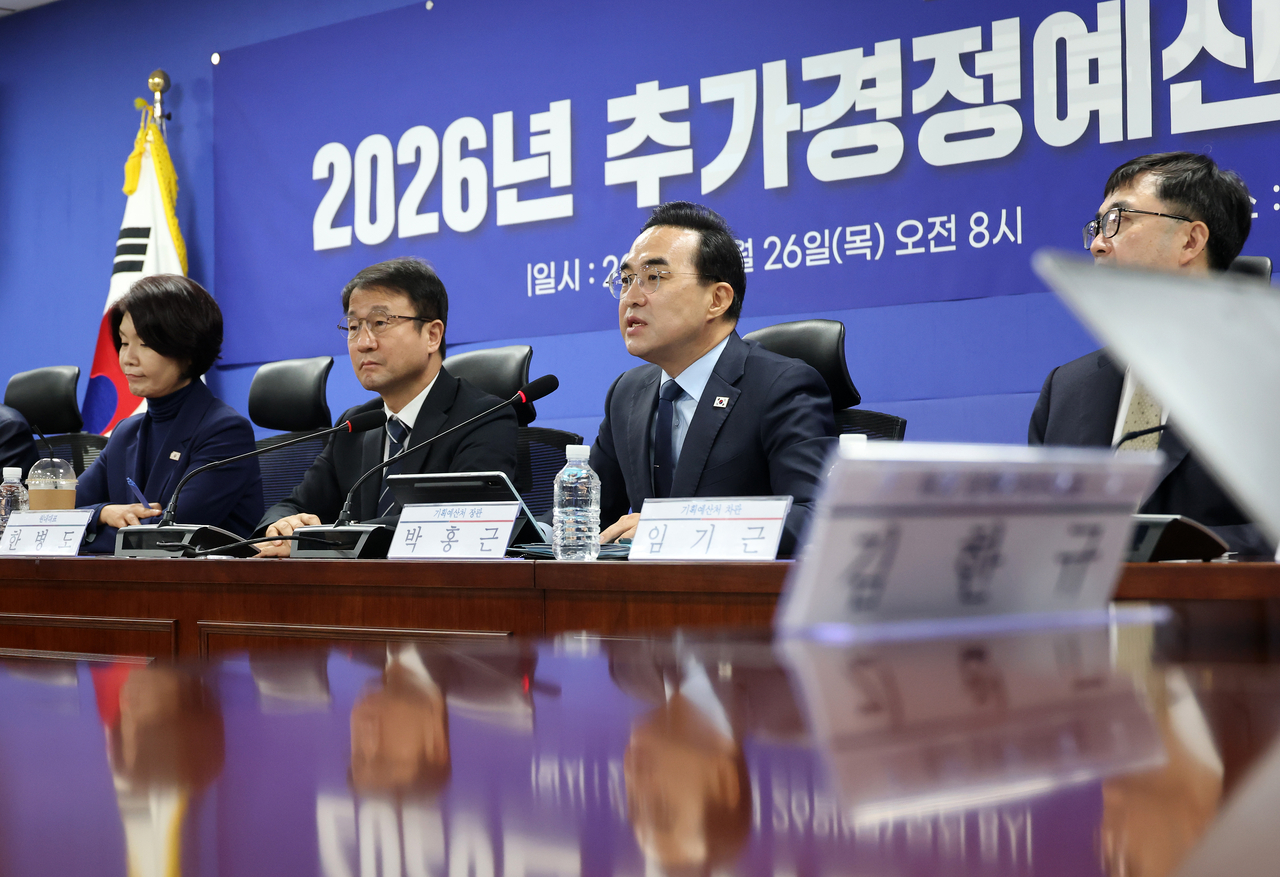
The ruling Democratic Party and the government agreed to submit an extra budget bill to the National Assembly next week, the budget minister said Thursday, in an effort to cushion vulnerable sectors from the economic impacts of a prolonged war in the Middle East.
The extra budget bill, to be submitted next Tuesday, seeks to ease the burden of rising oil prices, as well as support small and midsized firms and vulnerable households hit by the prolonged war.
"We will first ease the burden on citizens caused by high oil prices and support the smooth implementation of an oil price cap system to stabilize domestic fuel prices and reduce fuel costs," Budget Minister Park Hong-keun said during a consultative meeting between government officials and DP lawmakers held at the National Assembly earlier in the day.
With the extra budget, the government plans to compensate the financial losses oil refineries may suffer due to the price cap system, under which maximum prices are set for oil products supplied to gas stations and distributors.
The government will expand assistance to support low-income households, small business owners and the youth, and seek to "eliminate blind spots" in welfare services to ensure that their daily lives are not affected by the high oil prices and inflation from the Middle East conflict.
It also plans to concentrate the supplementary budget on supporting companies and industries affected by the crisis by helping stabilize supply chains and pushing forward with energy transition efforts.
The extra budget includes assistance for expanding oil reserves, ensuring the stable supply of naphtha, as well as rare earth elements and urea.
South Korea faces shortages of naphtha, a key feedstock for the petrochemical industry. Much of its naphtha imports are transported through the Strait of Hormuz, a vital shipping route effectively closed amid escalating tensions involving Iran.
The government also plans to use the budget to support the supply of renewable energy systems for households, including solar power, to reduce dependence on fossil fuels in the long term.
"The main opposition People Power Party has proposed delaying a review of the extra budget until mid-April at a time when a timely response is critical and this golden hour must not be missed," DP floor leader Han Byung-do said amid criticism from the opposition party that the budget is intended to woo voters ahead of the June 3 local elections.
Han said the DP and the government will accelerate the review of the budget bill in the National Assembly, stressing there is "absolutely no reason for delay."
President Lee Jae Myung earlier urged the government to swiftly draw up a supplementary budget, focusing on measures to stabilize the domestic economy, minimize the impact on affected industries and ensure the resilience of supply chains. (Yonhap)










