Seoul to introduce fuel tax cuts, require public workers to cut car use amid energy crisis

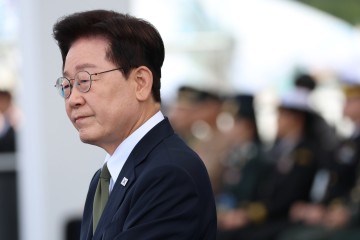
President Lee Jae Myung on Tuesday ordered a governmentwide emergency response to the Middle East crisis, renewing his call for a supplementary budget to cushion economic fallout.
Lee’s remarks came as the South Korean government mounted efforts to mitigate the energy supply shock through demand-curbing measures, government-led price stabilization and greater reliance on coal and nuclear power.
“With the expansion and prolongation of the Middle East war, instability in the supply and demand of crude oil and natural gas is increasing,” Lee said during the weekly Cabinet meeting on Tuesday.
Lee underscored the gravity of the current energy crisis, citing the warning from the International Energy Agency Executive Director Faith Birol that war in the Middle East is creating the “largest supply disruption in the history of the global oil market.”
“This is not just about energy," Lee said. "Because there is no place where petrochemical products used in our daily lives — from delivery containers to medical tools — are not used. It is a situation where it is difficult to predict when, where and what kind of problem will occur."
Lee underscored the importance of a government-level emergency response to prevent crises that could affect people’s livelihoods, the economy and industry.
Lee instructed relevant ministries to “thoroughly formulate and implement contingency measures based on even the worst-case scenarios," calling for assessing supply risks and securing alternative sources.
Speaking to Cabinet members, Lee said, “I hope we can take a more proactive approach,” emphasizing, “Isn’t the energy issue a matter of national survival for us?”
Reiterating the urgency of public cooperation, Lee added that a second round of price caps on petrochemical and petroleum products will take effect Friday, following the first fuel price cap introduced on March 13. The government seeks to lower the fuel tax to lessen the burden on the public.
"Public cooperation is urgently needed," Lee said. "Just as we overcame the foreign exchange crisis and the national crisis of COVID-19, we can overcome this crisis as well if all our people unite their hearts and minds."
Private-sector vehicle rotation returns
Lee urged public institutions to lead by example, such as through the license plate-based five-day vehicle rotation system set to take effect Wednesday, under which officials will be required to leave their cars at home one day a week.
The measure will be mandatory in the public sector, with repeated violations subject to disciplinary action. Private-sector participation is encouraged but voluntary. This is the first time since 1998, during the Asian Financial Crisis, that the government has sought to expand this system to the private sector, albeit on a voluntary basis.
Lee also proposed introducing intermediate steps before making private-sector participation in the system mandatory. Access to public parking facilities, he suggested, could be selectively restricted to encourage voluntary participation.
Climate, Energy and Environment Minister Kim Sung-whan said the government would move ahead with the proposal.
Kim added that if the resource security alert is raised one notch from "caution" to "alert" — the third-highest level in the four-tier system — the government may need to consider making the five-day vehicle rotation system mandatory for the private sector.
Lee suggested reviewing whether free rides for elderly passengers could be limited for one or two hours during peak commuting times.
"Wouldn’t it be uncomfortable if passenger traffic becomes too concentrated during commuting hours?" Lee said.
While acknowledging that drawing a clear line would not be easy — because some senior citizens also commute to work — Lee added, "Let’s look into ways to disperse usage during peak hours."
Lee defends extra budget
During the Cabinet meeting, Lee reiterated the urgency of swiftly compiling and passing the supplementary budget.
“As the shock from the war in the Middle East grows ever greater, the faster the wartime supplementary budget is drawn up and processed, the greater its effect will be,” Lee said.
Pushing back against criticism from the main opposition People Power Party and others, Lee emphasized the supplementary budget would be financed with expected excess tax revenue.
"It is not something we are doing by taking on debt,” Lee said.
Lee dismissed criticism that the government was again trying to “hand out money” to the public, calling such attacks "a misunderstanding created by political demagoguery."
"The government is supposed to spend money on the people. That is why it collects taxes,” Lee said. “It is the government’s job to use that money well, not to leave it unused."
dagyumji@heraldcorp.com