Export strength holds, but trade tensions, geopolitical risks cloud outlook
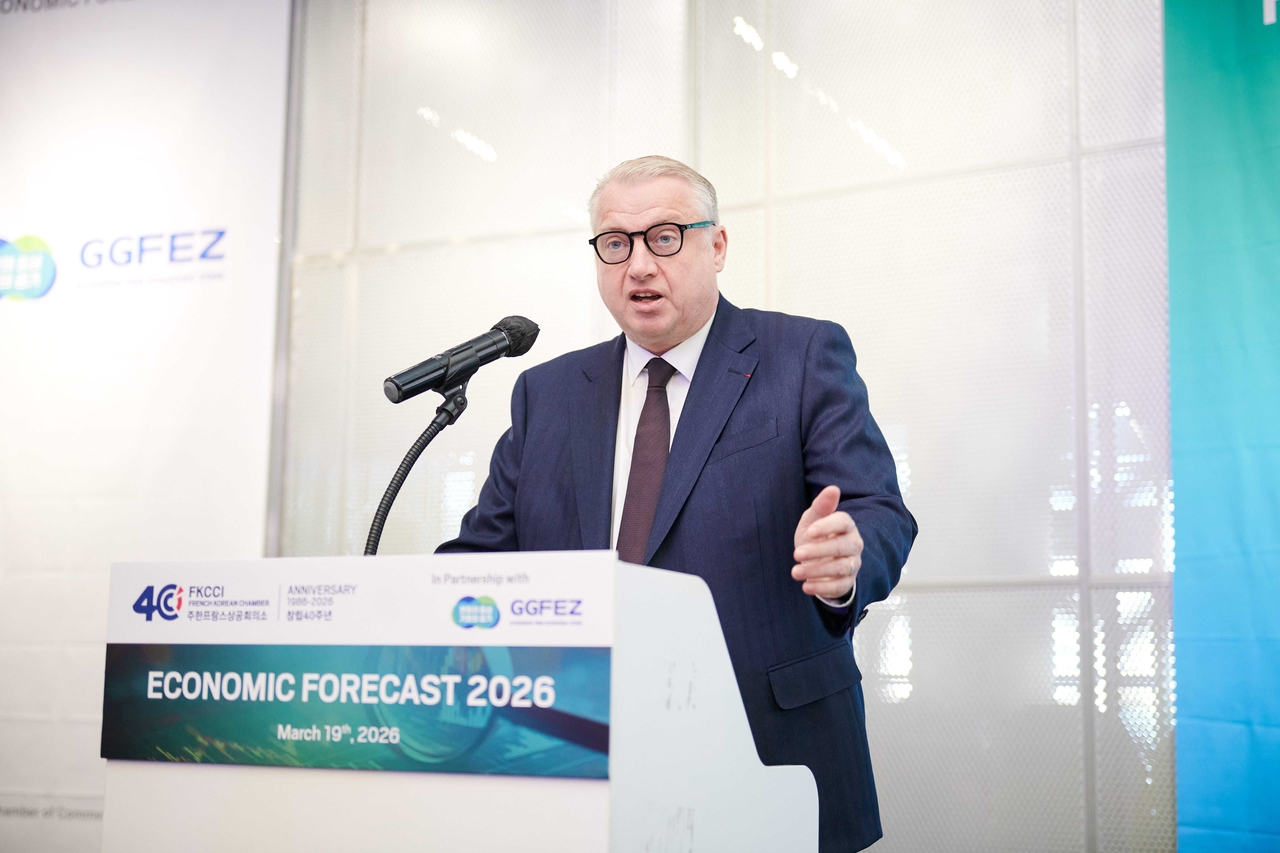
South Korea’s export-driven economy remains resilient but faces rising risks from global trade tensions and geopolitical uncertainty this year, speakers said Thursday at an event hosted by the French-Korean Chamber of Commerce and Industry.
The FKCCI held its Economic Forecast 2026, a high-level business luncheon focused on Korea’s economic outlook, global macroeconomic trends, and the shifting trade and geopolitical landscape affecting companies operating in and with Korea.
FKCCI Chairman David-Pierre Jalicon opened the event by underscoring Korea’s resilience. Jalicon, who also serves as CEO of D.P.J. & Partners Architecture, pointed to the country’s ability to withstand repeated shocks.
“What I’ve observed is that Korea performs best in times of crisis,” he said. “The Korean economy has consistently proven to be highly resilient.”
He noted that despite political uncertainties last year, Korea attracted $36.5 billion in foreign investment. “It is also worth noting that France was the third-largest investing country in Korea, with $3.8 billion,” he added.
Jalicon highlighted that French President Emmanuel Macron is set to make a state visit to Korea in April, marking his first trip to the country since taking office in 2017.
“There will be various topics associated with the visit, but we are particularly focused on the economic agenda,” he said, adding that a business forum will be held on the sidelines of the visit.
The opening remarks were followed by a welcome address from the Gyeonggi Free Economic Zone Authority, a co-host of the event.
“Our greatest advantage lies in our strategic location,” said Lee Moon-kyo, director of investment promotion, expressing hopes for deeper cooperation with participating companies.
The session then moved to economic outlook presentations.
Raphael Lee, deputy head of the economic department at the French Embassy, said Korea’s exports have remained robust, supported by semiconductors, automobiles and shipbuilding, but warned of mounting risks, including US-China trade tensions and the recent semiconductor boom being driven more by price increases than by volume growth.
He further identified weak private consumption as a key downside risk for the local economy.
“The structure of the Korean economy is heavily export-driven and less reliant on domestic investment or consumption,” Lee said.
“It is quite striking that consumption’s contribution can swing between negative and positive, whereas in the US and many advanced economies, consumption is the main growth driver,” he added.
Yoon Jee-ho, senior economist for South Korea and Taiwan at BNP Paribas, said the Korean economy is recovering, noting that the bank raised its growth forecast to 2.3 percent from 2 percent earlier this year.
The figure “means a lot,” he stressed, especially when compared with around 1 percent growth last year and the country’s estimated potential growth rate of 1.8 percent.
“However, the Middle East conflict could pose downside risks to growth, putting upward pressure on inflation,” Yoon said.
Roh Keon-ki, former deputy minister for trade negotiations at the Industry Ministry, emphasized “strategic indispensability” as a key capability in an increasingly fragmented global trade environment.
“Be like Korean chipmakers,” he said, referring to companies such as Samsung Electronics and SK hynix. “Make yourself so essential that no one can impose tariffs on you or challenge your position.”
Roh added that the current wave of global disruptions could also present opportunities for mid-sized economies such as Korea and France.
“With the Middle East in crisis, shifting US policies and climate change, it may sound like a headache,” he said. “But for those of us in the Korea-France business community, this can also be an opportunity to lead.”
The event concluded with a panel discussion among the speakers, moderated by Lee Jang-hyuk, professor at Korea University Business School and CEO of AligoAI.
silverstar@heraldcorp.com